Want higher sales? Learn how to understand your customers’ real consumer habits. Move from assumptions to data-driven decisions and build loyalty.
Customers don’t make decisions as rationally as businesses like to think. Sometimes they’re driven by price, sometimes by habit, sometimes by speed, and sometimes by something very simple: it’s easier for them to buy where they already know what to expect. That’s exactly why consumer habits are much more than just an interesting marketing topic. They are a signal that shows how people actually buy, what drives them, when they drop off, and why they come back.
For companies, that’s not a small difference.
If you understand consumer habits, you don’t have to guess why one campaign works while another has no effect. You can clearly see which customers buy frequently, which ones come only for discounts, which spend above average, and which are slowly drifting away from your brand. In other words, instead of relying on assumptions, you start making decisions based on real customer behavior.
That’s why today consumer habits are not discussed only in theory. They are seen as the foundation for better segmentation, smarter communication, more effective loyalty programs, and a higher long-term value of each customer. Businesses that take them seriously don’t just look at what was sold, but how the customer behaved before the purchase, during it, and after it.
Simply put, consumer habits are patterns of behavior that show how, when, why, and how often people buy. They include product choices, reactions to price, trust in a brand, preferred shopping channels, frequency of return, and willingness to respond to an offer.
For a business, this means only one thing: those who understand customer habits have a much better chance of influencing them.
What are consumer habits and why do they matter for business?
Consumer habits represent repeated patterns of purchasing behavior.
These are not isolated decisions, but repeated choices that become predictable over time.
A customer who buys the same products every Saturday
A customer who always responds to coupons
A customer who abandons the purchase as soon as there’s no fast delivery
A customer who returns only if they receive a personalized offer
All of them are showing their habits. These habits are not random. They are formed from experience, needs, routines, and expectations.
It’s important to understand that consumer habits are not the same as overall consumer behavior.
Consumer behavior is a broader concept and includes everything that influences a purchase decision: emotions, perception, social influence, motives, and barriers. Consumer habits are a narrower, but highly practical part of that picture. They show what repeats—and what repeats can be measured, analyzed, and influenced.
For businesses, this is extremely valuable because sales are rarely the result of a single great ad or promotion. Much more often, they are the result of repeated customer behavior.
When you understand how people buy, you can adjust your assortment, communication, offers, and timing. When you don’t, every campaign becomes a guess.
That’s why consumer habits are crucial for sales, marketing, and loyalty. They help you segment your customer base more precisely, understand who buys out of need and who buys impulsively, distinguish loyal customers from one-time buyers, and recognize when someone is starting to lose interest. This is not useful only for marketing teams—it’s equally important for sales, category management, product development, and long-term growth planning.
How are consumer habits formed?
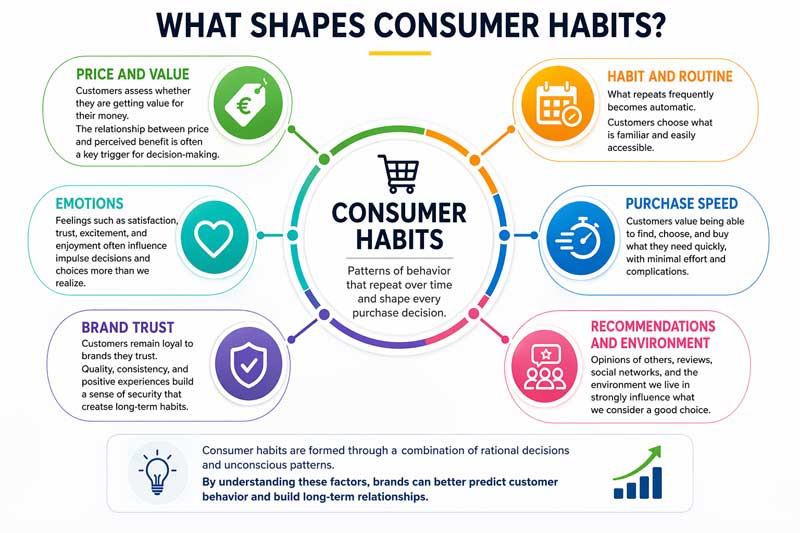
Consumer habits are built through a series of small decisions that become reinforced over time. Sometimes a habit forms because something is the most affordable. Sometimes because it’s the simplest option. Sometimes because the customer believes a certain brand won’t disappoint them. In any case, a habit is usually the result of a mix of experience, context, and a sense of security.
- Price is one of the strongest factors, but it doesn’t act alone. People don’t always buy what is cheapest—they buy what feels like the best value for money. That means the same price doesn’t mean the same thing to every customer. For some, getting more for the same money matters. For others, avoiding risk with an unfamiliar product matters more. For some, speed and convenience are key. That’s why price is not just a number—it’s a signal that customers interpret based on their experience, priorities, and expectations.
- Previous experience with a brand also plays a major role. If the purchase went smoothly, the product met expectations, and communication was simple, the customer will much more easily repeat the choice next time. The opposite is also true. One bad customer experience can change a habit faster than ten ads. That’s why trust is a huge part of consumer habits. People return where there is less uncertainty.
- Availability and ease of purchase also strongly shape habits. Customers often choose what is closest, clearest, and requires the least effort. If they can reach a product in two clicks, if payment is simple, if they know they can easily repeat the purchase or quickly find it again, it’s more likely that buying will become a routine. Often, what matters most is not what is objectively the best offer, but what requires the least effort.
- Emotions also play a role. People buy when they feel satisfied, stressed, tired, inspired, or in a hurry. Some purchases are planned, but many happen automatically. Those automatic decisions later become habits. If a product is associated with relief, reward, time-saving, or small moments of pleasure, customers will choose it more often without much thought.
- Finally, the environment shouldn’t be overlooked. Recommendations from friends, social media comments, reviews, trends, and perceived popularity all influence how people decide. Today, habits are not formed only in stores. They are formed while customers scroll, compare, read others’ experiences, and gradually build a sense of what “makes sense to buy.”
How do consumer habits change over time?
Consumer habits are not set in stone. They change when circumstances, priorities, purchasing power, or technological possibilities shift. What used to be a stable routine yesterday can today become too expensive, impractical, or simply replaceable. That’s why understanding habits is not a one-time project, but an ongoing process.
- Economic uncertainty strongly affects the way people buy. When prices rise, customers become more cautious, compare more, delay decisions, and look for a greater sense of control over their spending. This doesn’t mean everyone automatically switches to the cheapest option. Many simply change their criteria. They start paying more attention to durability, value for money, multipacks, loyalty benefits, or a clear reason to buy right now. In this kind of environment, loyalty can no longer be taken for granted.
- Digital habits have also reshaped behavior. Customers are used to speed, clarity, and relevance. They expect to easily find products, receive clear information, feel recognized by offers, and experience communication that reflects what they’ve already purchased. It used to be enough to send the same promotion to everyone. Today, that often feels like a brand talking to itself.
- Online and offline shopping are no longer separate. A customer might discover a product on Instagram, compare it on a website, check the price in an app, and then buy it in a physical store. Or they might see it in-store and order it later online. This means consumer habits now develop across multiple touchpoints, not along a single linear path. If you track only one channel, you’re seeing only part of the picture.
- Generational differences add another layer of complexity. Younger customers often expect speed, personalization, and strong digital support. Older generations may be more cautious, but also highly loyal once trust is established. One group responds more to authenticity and practicality, another to security and proven quality. That’s why it’s not enough to say “our customers like discounts” or “our customers value quality.” The real question is: which customers, at what moment, and under which conditions?
Key factors shaping consumer habits
Demographic factors
Age, income, location, and life stage don’t explain everything, but they provide an important framework. A customer with small children has different priorities than a student. Someone living in a large city behaves differently from someone with limited access to physical stores. Someone with a higher budget thinks differently from someone who carefully evaluates every purchase. These differences don’t determine every decision, but they shape behavioral patterns.
Psychological factors
Perceived value, sense of security, trust in a brand, and the desire to avoid mistakes can be decisive. Some customers prefer familiarity and avoid experimenting. Others constantly seek something new. Some buy when they feel they’ve made a “smart deal,” while others choose what feels premium and reliable. These nuances shape habits.
Social and cultural influences
People don’t buy in isolation. They are influenced by what they see around them, what others recommend, and what society considers desirable, practical, or trendy at a given moment. Sometimes a friend’s recommendation carries more weight than an entire campaign. Sometimes a trend creates the initial trigger, and later turns into a habit.
Technological factors
Discount apps, digital loyalty programs, online ordering, mobile payments, and automated communication don’t just change the purchase channel—they change expectations. Once customers experience a simpler way of buying, going back to a more complicated one becomes unlikely. Technology is no longer an add-on—it becomes part of the customer’s new standard.
Which consumer habits should every business track?
One of the biggest mistakes is thinking it’s enough to know total sales. Total sales are a result, but they don’t explain the behavior behind that result. If you want to truly understand consumer habits, you need to track patterns that precede the purchase and those that repeat afterward.
Purchase frequency
How often a customer returns often says more than a single large order. A business focused only on revenue may overlook that a small number of repeat customers drive most of the value, while many customers buy once and disappear. Frequency reveals the rhythm of the relationship between customer and brand—and helps you detect when that rhythm starts to change.
Average order value
It matters whether customers buy frequently with small baskets or less often with larger ones. These differences affect communication, offer strategy, and loyalty program design. A high-value customer isn’t necessarily more loyal—they may just buy strategically. Meanwhile, smaller but frequent purchases can be more valuable in the long run.
Read more: How to increase average order value
Timing of purchase
When do customers buy? In the morning, on weekends, before payday, during holidays, or specific campaigns? These insights help you understand behavioral rhythms. Sometimes customers don’t ignore your offer because it’s bad—but because it comes at the wrong moment.
Response to promotions and incentives
Some customers respond to discounts. Others to gifts, loyalty points, or limited offers. Some ignore generic campaigns but respond well to personalized recommendations. Without tracking this, businesses often fall into the trap of offering the same thing to everyone and hoping it works.
Products purchased together
These patterns reveal much more than cross-sell opportunities. They show how customers think, what they associate, what feels like the logical next step, and where there is an opportunity to offer a more relevant experience. Offers based on real habits perform much better than random suggestions.
When customers start drifting away
This doesn’t always happen dramatically. Sometimes the time between purchases increases. Sometimes basket value drops. Sometimes customers stop responding to messages. If you wait until they disappear completely, you’re already too late.
Tracking consumer habits should help you detect these signals early—while there’s still time to react.
Types of consumer habits that reveal growth opportunities
Purchase habits are the most visible and therefore the most analyzed. These include frequency, average basket value, favorite products, preferred channels, and buying rhythm. However, their real value lies in showing where growth opportunities exist.
If customers buy often but spend little, there may be an opportunity to increase basket size. If they spend a lot but rarely, there may be a way to bring them back more frequently.
Payment habits may seem technical, but they reveal a lot about customer profiles. Someone using a digital wallet likely expects speed and simplicity and prefers digital communication. Someone who uses a loyalty card shows willingness to build a relationship with a brand. Someone who buys only with vouchers reveals a different perception of value. These differences shape how you should communicate with them.
Seasonal and promotional habits are especially important in retail. Some customers activate around holidays, others at the beginning of the month, before travel, or during specific campaigns. If the same pattern repeats every year, it’s not a coincidence—it’s a signal. Seasonality is not only useful for inventory planning, but also for communication, budgeting, and loyalty strategy.
Loyal customer habits are often the least analyzed, yet they hold great potential. Loyal customers are not just those who buy for a long time—they are those who build trust, return more often, use benefits, compare less, and respond better to relevant offers.
When you understand loyal behavior, you can more easily identify which customers can be moved into that group.
Why most companies don’t clearly see their consumer habits?
Many companies have data but lack clear insights. The problem is not that nothing is measured, but that it is measured in fragments. One system tracks purchases, another tracks campaign responses, a third tracks loyalty usage, and a fourth may track online behavior. When these systems don’t communicate, you end up with more reports than understanding.
Another common issue is treating customers as one uniform group. When the entire base is viewed as having the same needs, motives, and price sensitivity, decisions become average—and average messaging rarely resonates. Customers driven by discounts are not the same as those seeking consistent quality. Impulse buyers are not the same as planned buyers. Without segmentation, these differences remain invisible.
Generic communication is another major problem. Companies often send the same campaigns to everyone and conclude that “the market isn’t responding.” In reality, it’s not the market—it’s the irrelevance of the message. People ignore brands that don’t feel like they understand them.
There’s also the trap of false insight. Numbers look impressive, dashboards seem serious, reports are generated regularly, and first-party data is collected—but none of it leads to action.
If you can’t answer who buys more often, who is slowing down, who responds only to promotions, and which segment has the potential to become loyal—then you have data, but not insight.
How to analyze and track consumer habits?
Analyzing consumer habits starts with the quality of your data. Transaction data is the foundation—it shows what was bought, when, how often, and at what value. But on its own, it’s not enough. It tells you what happened, but not always why. That’s why it’s useful to connect it with data from loyalty systems, campaigns, online behavior, surveys, and feedback channels

Loyalty data is especially valuable because it allows you to see the customer not just as an anonymous transaction, but as a repeating pattern of behavior. When you can connect transactions to a specific customer over time, you gain a much stronger foundation for analysis. At that point, you’re no longer looking only at sales—you’re looking at the relationship between the customer and the brand.
Online behavior adds another layer of understanding. What do people browse, where do they drop off, what do they click on, which products do they view multiple times, what do they add to cart but don’t purchase? These signals are not the same as a purchase, but they help you understand interest, hesitation, and friction points. In some cases, this data explains why a habit hasn’t formed yet—or why it has started to weaken.
When it comes to metrics, it’s important not to overwhelm yourself with numbers that sound good but don’t drive decisions. Much more useful are indicators such as purchase frequency, average basket value, retention rate, repeat purchase rate, customer lifetime value, and the time between purchases. These metrics don’t just show how much you’ve sold—they reveal the nature of the relationship customers have with your brand.
Segmentation is the next step—without it, analysis remains too general. The RFM model, which looks at how recently a customer purchased, how often they buy, and how much value they bring, is still highly practical because it quickly reveals differences between your most valuable, new, dormant, and at-risk customers. However, even deeper insight comes when you add behavioral segmentation: how customers respond to campaigns, whether they buy only during promotions, whether they use loyalty benefits, and whether they purchase habitually or occasionally.
This is exactly where modern customer analytics solutions become meaningful.
When a company uses a marketing platform that unifies data on purchases, segments, and communication, segmentation is no longer a manual, time-consuming task—it becomes the foundation for more precise decisions. Consumer habits are no longer treated as theoretical insights, but as something that can be immediately activated through campaigns, offers, or loyalty mechanisms.
Spotlight offers exactly that.
Trends in consumer habits businesses shouldn’t ignore
One of the strongest trends is that personalization is no longer an added value—it’s an expectation. Customers are increasingly resistant to communication that feels like it was sent to everyone the same way. They don’t necessarily want complex experiences, but relevant ones. They expect messages, offers, and recommendations to make sense based on what they’ve already shown through their behavior.
Another important trend is the normalization of omnichannel shopping. People expect to move between channels without any disruption in their experience. They don’t want the brand to “forget” them the moment they switch channels. This means companies need to seriously connect data and behavior across different touchpoints.
The third trend is growing sensitivity to relevance—not just price. Price still matters, but it’s no longer the only trigger. Customers want to feel there’s a meaningful reason to buy—not just a louder banner. Brands that can recognize the right moment and the right type of message are increasingly gaining an advantage over those relying only on mass promotions and discounts.
The fourth trend is a shift in how loyalty is understood. It used to be enough to offer a points card and expect the relationship to build itself. Today, loyalty requires more: relevant communication, a sense of recognition, clear value, and an experience that doesn’t feel generic.
A loyalty program without a clear understanding of customer behavior easily becomes just a formality.
The fifth trend is the growing importance of automation and analytics. Not because they are “modern,” but because without them it becomes difficult to keep up with the complexity of customer behavior across multiple channels. When the customer base is small, many things can be done manually. But as the number of customers, campaigns, and data grows, it becomes increasingly difficult to react on time without a system that unifies and activates insights.
That’s why companies that want to manage their customer base more seriously are increasingly looking for a platform that connects data, segmentation, communication, and loyalty mechanics in one place—like Spotlight.
Without it, analysis remains interesting. With it, analysis becomes actionable.