Did you know that a discount app and a loyalty app are not the same thing? Here’s how modern mobile solutions combine discounts, rewards, and loyalty into one unified system.
If you’re searching for a “discount app,” you probably want something that attracts customers, increases traffic, and gives them a reason to return.
The problem is that most apps do only the first part: they give a discount, the customer uses it — and the story ends there.
That’s why a discount often becomes a short-term habit, not real loyalty.
Modern businesses make a clear distinction: a discount app delivers instant savings, while a loyalty app changes customer behavior, collects data, and increases lifetime value.
In practice, the best results come from solutions that combine both approaches — but in a way where the discount is not the main feature, only a tool that leads to greater loyalty.
This is especially evident in industries with frequent purchases (pharmacies, beauty stores, retail, cosmetics), but it works equally well in markets where purchases are less frequent but much more valuable, such as gas stations, fitness clubs, and restaurants.
That’s why today you need an app that protects your most valuable customers, lowers acquisition costs, and increases the value of every purchase.
Below, you’ll learn how a modern discount app really works, why offering only a coupon is no longer enough, and what features a mobile app needs to actually influence customer habits — not just create occasional sales spikes.
Types of Discount Apps and Loyalty Programs
The market is full of solutions that seem similar at first glance. They all “offer something,” they all “collect something,” they all “reward something.” But in practice — the differences are huge.
Choose the wrong type, and you get a tool that brings customers once… but never brings them back.
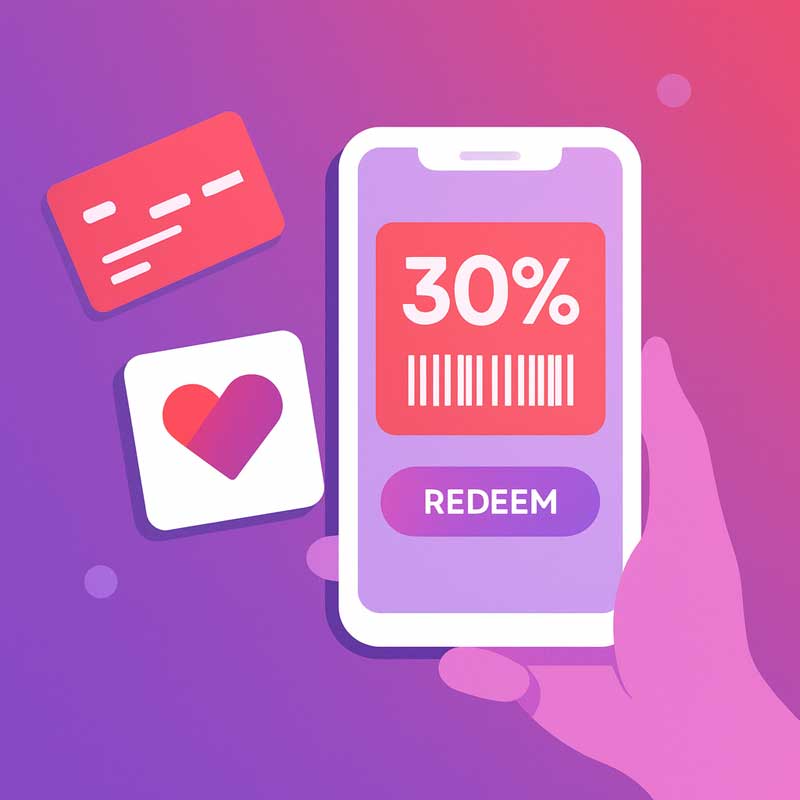
Here’s how discount apps and loyalty systems are actually categorized — what they can and cannot do.
Discount Trackers (Aggregators)
These are the simplest apps. They collect discounts from various stores and show them to the user.
Users love them — they simply go where it’s cheapest that day.
But for brands, they bring nothing except a temporary bump in sales.
No customer data.
No behavioral tracking.
No relationship with the customer.
Aggregators can bring traffic — but they don’t build loyalty.
Digital Wallets for Loyalty Cards
This model solves a practical issue: people don’t want 20 different loyalty cards in their wallets.
The app stores all cards in one place, which is convenient for customers.
But for the brand, it’s not enough.
A digital wallet doesn’t offer real loyalty mechanics, personalization, automated communication, or data for proper analytics.
Great as an add-on — insufficient as a strategy.
Branded Loyalty Apps (The Most Advanced Model)
This is what modern brands actually use.
A branded loyalty app combines discounts, points, automation, segmentation, and communication in one system.
The user doesn’t receive generic offers — but personalized benefits based on their behavior.
The brand gets deep insights: who buys, how often, which segment is growing, who is about to churn, who is close to VIP status.
This is the only model able to build long-term customer loyalty.
Types of Loyalty Mechanics
- Points: earn points through purchases and exchange them for rewards
- Tier levels: silver, gold, VIP — customers progress as they spend
- Cashback: a percentage of spending returns as store credit
- Subscription loyalty: customers pay a membership and receive premium benefits
- Hybrid models: a combination of mechanisms — most effective in retail
Understanding these categories is essential: there’s no universal “best solution.”
Only the solution that fits your customer base, purchase frequency, and business goals.
What a Modern Discount App Must Include
A discount app today cannot be just a digital flyer.
If you want it to actually influence customer behavior and drive growth, it must combine:
- discounts
- data
- automation
- real-time communication
- a clear, intuitive user experience
This is the checklist used by brands that take loyalty seriously.
Real-Time Updates of Offers and Benefits
Customers expect to see everything instantly: new discounts, points balance, available benefits, and expiration dates.
If the app relies on manual updates or delays information — trust is lost immediately.
Real-time operation isn’t a luxury — it’s the foundation.
POS and E-commerce Integration
Without proper integration, the app becomes a disconnected channel that can’t impact sales.
A good solution follows the customer across all touchpoints — store, web shop, checkout, terminal.
When everything is connected, customers have a consistent experience, and you get a full behavioral overview.
Segmentation and Personalization
Not all customers are the same — so they shouldn’t receive the same offers.
A strong app recognizes habits and creates relevant offers accordingly.
Personalization means the customer gets what they need — not a generic promotion.
Automated Campaigns
Loyalty works only when communication is timely.
Automation ensures messages are sent when they matter: birthdays, new purchases, inactivity, filled points balance, expiring coupons.
Manual sending is no longer sustainable.
Multiple Identification Methods
Phone number, digital card, QR code, physical card — users must be able to identify themselves quickly and conveniently.
Especially crucial in high-traffic industries where speed affects the entire checkout flow.
Simple User Dashboard
The customer must instantly understand:
- what they can use
- how many points they have
- when benefits expire
- what comes next
If they need to “search” for information — they stop using the app.
CRM and Analytics for the Brand
Data is at the core of any modern loyalty system.
A good app must show:
- which segment is growing
- who is churning
- who is becoming VIP
- what drives purchases
- what doesn’t work
Without this — discounts remain an expense, not an investment.
Push Notifications as a Return Trigger
Push notifications are the most direct way to send the right offer at the right moment — when a coupon is expiring, points are collected, or a relevant promotion appears.
A reliable push system is mandatory.
When push messages are relevant and precise, they significantly increase conversions.
Spotlight: An Advanced Loyalty-Driven Discount App
Spotlight belongs to the category of advanced loyalty platforms — the kind that use discounts not as bait but as tools for long-term customer retention.
Unlike simple apps that only track discounts or store cards, Spotlight unifies the entire process:
- data collection
- segmentation
- automated communication
- a real-time mobile app
- One Integrated Platform
No need for separate tools for CRM, push notifications, and loyalty.
Everything is connected, so every action automatically influences the next step.
- Real, Behavior-Based Segmentation
Spotlight automatically identifies customer types: new, active, VIP, occasional, and at-risk.
Each segment receives tailored communication — so discounts are never wasted.
- Automated Campaigns
Messages are sent automatically: when a coupon expires, when points are earned, on birthdays, after inactivity, etc.
Automation boosts customer return rates and saves employee time.
- Clear and Intuitive User App
All points, coupons, discounts, purchase history, and personalized offers are available instantly — in real time.
- Fully Customizable
From app design to program rules, points value, reward types, and communication channels — the entire system adapts to the brand, not the other way around.
How a Discount App Works in Practice
For an app to actually perform, the user flow must be simple and logical.
In practice, everything comes down to these steps:
Registration and Profile Creation
Users download the app or register at the store.
A few basic details or a phone number — and the system creates a profile tied to all future purchases.
This is where tracking and data collection begin.
Earning Points, Discounts, and Benefits
After each purchase, points or benefits are added automatically — no paper cards, no manual counting.
Users immediately see what they earned and what they can redeem.
This creates a clear link between purchase and reward.
Personalized Offers and Communication
As the system collects data, it recognizes patterns and sends:
- personalized discounts
- birthday benefits
- expiring coupons
- bonus points
- relevant category promotions
Personalization is the key difference between loyalty and one-off purchases.
Redeeming Benefits In-Store or Online
Users redeem benefits via QR code, digital card, or activating a coupon online.
The process must be fast — ideally within seconds.
Easy experience = repeat visits.
Analytics and Behavioral Tracking
The system tracks:
- frequency of purchases
- average receipt value
- response to promotions
- push effectiveness
- VIP progression
- inactivity patterns
These insights shape future campaigns and drive growth.
Program Optimization
Based on results and behavior, brands update rules, point values, rewards, and communication.
Strong loyalty programs are never “finished” — they evolve with customers.
Discount App vs. Loyalty App: Why a Discount Isn’t Enough
Although “discount app” and “loyalty app” sound similar, the difference is enormous.
A discount app is a short-term fix.
A loyalty app is a long-term strategy.
Discount apps create traffic for the day — and that’s it.
Loyalty apps build habits, status, and emotional connection.
A discount brings customers once.
Loyalty brings them back again — and again.
Discount apps don’t track who the user is or what they buy.
Loyalty apps do — and use that data for smart, automated communication.
That means fewer random discounts, lower marketing costs, and more benefits that truly affect behavior.
In modern retail, the best results come when discounts are a tool — not the strategy.
Loyalty apps bring structure, personalization, and measurable long-term growth.
A discount attracts the customer.
A loyalty app keeps the customer.
Savings for Customers — and for the Brand
One of the most common questions is:
“Is it actually worth it?”
The answer depends on who is asking — the customer or the brand — but in both cases, the impact becomes visible within the first months.

Savings for Customers: Clear, Noticeable, Motivating
When users receive discounts relevant to the products they already buy, savings accumulate quickly.
Instead of generic promotions, the app provides:
- birthday offers
- rewards for frequency
- bonus points
- promotions for favorite categories
Users don’t have to remember anything — the app notifies them at the right time.
Frequent micro-savings create the feeling that the app “pays off,” which is key for long-term use.
Savings for Brands: Lower Acquisition, Higher Retention
The biggest savings for brands don’t come from discounts — but from reduced acquisition costs.
When you retain existing customers, your acquisition spend naturally decreases.
Loyalty users spend more, visit more often, and respond better to campaigns.
Combined Effect: More Stable Sales, Less Seasonality
When discounts, personalization, and automation work together, sales stabilize.
Instead of peaks during big sales and long quiet periods, brands get consistent month-to-month traffic.
Both sides win — customers save on purchases, brands save on marketing.
How to Choose the Right Discount App for Your Business
Choosing a discount app is not a technical decision — it’s a strategic one.
The right app can:
- increase purchase frequency
- raise average order value
- reduce marketing costs
The wrong one becomes an unused expense.
Start by defining your true goal
If you only want short-lived traffic, a simple discount app may be enough.
If you want retention, return rates, and data-driven decisions — you need a loyalty-driven solution.
Consider purchase frequency in your industry
Frequent purchases = higher need for personalization and automation.
Retail, pharmacies, and beauty require fast identification and precise offers.
HORECA relies more on visit-based rewards and tier structures.
Integration is essential
Your app must connect with your POS, webshop, and communication channels.
If it can’t — every benefit loses value.
Choose the right communication channels
If real-time activation matters, you need push notifications, Viber, and automated flows.
That’s where most sales are “saved.”
Evaluate the level of analytics you need
Without data — you can’t improve the program.
A good app must show who spends, when they spend, and what triggers new purchases.
The right discount app isn’t the one that just offers savings — it’s the one that changes customer behavior.
FAQ – Common Questions About Discount Apps
- Does a discount app mean I need to constantly offer discounts?
No. Smart apps use discounts as a tool, not the foundation of the program.
Most loyalty is built through points, tiers, and personalized benefits. - Does it work for small businesses?
Yes. Smaller businesses often see results even faster. The key is simplicity, easy integration, and minimal operational effort. - How fast can we start using the app?
It depends on integration. With a connected POS or web shop, it can be very fast. If you’re digitizing from scratch, it takes some preparation — but clear rules and goals speed everything up. - Do users have to install the app?
Usually yes — but good platforms also offer digital cards or a web view.
Installed apps deliver the best results because of push notifications and real-time benefits. - Are discounts the same for everyone?
They don’t have to be. With segmentation, each customer gets different offers based on their habits and loyalty level. - Can the app replace a physical loyalty card?
In most cases — yes. The app becomes the digital card, but you can keep physical ones for users who prefer them.
If you’re planning to introduce a discount app or upgrade your loyalty program, the most important step is choosing a system that grows with your business.
You don’t need another tool — you need a solution that changes customer behavior and proves its value clearly.
A good discount app doesn’t just show lower prices.
It builds habits.
Habits create loyalty.
Loyalty drives revenue.
Spotlight is built to connect everything you need for modern loyalty: CRM, automation, mobile app, push communication, and analytics — all in one simple system.