Discover what loyalty mechanisms are, how they work, and how to choose a model that increases repeat purchases, strengthens customer relationships, and drives measurable growth.
Discounts no longer retain customers — they simply train them to wait for the next one. Loyalty mechanisms exist so that a purchase does not end with a single receipt, but evolves into a habit and a lasting relationship. That is why loyalty today is no longer built solely on a good product or decent service. Those remain the foundation, but they are no longer enough.
Below, we explain which loyalty mechanisms actually work, why most programs fail to deliver results, and how to build a system that truly brings customers back — without constantly lowering prices.
Loyalty mechanisms are not a decorative business add-on, nor something introduced simply because competitors have it. They are a way to structure your relationship with customers so that it becomes more predictable, stable, and profitable.
When properly designed, they do more than reward customers — they influence behavior. They encourage customers to visit sooner, purchase more frequently, increase basket value, return after periods of inactivity, and perceive your brand as a natural choice rather than just one of many options. That is why loyalty mechanisms should not be viewed as an expense, but as a business model designed to support sustainable growth.
What Are Loyalty Mechanisms?
When people hear the term loyalty mechanisms, many immediately think of a discount card or collecting points. That is part of the story — but it is not the full picture.
Loyalty mechanisms are a structured set of rules, benefits, and behavioral triggers designed to motivate repeat purchases and gradually build a habit of returning.
In other words, they are the ways a brand creates a reason for customers to stay present, active, and connected over time. At the core of every effective loyalty mechanism lies a simple question: What does the customer gain by returning to you — and why should that matter to them?
It is important to understand that a simple discount and a loyalty mechanism are not the same.
A discount is a one-time incentive. It can attract attention, speed up a decision, and temporarily increase sales. But on its own, it does not build a relationship. If customers come only when prices are lower, they are not loyal to your brand — they are loyal to the savings.
A loyalty mechanism goes further. It introduces continuity. The customer does not just receive a benefit for this purchase; they see value in continuing the relationship. That value may come through points, tiered rewards, personalized benefits, exclusive purchase conditions, or time-based incentives that encourage the next step.
This is why loyalty mechanisms matter both psychologically and commercially.
Psychologically, they create a sense of progress, belonging, and reward.
From a business perspective, they provide a framework for shaping purchasing behavior. Without that framework, communication with customers often becomes random and reactive. With it, every benefit has a purpose, every message has a goal, and every next purchase has a reason.
In serious business strategy, that shift makes a significant difference — moving from occasional promotions to a system intentionally designed to build repeat purchases and long-term retention.
Why Loyalty Mechanisms Directly Impact Revenue, Margin, and Business Stability
Every business wants growth — but not every type of growth is healthy.
If revenue increases only because you constantly lower prices, you quickly reach a point where margins suffer and customers become conditioned to wait for the next promotion. That is not a stable model.
Loyalty mechanisms help ensure that growth does not depend solely on discounts, but on giving customers a reason to return — even when there is no aggressive pricing campaign running.
That distinction matters. It shifts the business from relying on short-term spikes to building a predictable pattern of repeat purchases.
When properly designed, loyalty mechanisms influence three key areas:
First, they increase purchase frequency.
When customers know that every purchase counts toward something meaningful, they are less likely to postpone the next visit or switch to a competitor.
Second, they affect the average transaction value.
If the threshold for additional benefits is clearly defined, customers often increase their basket size on their own to reach the reward sooner.
Third, they strengthen customer retention.
This reduces the constant pressure to invest the same time and budget into acquiring new customers, because you are better leveraging the value of those who already know and trust your brand.
For management and business owners, this is particularly important because loyalty reduces uncertainty. Planning becomes far easier when there is a returning customer base, instead of relying entirely on new traffic and continuous acquisition.
In that sense, loyalty mechanisms are not just a marketing tool — they influence the quality of revenue. Revenue generated from returning customers is typically more valuable than revenue that must be repeatedly chased and re-earned.
When combined with deeper insights into purchasing behavior, loyalty mechanisms become a strategic decision-making asset — not just a way to distribute rewards.
Which loyalty mechanisms deliver the best results in practice?
There is no single universal model that works best for everyone. Different businesses have different purchase cycles, different average transaction values, and different customer motivations. However, there are mechanisms that consistently stand out in practice as the most effective, precisely because they are easy to understand and clearly influence customer behavior.
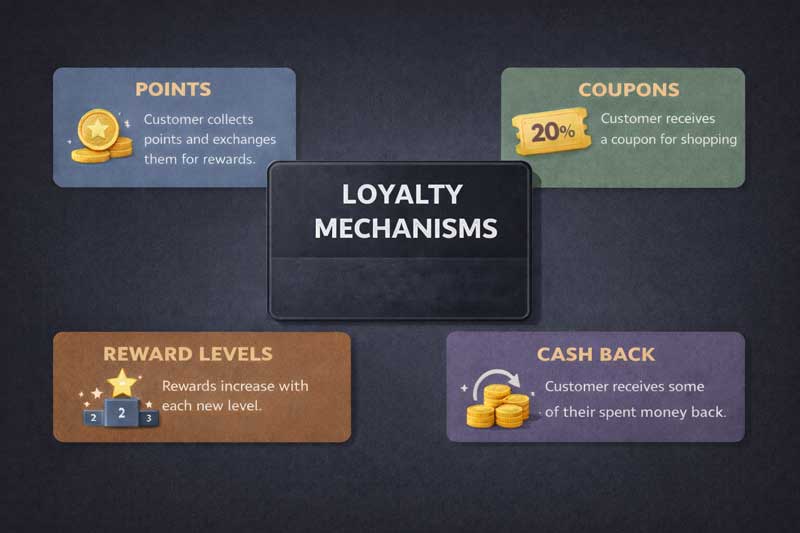
Points Collection Model
The strength of points collection lies in clarity and measurability. The customer understands that every purchase is recorded and moves them toward a concrete benefit. That sense of progress is simple but powerful, because each new transaction becomes connected to the next reward.
Cashback
Another important model is returning a portion of spending as value the customer can use later. This approach is effective because the benefit is not abstract. Customers clearly see that part of what they spent comes back to them, giving them a natural reason to return and use it. This type of mechanism builds loyalty not through promises, but through a tangible sense of value.
Loyalty Tiers
The third model is tiered benefits. These are especially important when you want to reward not only frequency, but also the overall value of the relationship with the customer. When customers see that they can move to a higher level — gaining better treatment, greater benefits, or special status — loyalty stops being purely mathematical and becomes relational.
Coupons
There are also time-limited coupons, which are highly effective for activating undecided or inactive customers, as well as personalized rewards that demonstrate you do not treat all customers the same. That differentiation often creates the greatest impact. When a mechanism feels designed specifically for an individual customer, its perceived value increases.
In practice, the best results usually do not come from a single mechanism, but from a smart combination.
A serious system therefore does not rely on just one benefit, but offers multiple ways to keep customers engaged across different stages of the relationship. It is important that the platform goes beyond simply recording points and supports tiers, coupons, personalization, and performance insights — which is one of the reasons why more advanced setups often consider a solution such as Spotlight. Its approach combines multiple models within a single system, instead of reducing loyalty to only one type of reward.
How to Choose the Right Loyalty Mechanism for Your Type of Business
The biggest mistake is choosing a loyalty mechanism because it sounds modern or because someone else in your industry is using it. The right choice does not start with a trend — it starts with your specific business situation.
First, you need to understand the purchase frequency in your business. If customers visit often and spend smaller amounts, the mechanism should be simple, fast, and provide frequent progress feedback. If purchases are less frequent but higher in value, tiered benefits, exclusive advantages, and carefully timed activations that bring customers back at the right moment become more important. In both cases, the goal is the same — but the path to achieving it is different.
The second factor to analyze is customer motivation. Not everyone responds to the same type of benefit. For some, savings matter most. For others, it is the feeling of receiving something special. For some, convenience and simplicity are key. If you do not understand this, you may build a program that is technically correct but ineffective in practice.
The mechanism must align with real customer behavior, not with management assumptions. That is why, before making a choice, you should think not only about what you want to stimulate, but also about what customers truly perceive as valuable.
The third factor is operational feasibility. A good mechanism is not the one that sounds impressive in a meeting, but the one that can be consistently implemented without daily disruption. The rules must be clear to employees, easy to explain to customers, and simple to track. If the program requires too many manual interventions, too much explanation, or too much improvisation at the point of sale, it quickly loses strength. That is why selecting the mechanism must go hand in hand with selecting a system capable of executing it without overburdening the team. Only then does loyalty become part of the process, rather than an additional task everyone struggles with.
What Makes Loyalty Mechanisms Actually Work — Instead of Remaining Just a Good Idea?
Many companies introduce a loyalty program and, after a few months, conclude that it did not deliver the expected results. In most cases, the issue is not the idea of loyalty itself, but the way it was implemented.
Here is what requires attention:
Simplicity
Customers must immediately understand how the system works, what they gain, and how close they are to the next benefit. If they have to think too much, remember complex rules, or seek additional explanations, interest quickly declines. Loyalty does not tolerate confusion. The clearer the program logic, the higher the likelihood of participation.
Visible Value
The reward must be clear enough for customers to feel that their effort is worthwhile. It does not need to be large at any cost, but it must be understandable and relevant. If the benefit feels too small, too distant, or irrelevant, it will not trigger the desired behavior.
Timeliness
Having a good mechanism is not enough if you do not know when to activate it. A customer who was active three days ago does not require the same message as one who has not returned in two months. The difference between an effective and a missed offer often lies not in the reward itself, but in the timing.
This is where the distinction between basic programs and serious systems becomes clear: data, segmentation, and automation. When you know who buys frequently, who spends more, who is slowing down, and who responds to which type of incentive, loyalty mechanisms stop being identical for everyone. They become precise. That is why advanced solutions increasingly connect loyalty with customer analytics and automated communication — without this integration, the program remains too broad and too generic.
Loyalty Mechanisms Are Not the Same as Communication Channels
In practice, two concepts are often confused: loyalty mechanisms and communication channels. This is understandable, because customers usually experience loyalty programs through the messages they receive. However, for a business, this distinction must be clear — because it determines how the entire system is structured.
A loyalty mechanism is what gives customers a reason to return. It is the specific benefit, rule, or reward model that influences behavior. This may include points, cashback, tiered benefits, a coupon for the next purchase, a birthday reward, or a benefit unlocked after a certain number of purchases.
In other words, the mechanism answers the question: What does the customer gain by continuing the relationship with your brand?
On the other hand, email, SMS, and push notifications are not loyalty mechanisms by themselves. They are channels through which the mechanism is delivered, activated, or reinforced. Their role is not to replace the program’s logic, but to communicate it at the right moment and in the right way.
- If you send a message informing customers they have enough points for a reward, the mechanism is the points — the message is simply a reminder.
- If you send a birthday coupon, the mechanism is the birthday benefit, while the channel is just the communication tool.
- The same applies to push notifications warning that a benefit is about to expire. In that case, the time-limited advantage is the mechanism, and the push notification is the trigger.
This distinction matters because many companies focus too much on messaging and too little on program logic.
It is possible to run excellent campaigns and still see weak results if there is no clear reason for customers to return.
A channel can accelerate action, but it cannot compensate for a weak mechanism.
That is why a serious loyalty system must first define what motivates the customer — and only then decide how to communicate it.
Only when mechanism and communication are aligned does loyalty stop being a sequence of messages and become a process that truly changes purchasing behavior. That is why it is important to use a solution that does not separate these two elements, but integrates them into a unified system.
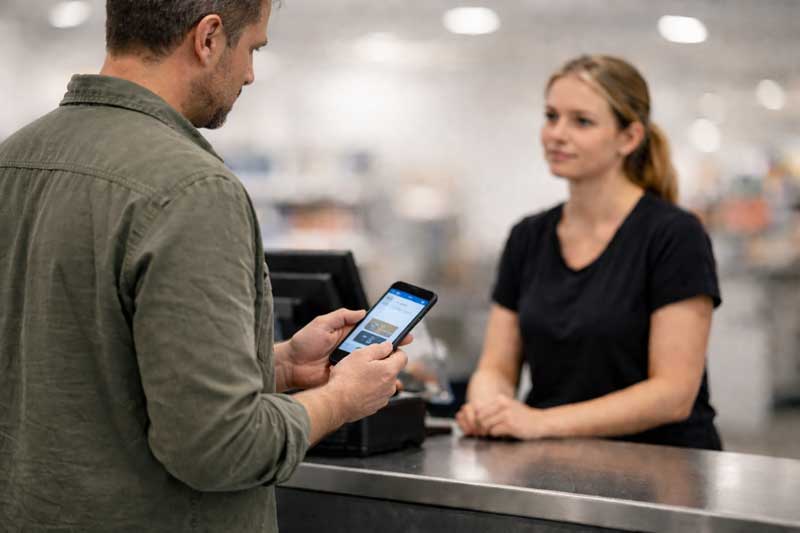
Spotlight is a strong example of this approach, as it combines loyalty mechanisms and communication channels within a single solution. This allows a business to define benefits, monitor customer behavior, and activate customers through the right message at the right moment — all within one integrated system.
The Most Common Mistakes That Prevent Loyalty Mechanisms from Delivering Results
One of the most common mistakes is the belief that simply “having something” is enough. A company introduces a card, adds a small discount, and concludes that the loyalty program is complete. But customers quickly recognize the difference between a real system and a formality that exists just for appearance. If the program lacks clear logic, does not evolve based on customer behavior, and has no plan for everyday use, it becomes ineffective. The problem is not that customers dislike loyalty programs — it is that they do not respond to weak and disconnected models.
Another major mistake is excessive complexity. Management sometimes tries to cover every possible scenario at once, resulting in a program overloaded with rules, exceptions, and small conditions. While this may seem thorough and strategic, in practice it often discourages both customers and employees. When sales staff must spend too much time explaining benefits and customers are still unsure what they receive, the program loses its main advantage. A loyalty mechanism should simplify decisions, not complicate them. In business, simplicity is not superficial — it is a sign of a well-designed system.
The third mistake is relying exclusively on discounts. If the only message of the program is constant price reduction, you quickly enter a situation where customers expect concessions as the norm. Loyalty does not grow — margins shrink.
The fourth mistake is the lack of measurement. If you do not track who uses the program, how often, with what impact, and after which activations, you cannot know what works and what does not. Without that insight, every decision becomes an assumption.
Finally, a frequent error is treating all customers the same. An inactive customer, a new customer, and a high-value customer should not receive the same message or the same type of incentive. When everyone is treated equally, you lose both precision and performance.
How Loyalty Mechanisms Become a Growth System — Not Just a Benefit Program
The real value of loyalty mechanisms is not in the benefit a customer receives. It is in the system the business gains.
When loyalty is properly structured, you do not simply gain another promotional channel — you gain a framework for managing customer behavior. You are no longer dependent solely on intuition, salesperson experience, or occasional campaigns. Instead, you have a clear model that indicates when to activate customers, how to reward frequency, how to differentiate higher-value customers, and how to re-engage those who are slowing down. At that point, loyalty becomes part of business strategy, not just an attractive addition for presentations.
In this model, every benefit has a purpose.
Points are no longer symbolic rewards — they are tools for driving the next purchase.
Coupons are not just discounts — they are activation tools used at the right moment.
Loyalty tiers are not merely formal segmentation — they are a way to reward relationships that bring greater value to the company.
When these elements are connected, loyalty mechanisms begin to influence purchasing habits, rhythm, and value. That is the moment when the program stops being “just a program” and becomes part of how the company manages sales and customer relationships.
For companies seeking more stable growth, this approach is far more valuable than one-time campaigns. A single promotion may generate a temporary spike in sales, but a loyalty system reshapes behavior over time. It is a slower, yet much healthier form of growth.
That is why, when planning, you should not think only about which benefit to offer — but how loyalty mechanisms will function as an integrated process.
In that sense, Spotlight is a natural choice.
Contact us to build a system tailored to your business.