How can customers visit more often? Discover tactics to increase purchase frequency and the role of modern loyalty programs in building long-term profitable retail.
When revenue stagnates, the first instinct is to launch a new campaign or cut prices. But in the long run, the healthiest growth does not come from one-off promotions — it comes from how often customers return.
Purchase frequency is one of the most underestimated metrics in retail and e-commerce. Yet it is often what makes the difference between a brand that is constantly chasing new customers and a brand that grows through its existing ones.
What Is Purchase Frequency and Why Is It Critical for Profit?
Purchase frequency shows how many times a single customer makes a purchase within a given time period — for example, over a month, a quarter, or a year.
It is a simple metric, but one with enormous impact on revenue: it tells you whether people only drop in occasionally or regularly come back to your brand.
Combined with average order value and customer lifetime, purchase frequency directly affects total customer value over time (CLV — the total value a customer brings to your business). The more often a customer returns, the higher their long-term contribution becomes, even without aggressive price increases or constant promotions.
That is why increasing purchase frequency among existing customers is often more cost-effective than constantly chasing new ones. Acquiring new customers requires spending on ads, discounts, and brand visibility, while with existing ones you are already starting from a foundation of trust. They know your offer, have experience with your products, and need a smaller “trigger” to buy again.
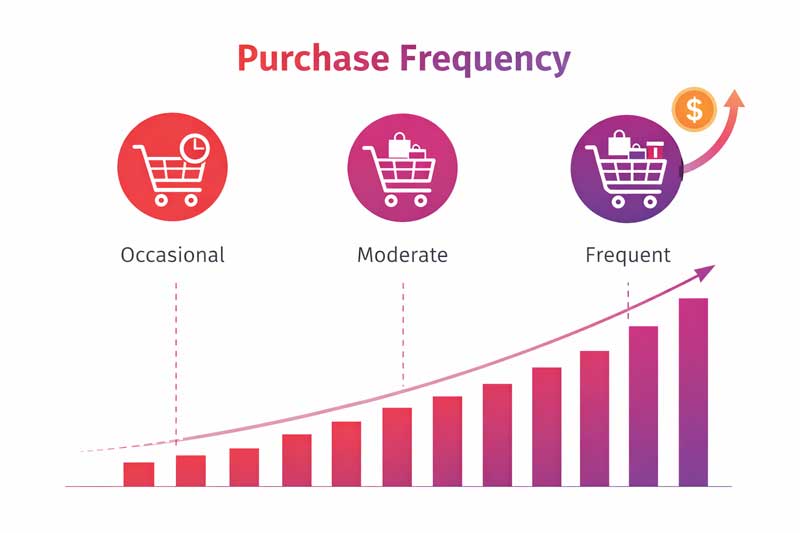
A simple example illustrates this clearly: if a customer increases their purchases from twice a year to three times, that represents 50% higher revenue from the same customer — without a proportional increase in marketing costs. When that kind of shift happens across a larger group of customers, the impact on total turnover can be substantial.
That is exactly why companies focused on growth do not treat purchase frequency as a secondary indicator, but rather as one of the key levers of profitability.
Why Don’t Customers Come Back More Often — Even When They’re Satisfied?
On paper, everything looks good: the customer was satisfied, the product met expectations, and the shopping experience went smoothly. Yet the next purchase does not happen — at least not with you.
The reason is simple: in the rush of everyday life, consumers quickly forget brands that do not reach out to them in the right way and at the right time. Without a clear reason to return, they easily go to whoever catches them first with the next offer.
Common reasons why customers do not come back:
-
They forget about the brand as soon as the first purchase is over.
-
They see no concrete reason to return because there is no added value beyond the purchase itself.
-
Competitors attract them with a promotion at the moment they are thinking about their next purchase.
-
They do not feel progress or rewards for loyalty — there is no sense that staying “pays off.”
-
Communication is not tailored and feels generic, making it easy to ignore.
In practice, satisfaction is only the beginning of the customer relationship.
A satisfied customer is not the same as a loyal customer. Consumer loyalty is built through constant reminders of value — via relevant messages, good timing, and real reasons to choose the same brand again.
How to Increase Purchase Frequency — Tactics That Actually Work
Increasing purchase frequency does not depend on a single move, but on a series of small, smartly connected steps. The best results come when communication is timed correctly, the offer makes sense for a specific customer, and the entire relationship feels continuous and rewarding.
Below are the tactics that most often prove to be the most effective in practice.
1) Right timing of communication
Customers do not return because you contacted them — they return because you contacted them at a moment when it was relevant.
That means:
-
sending reminders after the average purchase cycle (for example, when a product is usually repurchased),
-
activating seasonal triggers — collection changes, seasons, holidays,
-
identifying inactive customers and launching reactivation campaigns before they disappear completely.
A well-timed message does not feel like an ad, but like a helpful signal: “It might be the right time to stop by again.”
2) A reason to return, not just a discount
Discounts can bring customers back — but they rarely build habits. In the long run, reasons that make customers feel valued work far better.
These can include:
-
bonus points for the next purchase,
-
exclusive offers available only to members,
-
early access to new products or promotions,
-
small but consistent benefits for regular customers.
The goal is not for every message to mean a lower price, but for every communication to deliver added value.
3) Personalization instead of mass campaigns
One message for everyone rarely hits the right moment — or the right need.
A more effective approach includes:
-
offers based on previous purchases,
-
highlighting categories the customer already chooses,
-
adapting messages by location, communication channel, and habits.
When a customer receives a personalized offer that makes sense specifically for them, they are more likely to respond — and to return faster than they otherwise would.
4) Gamification and a sense of progress
People like to see progress. When there is a clear path within the relationship with a brand, coming back becomes more natural.
This is achieved through:
-
membership tiers that unlock as purchases repeat,
-
spending thresholds that lead to new benefits,
-
short-term challenges such as: “Shop three times this month and unlock extra rewards.”
These game-like mechanisms turn individual purchases into a process and give customers motivation to choose the same brand again rather than a competitor.
Where Do Loyalty Programs Make the Biggest Difference?
Up to this point, we have talked about individual tactics: message timing, personalization, rewards. But the real leap happens when these activities are connected into a system.
A modern loyalty program is no longer just a point-collection card or a simple mobile app. It functions as an infrastructure layer that connects data, communication, and offers into a single whole — which is exactly the approach developed by Spotlight.
In practice, that means several key things:
A central hub for customer data
All purchases, channels, visit frequency, and campaign responses are collected in one place. This creates a clear picture of who buys often, who is at risk of leaving, and who has the potential to become a regular.
Automation of customer return journeys
Instead of sending campaigns manually, the system can trigger specific scenarios and marketing messages automatically: reminders, bonus offers, or special benefits for customers who have been inactive for longer periods.
Connecting online and offline channels
In-store purchases, webshop orders, apps, and messages are all treated as part of the same customer relationship — not as separate worlds.
Continuity instead of one-off campaigns
A loyalty platform makes it possible to build purchase frequency continuously, through a sequence of smartly connected customer touchpoints rather than occasional promotions.
A practical example:
Instead of sending the same newsletter to all customers, a loyalty system can automatically identify those who have not purchased in 60 days and activate a campaign only for that group — with an offer tailored to their previous purchase history and the categories they previously chose.
This kind of approach shifts the focus from mass communication to precise return-driving actions, where every contact has a clear goal — to bring customers back more often and keep them longer.
From Data to Action: What Does This Look Like in Practice?
Imagine a typical customer who shows up in your store or webshop about once every three months. They are not dissatisfied — they simply do not have the habit of coming more often. For many brands, customers like this make up the largest part of the base.
At that point, a modern loyalty system does not wait for revenue to drop. It recognizes the behavior pattern and flags the customer as “at risk” of not returning within their usual rhythm.
- A personalized offer is triggered automatically: a message arrives at the moment when the probability of return is highest, with a product recommendation from a category they previously chose and an extra incentive — for example, bonus points valid if the purchase is made within the next 14 days.
- The customer responds, visits sooner than they otherwise would have planned, and that purchase moves them into a higher loyalty tier. Over the following months, they notice that benefits unlock faster, that offers adapt to their habits, and that staying active pays off.
The result is not a single occasional win, but changed behavior: a customer who used to visit quarterly now comes back much more often.
Purchase frequency does not increase by accident — it is designed.
How Do You Measure Whether You Have Successfully Increased Purchase Frequency?
Without clear indicators, improving purchase frequency remains just a good intention. That is why it is essential to track metrics that directly show whether customer behavior is truly changing — and whether loyalty activities are delivering real business impact
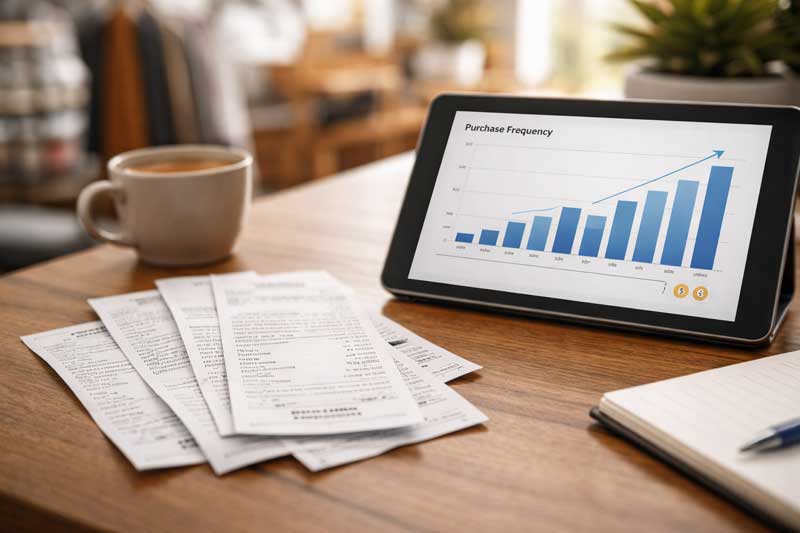
Key metrics include:
Average purchase frequency
How many times the average customer buys within a given period. An increase in this number is the most direct signal that the strategy is working.
Repeat purchase rate
Shows what percentage of customers return at least once. It is especially useful for measuring the impact of reactivation campaigns.
Cohort analysis
Comparing groups of customers who made their first purchase in the same period. This method reveals whether newer cohorts are becoming loyal faster than before.
Before-and-after campaign comparisons
Did customers who received an offer return more often than those who did not? This is where the real contribution of individual actions becomes visible.
Growth in customer lifetime value (CLV)
When frequency rises, the long-term value of the customer relationship almost always increases as well.
Churn reduction
A decrease in the number of customers who stop buying often usually goes hand in hand with higher visit frequency.
When these metrics are viewed together, they create a clear picture — not just whether customers are returning, but why they are returning and what influences that most.
Why Is a System More Important Than Individual Campaigns?
A single campaign can temporarily boost sales. However, once it ends, the effect often disappears.
Long-term growth in purchase frequency requires something different: continuity, automation, and connected customer touchpoints.
That is exactly where the value of modern loyalty platforms like Spotlight becomes clear.
Instead of relying on isolated actions, a system-based approach enables:
A constant flow of activations
Customers are encouraged to return through a series of predefined scenarios, not just occasional discounts.
Process automation
Campaigns trigger automatically based on customer behavior, without manual work or wasted time.
Scalable growth
What works in one location or segment can easily be rolled out across an entire chain or retail network.
System integration
Connections with POS systems, CRMs, and e-commerce platforms create a unified customer view and consistent communication across all channels.
When everything is connected into a single whole, loyalty stops being a promotional tool and becomes an infrastructure component of the business — one that builds repeat habits day after day and drives stable revenue growth.
Frequently Asked Questions About Purchase Frequency
Does increasing purchase frequency mean constantly messaging customers?
No. Over-communication without clear value can backfire. The goal is smart, well-timed, and relevant messaging based on customer behavior — not blasting the same content to everyone.
How quickly can results from increasing purchase frequency be seen?
Initial improvements are often visible within a few weeks, especially when reactivating inactive customers. Stable, long-term growth usually requires several months of systematic work and testing different approaches.
Can purchase frequency be increased without lowering prices?
Yes. Exclusive benefits, bonus points, early access to new products, personalized recommendations, and membership tiers often deliver stronger long-term effects than constant discounts.
How does the strategy differ for new versus existing customers?
New customers are mainly encouraged to make a second purchase — that is the critical moment for building a habit. For existing customers, the focus is on maintaining buying rhythm, rewarding loyalty, and preventing the relationship from “cooling off.”
Can purchase frequency vary by product category?
Absolutely. Consumables naturally have shorter repurchase cycles, while higher-priced or durable goods involve longer intervals. That is why goals and campaigns must be tailored to each category.
Is it risky to push frequent purchases too aggressively?
If driven only through discounts, margins can suffer and customers may become conditioned to promotions. That is why it is important to combine rewards, experience, personalization, and added value — not price alone.
How can you tell whether increased frequency comes from loyalty or a one-off campaign?
By tracking behavior over time: whether customers continue returning at the same pace after the promotion ends, whether their lifetime value grows, and whether the gap between purchases permanently shortens.
Increasing purchase frequency is not a matter of luck, seasonal promotions, or a single good discount. It is the result of a strategic approach in which data turns into timely messages, rewards turn into habits, and individual campaigns become a long-term system.
Brands that understand customer behavior and invest in analytics-driven loyalty programs gain a clear advantage: customers return more often, spend more consistently, and stay longer.
If you are considering how to build such an approach in your own business, it is worth exploring how modern loyalty management platforms, such as Spotlight, can support purchase-frequency growth through automation, personalization, and omnichannel integration.
Real results do not come from one campaign. They come from a system that works for you — every day