Consumer behavior isn’t theory. See how customers make decisions, which models exist, and how behavioral insights drive sustainable growth.
Consumer behavior is one of those concepts that sounds academic, yet in practice solves very real business problems: why someone chooses you, why they hesitate, why they buy once and disappear—and why sometimes even discounts don’t work. If you’re generating sales but not stability, the issue usually isn’t that people “don’t want to buy,” but that you don’t fully understand what moves them forward and what holds them back.
Learn how customer behavior is measured through data—and what you can do to increase purchase frequency, average basket value, and loyalty without relying on constant discounts.
What Is Consumer Behavior and Why It’s Critical for Growth
Consumer behavior describes how people choose products and services: how they recognize a need, search for information, compare options, what ultimately motivates them to buy, and how they feel after the purchase.
It’s important not to treat this as a single moment (“they bought”), but as a sequence of steps. Sometimes that sequence is short (routine purchases), and sometimes it’s longer—when the decision is more expensive, more important, or riskier.
In business, the term customer behavior is often used. That’s a narrower angle: it focuses on how customers buy from you—how often they purchase, what they bundle together, when they stop, and what brings them back. Consumer behavior is the broader picture, including psychology and environmental influences, while customer behavior delivers operational answers: “What should we change tomorrow to get better results?”
Why is this so critical for growth? Because growth isn’t only about acquiring new people. More often, it comes from existing customers buying slightly more often, spending a bit more, and fewer of them drifting away.
When you understand consumer behavior, you stop running random campaigns and start fixing the exact points in the buying journey where the most people drop off.
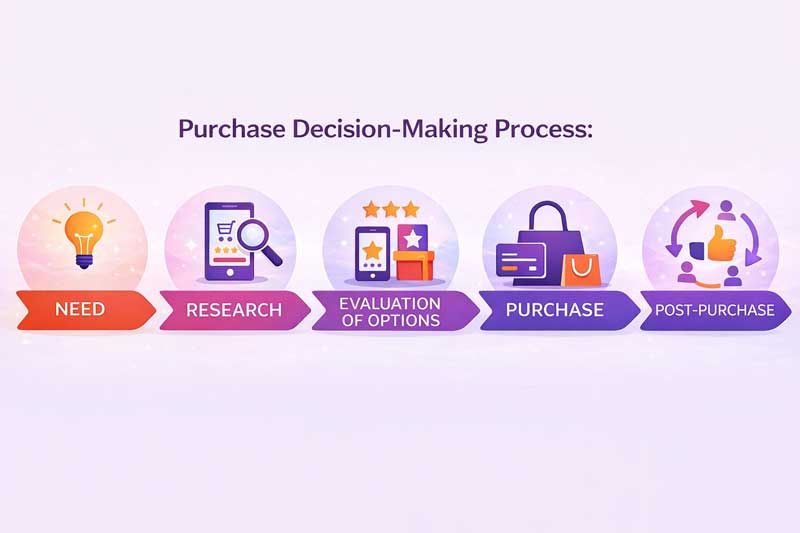
The Purchase Decision Process in Five Stages
Buying may look like a single moment, but it’s almost always a process. Even when a customer says, “I saw it and bought it right away,” what’s happening behind the scenes includes past experience, habit, trust in the brand, recommendations, and earlier comparisons. Once you understand the stages, it becomes easier to spot exactly where friction appears
1) Need Recognition
A need can be practical (“I need something that works”) or emotional (“I want to feel safer, more confident, smarter about my choice”). At this stage, your messaging should clearly highlight the problem you solve.
2) Information Search
The customer reads reviews, asks friends, researches, and compares. What matters most here is that information is simple, clear, and easy to find. If people have to dig for answers, there’s a strong chance they’ll leave.
3) Evaluation of Alternatives
This is the elimination phase: customers look for reasons to say “no” to most options. Comparisons, concrete proof, clear differentiators, and responses to common doubts all help at this point.
4) Purchase Decision
Small details often make or break the sale: a complicated checkout, unclear shipping, hidden costs, or a sense of risk. The fewer obstacles there are, the more purchases you’ll see.
5) Post-Purchase Behavior
This is where it’s decided whether a customer becomes loyal or one-time only. People need reassurance that they made the right choice, help with using the product, and a meaningful next step. This is also where habits are most often formed—and habits are the foundation of repeat purchases.
What Influences Consumer Behavior—The Factors That Shift Decisions
People like to think they buy rationally, but decisions are almost always a mix of logic, emotion, and environment.
In practice, it helps to group these influences into a few categories—because that makes it easier to see what you can actually change.
Cultural Factors
These include the habits and values of a society: what’s considered a good choice, what’s “normal” to buy, and what signals quality. In some markets, people stick to what’s familiar; in others, they’re drawn to novelty. If your message doesn’t fit that context, customers may resist before they even seriously evaluate your offer.
Social Factors
Recommendations, reviews, and opinions from family and friends often outweigh advertising. Customers look for reassurance: “Has anyone tried this?”, “Is it safe?”, “Is it worth it?” That’s why content that shows real experiences matters—as does how you respond to questions and objections.
Personal Factors
Budget, lifestyle, life stage, and daily schedule all shape decisions. The same person may buy very differently when rushed, short on cash, stressed, or changing routines. That’s why one-size-fits-all messaging rarely works.
Psychological Factors
Motivation, perception, attitudes, and past experiences. Some people care most about saving money; others about security; others about feeling they made a “smart” choice. When you understand the underlying motive, choosing the right arguments becomes much easier.
In practice, the most useful step is turning each factor into a question: “What does the customer need to hear?”, “What worries them?”, “Who influences their decision?”, and “What situation are they in when they buy?” When you connect those answers with purchase data, you get a clear action plan—not just theory.
Consumer Behavior Models That Actually Help in Practice
Consumer behavior models are designed to explain how customers arrive at decisions and where influence occurs. You don’t need to know them academically—what matters is that they give you structure: what influences decisions, when it happens, and how choices evolve over time. Their biggest value is that they push you to stop blaming “price” for everything and start looking at the entire buying journey.
The Nicosia model emphasizes the relationship between brand messaging and consumer response. Simply put: communication shapes attitudes, attitudes drive interest and information search, and post-purchase experience reshapes future behavior. This is especially useful when people “don’t get” your value proposition—or when you have plenty of traffic but too few conversions.
The Howard–Sheth model focuses on how customers process information and learn through experience. Shoppers receive multiple signals—ads, recommendations, past experiences—filter them through existing beliefs, and gradually form preferences. This model is helpful when customers keep choosing competitors and you want to understand what “better” really means to them.
The EBM model (Engel–Blackwell–Miniard) views purchasing as a process: inputs (information), processing, decisions, outcomes, and feedback. In practice, it’s excellent for mapping exactly where people drop off—whether the issue is explanation, selection, checkout simplicity, or the post-purchase experience.
Models are the map. Data is the compass. When you combine the two, you get clear moves instead of guesswork.
Customer Behavior Through Data: How to Measure It Without Guessing
You can talk about consumer behavior all day, but real value comes from measuring it—because what you measure, you can manage. In practice, customer behavior leaves a trail: when people bought, how often they purchase, how much they spend, what they buy together, when they stop coming back, and what brings them back.
One of the simplest frameworks looks at recency, frequency, and monetary value (often referred to as RFM).
-
Recency shows how “active” a customer is—whether they’re still engaged or starting to drift away.
-
Frequency reveals whether purchasing is habitual or occasional.
-
Monetary value reflects the overall value of the relationship.
Those three metrics alone can already separate your customer base into segments that need different approaches.
Beyond that, track time between purchases, average order value, preferred categories, and reactions to promotions—such as whether someone buys only when there’s a discount or also at full price.
Then come more advanced insights: identifying the most common “next product,” the ideal timing for reminders, and which segments carry the highest risk of churn.
Solutions like Spotlight help turn these signals into clear segments and concrete actions—messages, offers, rewards, and reminders—without manually stitching everything together in spreadsheets or guessing at timing.
Common Consumer Behavior Patterns You Can Spot Right Away
Theory only becomes useful when you start recognizing it in real people. In practice, most customer bases fall into a handful of recurring patterns—not because people are all the same, but because habits tend to follow certain logic.
Deal Hunters
These customers respond strongly to discounts and often delay purchases until a promotion appears. If you constantly offer price cuts, you train them to wait. A better approach is to give them value and a reason to buy sooner: bundles, added benefits, loyalty points, or clear savings through rewards systems—not just lower prices.
Routine Buyers
They purchase the same or similar products at regular intervals. What matters most to them is simplicity: finding the product quickly, an easy checkout, and no surprises. Add friction, and they’ll leave quietly.
Seasonal Shoppers
Their buying depends on the time of year, budget cycles, holidays, or specific events. With this group, timing is everything—reach out before the season starts, not after.
One-Time Buyers
They purchase once and disappear. This segment is critical, because the jump from one to two purchases is enormous. The most common reason is a lack of post-purchase activities: no follow-up, no guidance, no reassurance that they made the right choice.
Premium Customers
They care more about quality and experience than discounts. Bombarding them with constant sales can actually turn them off. What they want instead is a clear explanation of value, reliable service, and a sense of confidence.
When you connect these patterns with data, you get a communication plan that feels natural—because it follows how customers actually behave.
How to Change Customer Behavior Without Relying on Constant Discounts
Changing consumer behavior isn’t about tricks. It means making decisions easier, reducing the risk customers feel, and building habits. Discounts are the easiest lever to pull—but often the most expensive one in the long run. Instead, there are other levers that deliver more sustainable results.
Remove friction.
People abandon purchases over small things: unclear information, complicated checkout, hidden fees, slow responses. When the path to purchase is simple, more decisions happen “without overthinking.”
Prove your value.
Instead of vague promises, show specifics: customer experiences, clear benefits, guarantees, and answers to common objections. Shoppers often aren’t looking for the cheapest option—they’re looking for the safest one.
Introduce rewards that build habits.
Loyalty doesn’t have to mean only “collect points.” It can reward consistency, returning within a certain timeframe, or buying from a new category. That gives customers a reason to come back that isn’t purely price-driven.
Work the post-purchase moment.
After checkout, customers evaluate whether they made the right choice. If you help them use the product, give them a clear next step, and reinforce that they chose well, they’re much more likely to return.
Communicate at the right time.
The goal isn’t to send more messages across every channel—it’s to send relevant ones. When you know when a customer typically repurchases, you can reach out before you lose momentum.
Systems like Spotlight exist to make all of this run consistently, based on real customer behavior—not gut feeling or manual work
The Impact of Loyalty Programs on Consumer Behavior
Consumer behavior and loyalty programs are far more closely connected than many people realize. A strong loyalty program doesn’t work because it offers points—it works because it follows customer habits and rewards exactly the behaviors that lead to long-term relationships: returning within a certain timeframe, buying from a new category, using a service regularly, or recommending it to others.
When you understand how customers make decisions, how often they buy, and what motivates them to come back, loyalty stops being a generic card or discount app—it becomes a tool that fits into real customer life.
Instead of giving everyone the same offers, the program adapts to different behavior patterns: routine buyers get reminders at the right moment, seasonal shoppers are reactivated before they drop out of the cycle, and your most valuable segment gets reasons to stay without waiting for a sale.
That’s how loyalty programs stop being a short-term sales tactic and become systems that build habits and stable revenue.
How Do Gift Cards Influence Consumer Behavior?
Gift cards are an interesting example of how consumer behavior shifts when flexibility enters the equation. People often buy them when they’re unsure what to give, short on time to think, or trying to avoid the risk of choosing the wrong gift.

From the recipient’s side, a gift card removes decision pressure—it lets them choose when and what to buy, which often leads to higher satisfaction and spending beyond the card’s original value.
From a business perspective, gift cards influence customer behavior by creating new entry points into the brand relationship: someone visits for the first time because of a gift, tests the experience, and then returns with their own money. They also encourage faster decisions during holidays and gifting seasons, while extending engagement because cards are often redeemed later.
When gift cards are connected to purchase data and loyalty programs, they become more than a convenient present—they turn into a tool for understanding new segments, spending patterns, and the moments when people most often begin relationships with a brand.
FAQ: Common Questions About Consumer Behavior
How do digital channels change consumer behavior?
Online stores, social media, and apps have shortened the path to information while increasing the number of comparisons. Today’s customers expect fast answers, clear pricing, reviews, and frictionless purchasing. When those are missing, they switch to competitors without much hesitation.
Does consumer behavior differ between online and physical stores?
Yes. In-store, location, staff, and product availability often drive decisions. Online, website simplicity, shipping, return policies, and customer ratings play a bigger role. The same person can behave very differently in these two environments.
How does price affect customer behavior in the long run?
Constant promotions can train customers to wait for discounts. Over time, this can weaken loyalty and perceived value. More sustainable growth comes from combining price with clear benefits, strong experiences, and reward programs.
How ethical is it to influence consumer behavior through marketing?
Influence is acceptable when it’s based on transparency and real value for the customer. Manipulation, hidden fees, or pressure tactics may work short term, but they damage trust over time.
Consumer behavior isn’t an abstract academic concept. It explains why people return, why they buy more often, why they respond to certain offers, and why others disappear after a first purchase. When you understand how customers think, decide, and buy, you stop running sales on instinct and start fixing the exact points in the process that truly matter.
Consumer behavior models provide a thinking framework. Customer data reveals what actually happens. And when those two come together in one system—segments, habits, perfect timing for messages, and clear reasons to come back—you get stable growth that doesn’t depend on constant discounts.
If you want to see how customer behavior plays out in your own database, where people most often drop off, and which segments carry the highest value, Spotlight is worth exploring. Through customer analytics, smart segmentation, and well-timed communication, Spotlight helps turn consumer behavior theory into a practical advantage for everyday business.