
Customers don’t decide based on price alone. Sales psychology reveals hidden purchase triggers that most businesses never use.
Why do two almost identical products achieve completely different results?
Why does a customer say “I’ll think about it” — and never come back?
Why does one person buy once, while another keeps returning without hesitation?
At first glance, the answer seems simple: price, quality, marketing. But in reality, purchase decisions are rarely that rational.
This is where sales psychology comes in.
Selling is not just a matter of presentation or negotiation skills. It starts much earlier — in the way customers think, what they feel when they see an offer, what holds them back from deciding, and what gives them the confidence to say “yes.”
In other words, if you want to sell more, it’s not enough to know what you’re offering. You need to understand the psychology of your customer — their triggers, habits, doubts, and expectations.
That’s when selling stops being guesswork and becomes a process with clear logic.
Sales psychology explains how customers think, feel, and make decisions during the buying process. It shows that decisions depend not only on price or logic, but also on trust, perceived value, habits, social proof, and personal relevance. Understanding consumer behavior and purchase psychology helps businesses increase conversions, drive repeat purchases, and build long-term customer loyalty
Here’s how to turn that knowledge into real results and get the most out of it.
What is Sales Psychology?
Sales psychology is the field that studies how customers think, react, and make decisions during the buying process — from the first contact with an offer to the final decision and eventual return.
In other words, it doesn’t just analyze what you’re selling, but how the customer perceives what you offer.
This includes understanding:
- how the customer interprets your offer and whether it’s immediately clear
- what captures their attention in a sea of information
- what builds a sense of trust in a brand or product
- what reduces their doubt and resistance
- what motivates them to make a decision at that exact moment
- and what brings them back to buy again
One key thing to understand: purchasing is not a purely rational process.
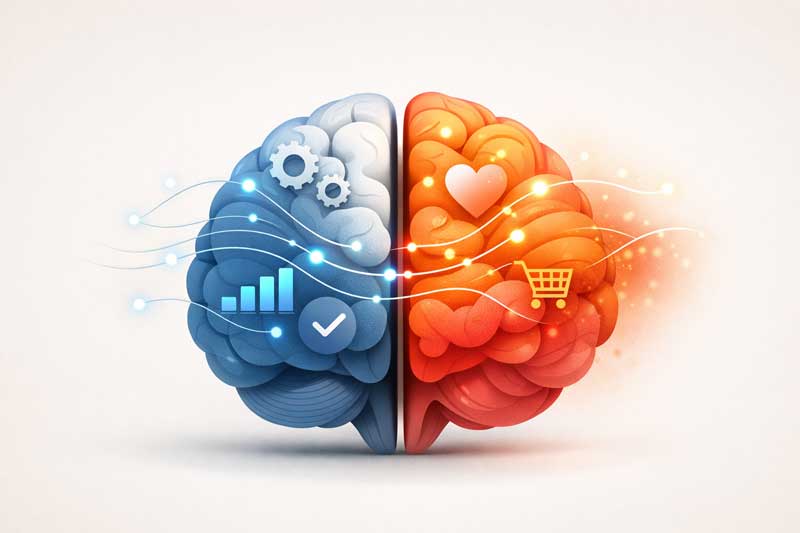
Customers don’t make decisions based on logic, specifications, or price alone. A large part of the decision-making process happens on a subconscious level, where emotions, a sense of security, and perceived value often play the decisive role. That’s exactly why two similar products can achieve completely different results.
This is why sales psychology is not an add-on to marketing — it is the foundation for understanding how buyer psychology and consumer behavior directly impact real business results.
Why Sales Psychology Is Not the Same as Manipulation
Sales psychology is often mistakenly associated with tricks and pressure. In practice, the difference is clear.
Manipulation tries to push customers toward a decision they might not make on their own.
Good sales do the opposite — they remove uncertainty and make decision-making easier.
Instead of pressure, the focus is on:
- clear communication of value
- reducing doubt and risk
- building trust
- delivering the right information at the right time
When you understand purchase psychology, you’re not trying to force a sale.
You’re helping the customer make a decision that makes sense to them.
And that’s where the difference lies between short-term sales and long-term customer loyalty.
How Customer Psychology Works During the Buying Process
A purchase is not a single moment. It’s a process that happens in several steps — often quickly, but not randomly.
Customer psychology shows that every decision follows a certain flow: from the first contact with an offer, through value evaluation, to the final decision and post-purchase behavior.
When you understand these steps, you stop guessing and start influencing what actually happens in the customer’s mind.
1. Attention — The Customer Has to Notice You First
Customers see dozens of offers every day. Most of them get ignored.
Not because they’re bad — but because they don’t feel relevant at that moment.
People react only to what feels:
- relevant
- clear
- new
- useful
If your message requires effort to understand, it’s usually already lost.
Customers don’t stop because you say something is “the best.”
They stop because they instantly understand what problem it solves for them.
This is the first filter in purchase psychology — either you’re noticed, or you don’t exist.
2. Interest — The Customer Looks for Personal Meaning
Once you’ve captured attention, the next question in the customer’s mind is simple:
“What do I get out of this?”
This is where most offers fail — they talk about the product, not the outcome.
Consumer psychology clearly shows that people don’t buy features — they buy results.
Those results can be:
- saving time
- feeling safe
- making a better choice
- buying smarter
- gaining status
- receiving a reward
- simplicity
The clearer and more relatable the outcome, the higher the chance the customer moves forward.
3. Trust — No Decision Without It
Even when an offer seems interesting, customers won’t decide until they feel safe.
Trust isn’t built with a single sentence. It’s built through signals.
The most important ones include:
- reviews
- customer experiences
- clear pricing and conditions
- consistent communication
- a recognizable brand
- professional presentation
Research shows that people trust recommendations from other people the most — especially real users, not brands themselves.
This means purchase psychology depends not only on what you say, but also on what others confirm.
4. Perceived Value — Customers Don’t Buy the Lowest Price
One of the biggest misconceptions in sales is that customers choose the lowest price.
In reality, customers choose what feels like the best value for what they give versus what they get.
That’s why “too expensive” often doesn’t mean “I don’t have the money,” but:
“I don’t see enough value for this price.”
The same price can feel like a good or bad decision — depending on how the offer is presented.
Perceived value is influenced by:
- how the offer is packaged
- additional benefits
- clarity of outcomes
- bonuses and rewards
- loyalty benefits
When customers feel they’re getting more than expected, price stops being a barrier.
5. Risk Reduction — Customers Don’t Want to Make a Mistake
Even when customers want to buy, they still have one final question:
“What if I make the wrong choice?”
This is often where drop-offs happen.
That’s why reducing risk is a critical part of sales psychology.
Customers need:
- clear information
- a simple purchase process
- transparency
- social proof
- a “safe option” if things don’t go as expected
The lower the perceived risk, the easier the decision.
And that’s where one cycle ends — and the next begins.
When customers go through this process without stress, they are far more likely to return.
What Happens After the Purchase — The Part That Drives the Next Sale
Most businesses treat a sale as complete the moment the customer pays.
In reality, that’s when the most important part begins.
Purchase psychology doesn’t end with a decision. It continues through the experience customers have after buying — and that experience determines whether they return or disappear.
In other words: the first purchase brings revenue, but post-purchase experience drives growth.
How Post-Purchase Experience Shapes Customer Psychology
After buying, customers go through a phase where they validate their decision.
If the buyer experience is positive:
- they feel they made the right choice
- trust in the brand grows
- the need for further research decreases
- repeat purchase likelihood increases
If the experience feels empty or disappointing:
- no emotional connection forms
- customers reconsider competitors next time
- the relationship stays transactional
That’s why post-purchase communication is the bridge between one purchase and a buying habit.
What Makes a Strong Post-Purchase Strategy?
Effective post-purchase actions are not random messages — they are a logical continuation of the experience.
They include:
- a thank-you message that doesn’t feel generic
- relevant recommendations based on the purchase
- reminders at the right time (not too early, not too late)
- benefits that make sense for that specific customer
- a sense that the customer is recognized, not just counted
Customers don’t respond to message volume — they respond to relevance.
How One Purchase Becomes Loyalty
Loyalty doesn’t happen by accident.
It’s built when customers:
- have positive experiences repeatedly
- get a reason to return
- feel additional value in their relationship with the brand
- recognize consistency
Key drivers include:
- personalization
- rewarding behavior
- consistent communication
- clear incentives to return
Without this, every new sale starts from zero.
Where Sales Psychology Becomes a System
Understanding customer psychology is one thing.
Applying it consistently, across many customers, without improvisation — that’s the real challenge.
This is the difference between:
“We know what works”
and
“We have a system that delivers it every day”
If you know customers respond better to personalized offers — you need a way to segment them.
If you know loyalty comes from repetition — you need a way to drive return behavior.
If you know timing matters — you need a way to communicate at the right moment.
Otherwise, sales psychology remains just theory.
How Spotlight Turns Purchase Psychology Into Action
Platforms like Spotlight make it possible to turn customer insights into real actions.
Instead of guessing:
- who will buy
- when they will buy
- what motivates them
- why they return
you can:
- segment customers based on behavior
- create personalized offers
- automate communication
- reward loyalty at the right moment
- connect online and offline purchases into one view
This is where sales psychology stops being abstract — and becomes part of everyday business.
And that’s where the real difference appears:
between businesses constantly chasing new sales, and those building systems where customers return — because they have a reason to.
What Psychological Factors Have the Biggest Impact on Sales?
When you break it down, a purchase decision rarely depends on just one reason.
The difference between average and consistent sales often isn’t the product — it’s how well you understand these triggers.
Emotions
Customers often feel first — and only then justify their decision.
This means the decision isn’t purely rational. Logic comes later, as a confirmation of a choice that has already been made.
That’s why a product or service must also make emotional sense:
- a sense of security
- a feeling of making a smart decision
- a sense of reward
- a feeling of control
- a sense that “this makes sense for me”
Research in consumer behavior (HBS/HBR) shows that emotional connection with a brand can directly impact business results, because people don’t respond only to information — they respond to the experience that information creates.
Social Proof
Customers rarely want to be the first to “take the risk.”
That’s why they look for confirmation that others have already made the same choice.
This can include:
- reviews
- comments
- recommendations
- ratings
- number of satisfied customers
When customers see that others are already choosing a product or brand, uncertainty decreases and the decision becomes easier.
In other words, people don’t just trust you — they trust those who’ve already had the experience.
Sense of Urgency
Customers often delay decisions — not because they’re not interested, but because they don’t have a clear reason to act now.
That’s where urgency comes in — not as pressure, but as a signal.
Effective triggers include:
- limited editions
- time-sensitive offers
- exclusive benefits
- clearly defined deadlines
It’s important that urgency feels real.
If it seems artificial, it can reduce trust.
When used naturally, it helps customers move from “I’ll think about it” to “I’ve decided.”
Habit
One of the most underestimated factors in sales is habit.
A large portion of revenue doesn’t come from constantly acquiring new customers, but from returning and reactivating existing ones.
When a customer:
- already has a positive experience
- knows what to expect
- doesn’t need to research again
- has a reason to return
the decision becomes faster, easier, and more frequent.
At that point, sales no longer depend on persuasion — but on continuity.
Personalization
In modern sales, a generic message is no longer enough.
Customers expect offers to feel relevant to them personally.
Personalization means:
- relevant offers
- the right timing
- messaging that fits real customer needs
Research shows that personalization has a direct impact on results:
- 76% of consumers say it’s important when considering a brand
- 78% say it increases the likelihood of repeat purchases
This means consumer psychology today doesn’t work without data and customer insights.
Customers don’t want more options.
They want the right option.
How These Factors Work Together
The key thing to understand: these factors don’t operate in isolation.
- Emotions drive interest
- Social proof builds trust
- Value justifies the price
- Urgency triggers action
- Habit creates continuity
- Personalization makes everything relevant
When they work together, sales become more predictable.
When they’re missing, everything becomes guesswork.
And that’s exactly where the difference begins — between sales that depend on the moment, and sales that operate as a system.
Turning Psychology Into a Competitive Advantage
Spotlight allows you to turn this understanding into a real advantage — transforming customer behavior data into personalized communication, timely offers, and clear reasons to return.
Every time. Not by chance
Purchase Psychology in Physical Stores and Online Sales
At first glance, in-store and online sales seem like two completely different worlds.
One is physical, the other digital.
One relies on space, the other on a screen.
But customer psychology remains the same.
Customers are still looking for:
- clarity
- security
- relevance
- and a reason to return
The difference lies only in how these signals are communicated.
In-Store
In a physical space, purchase decisions are often made faster — but under the influence of many factors that customers do not consciously analyze.

Purchase psychology is influenced by:
- layout — whether the customer can easily find what they’re looking for or gets lost
- sense of simplicity — whether the experience feels intuitive or exhausting
- speed of decision-making — whether the customer can decide quickly or delays the choice
- visual signals — how products are presented, highlighted, and grouped
- brand experience — how the space, staff, and atmosphere shape perception
- purchase reward — whether there’s an additional reason to “complete” the purchase
In-store, customers often react to the feeling.
If everything is clear, pleasant, and logical — the decision comes naturally.
If they have to think too much, search, or hesitate — there’s a high chance they will walk away.
Online
In an online environment, customers don’t have physical contact with the product — so the need for security is even stronger.
Here, customer psychology works through different signals:
- trust in the website — design, speed, transparency of information
- reviews — other people’s experiences as a substitute for direct contact
- simple checkout — how easy it is to complete the purchase without friction
- relevant recommendations — whether the system “understands” what the customer is interested in
- personalized communication after a visit or purchase — whether the relationship continues or stops
Online customers have more time to think — but also more reasons to drop off.
That’s why every obstacle, every unclear element, or extra step directly impacts conversion.
Channels are different.
Communication methods are different.
Tools are different.
But the essence remains the same:
Customers want to quickly understand the offer.
They want to feel safe while making a decision.
They want something that makes sense for them.
And they want a reason to come back.
When this exists — sales happen both in-store and online.
When it doesn’t — no channel can compensate for it.
That’s why, no matter where you sell, purchase psychology is the same game — just with different rules of delivery.
How Do You Know If Your Business Understands Consumer Psychology?
Most businesses believe they understand their customers — as long as sales are happening.
But the real difference shows in the details:
do customers come randomly, or do they return with a reason?
Understanding consumer psychology isn’t reflected in one campaign or a good month — but in how you communicate, analyze, and respond to customer behavior over time.
Mini Checklist
Your business understands customer psychology if it:
- doesn’t communicate the same way with every customer, but recognizes differences in behavior and needs
- knows what drives repeat purchases, not just the first transaction
- tracks customer behavior, not just revenue and totals
- sends relevant messages and offers instead of generic campaigns
- rewards loyalty, not just initial purchases
- recognizes the moment when customers drop off — and understands why
- uses data to improve the experience, not just to report results
If most of these are not part of your daily operations, the problem isn’t sales — it’s that decisions are made without insight into real customer behavior.
Purchase psychology doesn’t deliver results on its own.
It works only when translated into concrete actions.
Sales psychology becomes a system when:
- you don’t rely on individual campaigns
- you don’t send the same messages to everyone
- you don’t guess the right moment to communicate
- you don’t restart every customer relationship from zero
Instead, you have:
- clear insight into customer behavior
- segmentation based on real data
- automated messages delivered at the right time
- a logic that rewards loyalty and encourages return
At that point, sales are no longer a result of chance — but of a system.
Instead of treating customer psychology separately from the tools you use, you need a system that connects them.
The Spotlight loyalty program allows you to:
- centralize customer data in one place
- segment your audience based on behavior, not assumptions
- trigger personalized communication at the right moment
- implement a loyalty program that truly impacts repeat purchases
- connect online and offline sales into one unified system
- track what actually influences customer decisions
This is how sales psychology and consumer psychology stop being theory you understand — and become a system that works in your favor every day.
How to Increase Sales by Better Understanding Customer Psychology
When you understand how customers think, sales stop being a matter of luck and start following a clear logic.
But the real difference isn’t made in theory — it’s made in small, practical decisions you take every day.
Here are five guidelines that directly connect customer psychology with sales growth:
Don’t Sell the Product — Sell the Reason to Decide
Customers aren’t looking for a product. They’re looking for an outcome.
Instead of explaining what something is, show what it changes:
- what it solves
- what it simplifies
- what it speeds up
- what it improves
When customers immediately see the meaning for themselves, the decision becomes more natural.
Reduce Uncertainty at Every Stage of the Purchase
The biggest enemy of sales isn’t price — it’s doubt.
If customers don’t know:
- what exactly they’re getting
- how much it costs without hidden conditions
- what the process looks like
- what they can expect
the decision gets delayed — or never happens.
Clarity and transparency are not optional — they are the foundation of trust.
Build Trust Before Asking for Action
Customers rarely buy on first contact.
Before deciding, they need signals that they’re in the right place:
- experiences of others
- consistent communication
- professional presentation
- a logical offer
If you skip this step and push for action immediately, you increase resistance.
Trust doesn’t just speed up the first purchase — it makes every next one easier.
Personalize the Offer Whenever You Have Data
Generic messaging doesn’t work like it used to.
Customers expect offers to feel relevant to them — not to “everyone.”
If you have data about:
- previous purchases
- interests
- behavior
use it.
A relevant offer at the right moment has far more impact than any generic campaign.
Reward Return, Not Just the First Purchase
Most businesses invest the most effort into the first sale.
But the real value comes from the second, third, and every next one.
Customers return when they have a reason:
- a feeling of getting more
- continuity of experience
- rewards for loyalty
- a recognizable relationship with the brand
When return behavior is encouraged systematically, sales become more stable and predictable.
Frequently Asked Questions About Sales Psychology
Does sales psychology work in every industry?
Yes, but the application differs. In retail and eCommerce, the focus is on speed of decision and visual signals, while in B2B, trust, long-term relationships, and rational justification play a bigger role. The core remains the same — understanding how customers decide.
How long does it take to see results?
Some effects, like clearer communication or better presentation, can show results immediately. But the real impact appears over time — through increased repeat purchases, loyalty, and customer lifetime value.
Is sales psychology more important than price?
Price matters, but it’s not decisive on its own. Customers often choose the option that feels like the best value — even if it’s not the cheapest. Sales psychology shapes how that value is perceived.
How can small businesses apply it without a big budget?
Through simple steps:
- clearer communication of the offer
- collecting and displaying reviews
- consistent customer communication
- focusing on post-purchase experience
Even without complex tools, understanding customers can significantly improve results.
How does sales psychology influence impulse purchases?
Impulse purchases happen when emotion, simplicity, and perceived value align at the right moment. A clear offer, minimal steps, and a feeling of “this makes sense now” are key triggers.
Does sales psychology change over time?
The core principles stay the same, but their application evolves. Today, customers have more information, more choices, and higher expectations — making relevance and personalization more important than ever.
Customers don’t make decisions with logic alone.
They decide through a sense of security, value, habit, and relevance.
If you want to turn purchase psychology into real results, Spotlight can help you build it as a system — not as improvisation.