
VIP customers don’t seek the same experience as everyone else. Discover how to identify your most valuable customers and what truly creates a sense of exclusivity that keeps them coming back.
Many businesses still believe that retaining important customers comes down to offering slightly lower prices again and again. Another 10%. Another coupon. Another “just for you” deal. In the short term, this can boost sales. In the long run, it often teaches the wrong lesson: trying to keep VIP customers purely through price.
When a customer stays only because they’re waiting for the next discount, you haven’t built customer loyalty. You’ve built a habit where your brand’s value is measured by the percentage at checkout. And that’s not the same thing.
A true VIP experience looks different. It gives the customer a sense of recognition, a feeling of special status, and the impression that they’re not going through the same journey as everyone else.
That doesn’t mean every purchase comes with the biggest discount. More often, it means something smarter: better treatment, a higher level of attention, more relevant benefits, and a sense that the relationship with the brand is tailored specifically to them.
VIP status doesn’t have to be expensive, but it has to feel special.
Who are VIP customers?
The first mistake companies make is imagining a VIP customer solely as someone who spends the most in a single purchase. In reality, it’s a bit more nuanced.
A VIP customer can also be someone who buys frequently, even if individual purchases aren’t the largest.
It can be someone who keeps coming back without much prompting, chooses your premium products, responds to new offers, uses the benefits you provide, and over time generates far more total value than someone who made one large purchase and disappeared.
In other words, a VIP customer is not just the “biggest receipt.”
A VIP customer is someone who brings greater value to your business over time.
These can also be customers who recommend you to others as brand ambassadors, who tend to try new products first, who join your loyalty program and actually use it, and who don’t come to you only during sales, but when they genuinely need something and trust you.
That’s why you shouldn’t build your VIP segment blindly. If you reduce it only to the amount spent in a single purchase, you can easily overlook a customer who returns ten times a year, generates steady revenue, and is far more valuable than they appear at first glance.
VIP is not a label for the “richest” customer. VIP is a label for the customer who brings exceptional value to your business—and one worth retaining more thoughtfully than the average buyer.
Why big discounts are not the same as VIP treatment
A big discount seems like the easiest solution. It’s quick to create, easy to communicate, and instantly understood. That’s why many brands stop there. But what’s easy isn’t always what works best.
When you keep offering VIP customers bigger discounts, you’re sending a message that their value to you is measured only in price. That might work for a while, but over time it becomes an expectation.
Once something becomes an expectation, it stops feeling special.
Another issue is that discounts don’t create a relationship. They create a transaction. The customer doesn’t think, “This brand knows me.” They think, “I’ll wait here for the next sale.” That’s a big difference.
On top of that, over-relying on discounts can lower the perceived value of what you sell. If something is always “on special,” customers start questioning its real price—and whether it’s worth buying at full value at all. That’s a problem you create for yourself.
The most uncomfortable part is margin. VIP customers are often the ones who would stay loyal even without aggressive price cuts—yet they’re the ones you discount the most. Instead of building the relationship through smartly designed benefits, you build it by accepting lower profit.
A customer doesn’t feel like a VIP because they got an extra 10% off. They feel like a VIP when they get something not available to everyone else—when their status feels real, not just a marketing label attached to a promo code.
What actually creates a VIP feeling?
If big discounts aren’t the answer, what is?
The answer is simple: exclusivity. Not necessarily expensive exclusivity—but intentional, well-designed exclusivity.
Early access to new products and offers
Customers value the feeling of being first. Not waiting for something to be available to everyone, but getting access before others do. That sense of priority often matters more than an extra percentage off.
Early access to new collections, new flavors, limited editions, or seasonal campaigns sends a clear message: you’re not just another name in our customer database—you’re among the first to see what’s new.
This kind of benefit carries high perceived value without necessarily adding significant cost for the brand—which makes it especially powerful.
Exclusive perks that aren’t purely financial
A VIP benefit doesn’t always have to be tied to price. Sometimes it’s about better treatment.
That can include priority customer support, a lower threshold for free shipping, a dedicated communication channel, product reservations, access to limited offers, special gifts with certain purchases, or pre-designed personalized recommendations.
Why does this work? Because customers don’t measure value only in money. They also evaluate time, attention, convenience, and the feeling that they’re not treated the same as everyone else.
Sometimes “you don’t have to wait” is a stronger benefit than “you’ll pay a little less.”
Tailored communication
One of the most common mistakes is sending VIP customers the same messages as everyone else. Same subject line. Same promotion. Same timing. Same logic.
If you want someone to feel special, you can’t send them a mass message that looks like it went out to 40,000 other people.
VIP communication with customers should be more relevant, more precise, and calmer. Less “hurry, last chance,” more of a sense that the message exists because it’s genuinely useful to the customer.
This doesn’t mean every message has to be written manually. It means it has to be intelligently segmented and well-timed.
Loyalty tiers that actually feel different
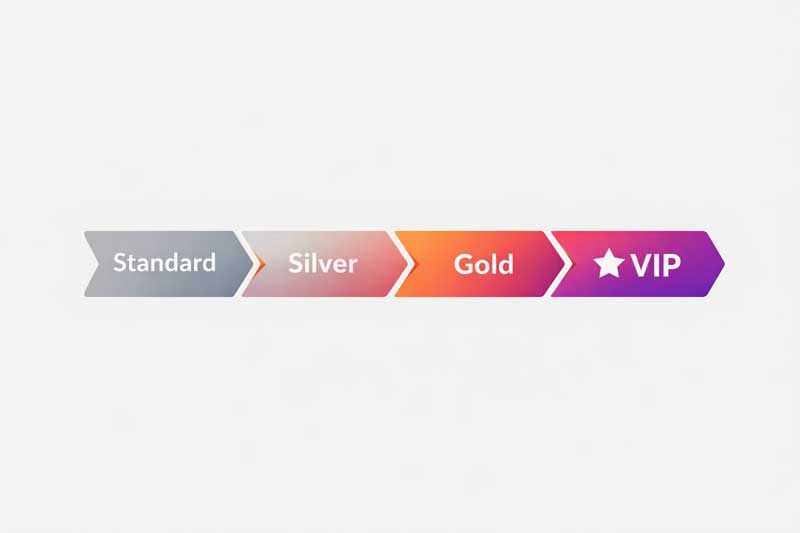
Many loyalty programs have tiers—but the problem arises when customers don’t see why those tiers matter. If the differences between loyalty levels are weak, unclear, or purely cosmetic, the whole concept feels decorative.
Loyalty tiers only make sense when customers understand two things: how they move to the next level—and what they actually gain from it.
If moving up unlocks meaningful benefits, earlier access, exclusive perks, or a noticeably better experience, then the tier has real weight. But if the only difference is a more “premium-sounding” card name while the experience stays the same, customers won’t feel the value.
A VIP experience has to be visible in practice—not just in the name of the segment.
A sense of recognition
This might be the most important part of all.
Customers want to feel understood. They don’t want random recommendations or offers that clearly don’t match their interests. They expect you to know when they buy, what they typically choose, what kind of benefits they respond to, and what actually makes sense for them.
When customers feel that the system “remembers” their habits and responds intelligently, the value of the entire experience increases. At that point, they’re no longer talking about discounts—they’re talking about how buying from you simply makes more sense.
That’s why a true VIP experience shouldn’t rely on improvisation. It should be built on a system that can identify high-value customers, understand their behavior, and trigger the right communication at the right time. The Spotlight loyalty program helps brands turn that approach into reality—through smart segmentation, personalized benefits, and a consistent experience that feels intentional, not random.
How to make VIP perks feel valuable—without costing too much
The first rule is simple: don’t give everything to everyone. VIP perks only make sense when they’re tied to customer behavior, value, and the relationship they have with your brand. When everyone gets everything, nothing feels special anymore.
Second, think in terms of actual cost vs. perceived value. That’s where the smartest moves happen.
For example:
- Early access to a new collection may have minimal direct cost for you—but high value for a customer who wants to be first.
- A lower free-shipping threshold can feel like a strong benefit, while being far more sustainable than constant extra discounts.
- A personalized gift with purchase often leaves a stronger impression than a generic price reduction, because it feels more intentional.
- The same applies to extended redemption periods, access to special events, exclusive recommendations, or offers that aren’t publicly available. All of these send a clear message: you’re part of a different group.
A strong VIP model doesn’t try to be the cheapest. It tries to be more valuable.
Mistakes that make a VIP program feel… not VIP
Many companies technically have a VIP segment—but customers barely feel it. That happens when the idea is good, but the execution is average.
Unclear communication
Customers often don’t know why they have VIP status, what they can do with it, or which benefits are available. If you have to explain the benefit multiple times, the system isn’t set up well.
Too many rules
If customers need to read fine print, calculate conditions, or guess when something applies, the VIP experience disappears. It should feel simple and natural.
Status exists only on paper
A customer is technically in a special segment—but nothing in communication, support, offers, or experience reflects that. In that case, VIP becomes an empty label.
Random perks
If benefits are given without logic or connection to real customer behavior, the sense of a well-designed system disappears.
How technology makes VIP experience sustainable
When your customer base is small, you can manage things manually. You know who buys the most, who returns often, who deserves special attention, who should get a personalized message.
But as your customer base grows, that approach becomes chaotic.
At that point, it’s no longer enough to “have a feeling” about who your best customers are. You need a system that can recognize patterns, identify valuable segments, activate the right benefits, and deliver the right message at the right moment.
That’s where the difference between a nice idea and a scalable strategy appears.
The Spotlight loyalty program isn’t just about collecting points—it’s a platform for customer segmentation, loyalty tiers, customer analytics, and automated communication across multiple channels, including email, SMS, Viber, and push notifications. This matters especially in VIP scenarios, where special experiences don’t work well when managed manually or inconsistently.
In other words, if you want VIP customers to get early access, tailored benefits, smarter communication flows, and a status that truly feels real—you first need to recognize them, and then consistently deliver that experience at scale.
What a strong VIP model looks like—without relying on big discounts
Imagine a retail brand with a large customer base, aiming to give special attention to those who return regularly and generate the most value over time.
Instead of constantly offering them the lowest price, the brand builds a simple VIP model.
Customers first enter a basic loyalty program. After reaching a certain level of activity, they move into a higher tier. At that point, they receive benefits such as a birthday reward, personalized recommendations, a lower free-shipping threshold, and occasional perks that aren’t available to all customers.
Notice what happens here: the customer isn’t trained to wait for the biggest discount. They’re trained to see their status as a gateway to a better experience.
For the business, this is smarter—it protects brand value and preserves margins. For the customer, it’s more engaging—it creates a sense of belonging to a group that receives more attention and a different kind of treatment.
That’s the difference between a program that simply gives concessions and one that builds a relationship.
How to know if your VIP experience actually works
A well-designed VIP model sounds great on paper. But the real question is: does it deliver results?
The first thing to track is purchase frequency within your VIP segment. If the experience works, your most valuable customers shouldn’t just be satisfied—they should return more consistently.
The second key metric is average order value. A strong VIP model doesn’t just encourage repeat purchases—it often increases willingness to choose higher-quality, premium, or additional products.
The third metric is benefit usage. If you’ve designed VIP perks but customers rarely use them, the issue is either communication—or the relevance of what you’re offering.
The fourth is retention rate—how often VIP customers return within a given period, and whether that rate improves after introducing the VIP experience.
Finally, look at engagement with communication. If VIP messages generate stronger responses than generic campaigns, it’s a clear sign that segmentation and relevance are working.
Always compare VIP vs. non-VIP behavior. If the status exists but the behavior doesn’t meaningfully differ, then you haven’t created a VIP experience the customer truly feels.
VIP status doesn’t gain weight when you label it in a loyalty program—it gains weight when the customer actually experiences it. That’s the difference between a simple perk and an experience that stays with them.
And when customers feel that difference, they don’t come back because they have to—they come back because your brand simply makes more sense than the alternatives.
If you want your VIP experience to be more than just a good idea—and turn it into a system that truly works—let us show you how the Spotlight loyalty program can help you identify your most valuable customers and build a stronger, more meaningful relationship with them.