How to reward loyal customers without discounts eating your profit? We reveal ideas that actually work, when to use them, how to automate them, and how to measure results.
Everyone loves fast sales, but few like the aftermath: customers get used to the idea that the “real” price is the discounted one. The problem is that every next campaign then has to be bigger to achieve the same effect.
That’s not rewarding loyalty. That’s training your audience to wait for discounts.
Customer loyalty is built differently. Not just through “how much to give,” but through the feeling that the customer is recognized, that it’s easier for them to buy again, and that they have a reason to return to you—even when competitors hit the market with -30%.
The point of good rewarding is simple: the reward should be attainable, clear, and repeatable. The customer should understand what they’re getting and why, without you having to “invent” something manually every week. And even more importantly: rewards shouldn’t be a leaking cost, but a system that increases purchase frequency, average order value, and referrals.
Why is this worth doing at all?
Because a large part of growth isn’t found in “more new customers,” but in existing customers buying more often, deciding faster, and thinking less about alternatives.
Even a small improvement in customer retention can make a big difference in profit, because you already have the relationship, the trust, and the habit.
The first question: who exactly are you rewarding (and is it worth it)?
Before you hand out a single coupon, you need to answer one thing: are you rewarding the right people?
The most common mistake is defining a “loyal customer” as anyone who has purchased multiple times. That can include customers who constantly return items, buy only on discounts, place tiny orders that eat up logistics costs, or buy products with the lowest margins.
In that case, rewards don’t drive growth—they just make your stats look nicer.
A “loyal customer” is not always a “good customer.”
Three quick questions that separate “likable” from “profitable”:
-
How often do they buy? Frequency matters, but it’s not enough. A customer who buys six times a year for €8 isn’t the same as one who buys three times a year for €50.
-
What’s their average order value and margin? You may have popular products with thin margins. If you reward everyone, you can easily eat into profit. Rewards should encourage behavior that brings a healthy revenue-to-cost ratio.
-
How much does it cost to serve this customer? Returns, complaints, special requests, frequent questions, small orders, expensive shipping… Some customers are active but costly. That doesn’t mean you should drop them—it means rewards must be smart, not broad.
Three segments that almost always make sense to reward
If you want a system that works steadily, focus on segments where rewards most often pay for themselves.
Repeat buyers (core)
These customers buy “normally.” They’re not just discount hunters—they have a rhythm. Rewards help lock that rhythm in. This is where growth is easiest, because you’re not convincing a cold audience—you’re just removing reasons for them to drift away.
How to reward them: simple and consistent benefits. Accumulating points, clear thresholds, occasional vouchers that encourage the next purchase.
VIP customers (high spenders)
VIP customers don’t necessarily want bigger discounts. They want treatment. Faster delivery, priority handling, a sense of exclusivity, early access. If you give them the same thing as everyone else, you risk losing them to brands that make them feel more “seen.”
How to reward them: status, priority, access, exclusivity. Discounts are the fourth option, not the first.
“At risk” customers (win-back segment)
These are customers who used to buy but have stopped. Rewards often work best here, because they break the silence and restore the habit—but timing and relevance are crucial. Sending a generic coupon after nine months is often too late.
How to reward them: an offer that gives a reason to try again (for example, “You haven’t purchased in 60 days—here’s a benefit to come back”), paired with messaging that feels human, not robotic.
Rewards are not “for everyone.” They are a filter that protects your budget and amplifies results.
Customer reward models that most often work—and when to choose which one
Points – easy to understand, but requires solid math
Points are popular because customers instantly get the logic:
I buy → I earn points → I redeem a reward.
The problem starts when points are set “by feel,” without proper calculation.
What you need to define clearly:
-
Point value: how many points equal one unit of real benefit
-
Thresholds: when the customer can realistically feel the reward (too far away = they give up)
-
Limitations: points shouldn’t apply to everything (for example, exclude products with minimal margins)
-
Expiration: points should motivate, not create frustration (a realistic, clearly explained deadline)
When points work best:
-
with frequent purchases (retail, drugstores, coffee, cosmetics, services)
-
when you want to increase purchase frequency and habit
-
when you want a simple, repeatable rule
Tier systems (Bronze / Silver / Gold) – status drives higher spend
Tier systems are powerful because customers don’t chase just a reward, but status.
“I’m Gold” doesn’t feel the same as “I have 300 points.” Status creates emotional attachment and a competitive element, while also following a clear business logic: the more you buy, the more privileges you get.
How it usually looks in practice:
-
Bronze: basic benefits (points, birthday perk)
-
Silver: faster delivery, early access to promotions, better thresholds
-
Gold: priority support, exclusive gifts, events, special offers
When tiers work best:
-
when a small group of customers generates a large share of revenue
-
when you want to increase average order value and purchase frequency
-
when you want to reduce reliance on discounts and shift toward privileges
Value-based programs – rewards built on values and brand meaning
This model is based on the idea: “We stand for something, and you’re part of it.”
It can involve donations, community support, sustainability, or benefits that truly resonate with your audience.
Examples:
-
customers can convert part of their points into donations
-
rewards linked to education (webinars, workshops, guides)
-
VIP treatment tied to community (closed clubs, events, exclusive content)
When value-based programs work best:
-
when you have a clear brand and an audience that identifies with its values
-
when you want loyalty that isn’t price-driven
-
when your goal is referrals and long-term relationships, not just the next purchase
Most reward models can be set up manually—but that approach quickly becomes inefficient. Rules get forgotten, messages are sent to everyone the same way, and you lose visibility into what actually works.
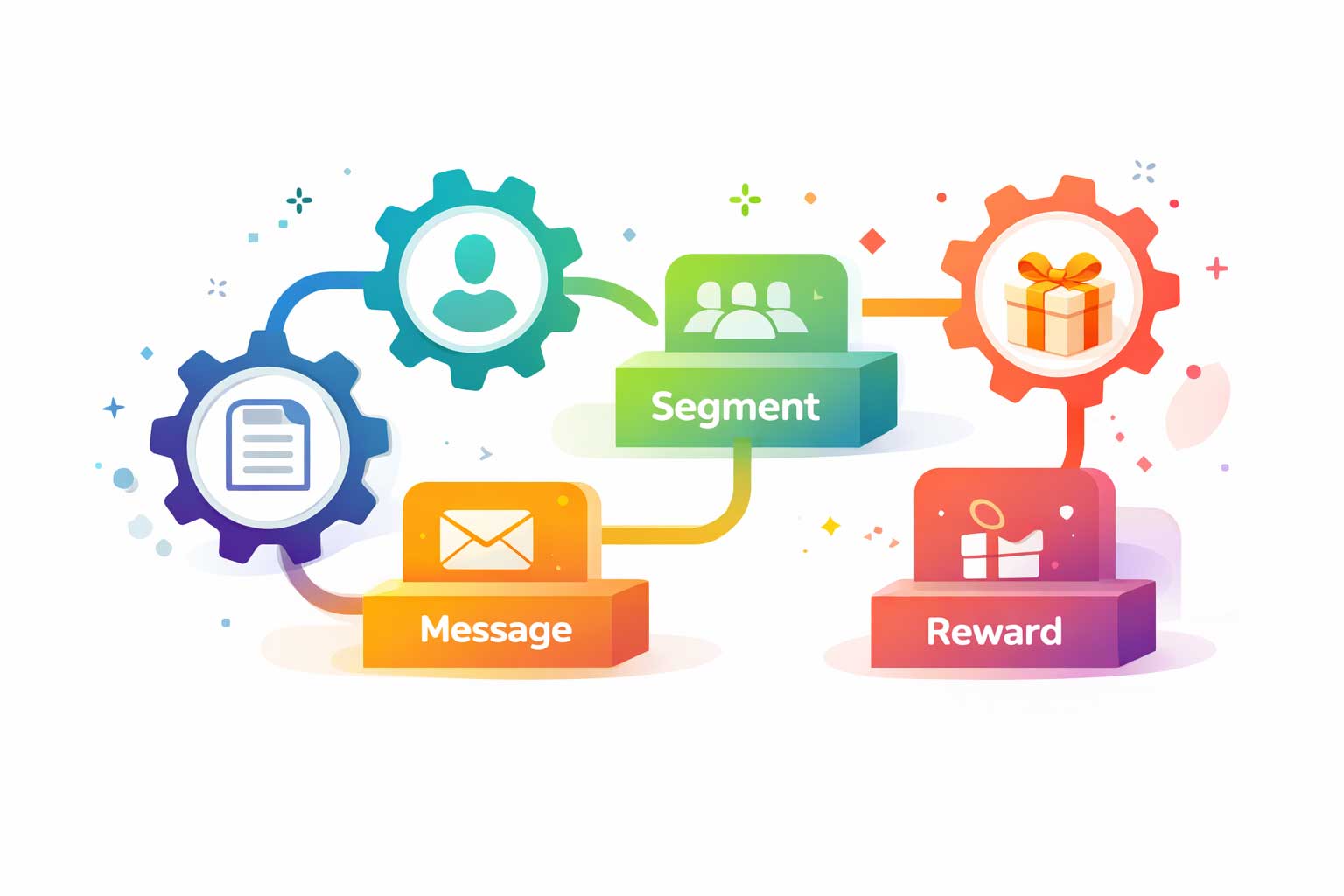
Spotlight turns customer rewards into an automated, measurable system. Based on purchase data, the system automatically identifies customer segments, assigns points or statuses, and sends personalized messages at the right moment—through the channel the customer actually uses.
Instead of occasional campaigns and manual work, you get a clear framework where points, loyalty tiers, and rewards operate continuously, with full control over both impact and cost.
How to reward loyal customers – practical, actionable advice
Here are 15 ways to reward customers, not as a simple list, but as a toolkit: what each reward gives you, who it’s for, and what to watch out for.
Quick rewards customers understand in 5 seconds
Bonus points on the next purchase: A strong incentive because it pushes repeat buying. Timing is crucial: bonus points should arrive shortly after a purchase, while the experience is still fresh. Don’t give them “to everyone, all the time.” Use them when you want to boost momentum—for example, after the second purchase or once a customer crosses a spending threshold.
Time-limited voucher (but realistic): Deadlines create decisions. But “24 hours only” often feels aggressive and unserious. A realistic deadline gives customers enough time to buy when they actually need to, while still accelerating conversion. The best deadline follows your buying cycle—if customers buy every 30–45 days, a 7-day expiry makes no sense.
Free shipping / faster shipping: This is often more powerful than a discount, because customers psychologically experience shipping fees as a “penalty.” If your logistics allow it, faster shipping as a benefit can feel like a VIP upgrade without cutting into product prices.
“2+1” on selected products (not everything)
Works well when you want to increase volume or clear specific inventory without devaluing your entire catalog. Best used with consumables or products customers are happy to stock up on.
Gift with purchase (low cost, high impact)
A small gift often leaves a stronger impression than a 5% discount because it’s tangible. The trick is relevance: samples of related products, useful mini add-ons—something the customer will actually use. Rules must be clear: “with purchases over X” or “after the third purchase.”
Rewards that build a VIP feeling
Early access to new products / “before everyone else” offers
Elegant and margin-friendly. You’re not changing price—just access order. If you launch new products, limited editions, or periodic promos, giving members 24–48 hours early access works extremely well.
VIP support / priority fulfillment: Especially powerful in B2B. If customers depend on fast delivery or quick responses, priority handling has real operational value—not just emotional appeal.
Priority booking for members (services, salons): Gold if you sell services. Members get earlier slots or prime-time appointments. This saves customers time and builds loyalty without discounting.
Exclusive events / mini workshops / tastings (industry-dependent): Doesn’t need to be glamorous. It can be an online demo, Q&A, or educational session. What matters is access—to knowledge, experience, or the people behind the brand. That builds relationships.
“Small luxury” with the order (packaging, note, sample): Packaging and small details seem trivial until you see how much they influence perceived value. A handwritten note, thoughtful wrapping, a small extra—these are rewards customers remember, without being “just another discount.”
Personalized rewards (highest ROI when you have data)
Birthday benefit (discount or gift): A classic—but only if done naturally. No over-the-top messaging. Keep the benefit simple and the tone human. Best practice: birthday + 7–14 days to redeem, so customers actually have time to use it.
Category-based reward (not a generic coupon): A generic “10% off everything” coupon is easy but weak. If you know what category a customer buys most often, tailor the reward to that habit. Customers feel understood—and you increase repeat purchase likelihood.
“We missed you” offers for inactive customersThis isn’t aggressive selling. It’s a relationship reset. The message should say: we noticed you’ve been gone, here’s a reason to come back. Benefits can be slightly stronger here than for core customers, because you’re rebuilding habit.
Habit-based bundles: If customers often buy Product A and Product B together, offer them as a meaningful bundle that saves time or adds a small benefit. This isn’t classic discounting—it’s decision simplification. These bundles increase basket value and make purchases feel smart and intentional.
Threshold-based coupons (“Spend X more to get…”): One of the most profitable tactics because the reward isn’t unconditional. You give it to lift basket value. The threshold must be realistic—just above the segment’s average order value, not double.
How to communicate rewards personally, using data
Effective rewarding doesn’t start with channels—it starts with data and customer analysis. When you know who the customer is, how often they buy, what they buy, and when they were last active, communication stops being mass messaging and becomes a personal trigger. Instead of one campaign for everyone, you create different messages for different behavior patterns.
For example, it makes little sense to send aggressive SMS coupons to customers who already buy regularly. For them, an email or in-app message reminding them about available points or an upcoming reward threshold works better. On the other hand, customers who’ve stopped buying often need a short, direct message (SMS or Viber) with one clear reason to return—no long explanations, no extra steps.
Personalization means context-driven messaging:
-
Email when you want to explain reward value, program status, or upcoming benefits (e.g. “one more purchase to reach the next tier”)
-
SMS or Viber when visibility and immediacy matter, with one clear action (“valid until Sunday”, “active today”)
-
Discount App or push notifications for loyal customers you don’t want to overwhelm, but want to keep informed in real time
The key difference from traditional campaigns is that rewards aren’t sent to everyone at the same time, but when the likelihood of response is highest.
That might be right after a purchase, shortly before the expected next buying cycle, or the moment data signals declining activity. In those moments, messages don’t feel like ads—they feel like a natural continuation of the relationship.
Just as important is frequency control. Active customers shouldn’t receive the same messages as inactive ones. Data lets you leave some customers alone while activating others precisely—saving budget and protecting trust.
In practice, this means rewards aren’t just benefits. They’re signals sent to the right customer, at the right time, through the right channel. When communication follows behavior, rewarding stops being a campaign and becomes a system that works continuously, quietly, and efficiently.
How to make rewards run “on autopilot” – and save time
If rewarding depends on someone remembering to do it on Monday, it won’t last. First comes enthusiasm, then “we forgot,” and finally “let’s just do another discount.”
Automation means: rules are defined upfront, messages go out automatically, and rewards are assigned without manual work. You focus on strategy—the system handles operations.
Three automations to set up first
1.Welcome reward on signup
Goal: make the customer see the value of membership immediately. It doesn’t have to be a big benefit. It can be small but clear: welcome points, free shipping on the first purchase, or “bonus points valid for the next 7 days.”
Important: a welcome reward must not be “just another coupon sitting in the inbox.” It needs a simple rule and a logical deadline.
2. Birthday message + benefit
Goal: give the customer a “personal” moment that brings them back to purchase. Birthdays are powerful triggers because they don’t feel like sales—they feel like attention.
Important: the birthday benefit shouldn’t be generic. If possible, tie it to the customer’s buying habits (for example, a benefit in the category they usually purchase).
3. Win-back automation (customer hasn’t purchased for X days → activation)
Goal: catch the customer before they leave for good. The value of “X days” depends on your purchase cycle. If customers usually buy every 30 days, a win-back at 45–60 days makes sense. If purchases are less frequent, shift the window accordingly.
Important: win-back messages should be short and relevant. Not “We miss you,” but “Here’s a reason to come back.”
Omnichannel logic
A customer is not an “email customer” or an “offline customer.” A customer is a customer. If points are valid in-store, they must also be valid online. If a voucher appears in the app, it must be recognized both at the POS and in the webshop.
Omnichannel logic means:
-
the same reward rules everywhere
-
one customer identity (one profile, not three databases)
-
communication through the channel the customer actually uses (email, SMS, app, Viber, POS)
This directly affects trust. The fastest way to kill a loyalty program is when a customer says: “The website says one thing, the store says another.”
This is exactly where most loyalty programs break down in practice. Rules exist, but they’re not applied consistently; automations are limited to one channel; and data ends up scattered across different systems.
Spotlight solves this gap by connecting all three automations into a single flow, with one customer profile and the same rules across all channels.
That means customers receive the same reward and message whether they shop online or in-store, whether they read it via email, Viber, or an app—and everything is triggered by real behavior, not manual campaigns. Omnichannel logic stops being theory and becomes everyday practice, visible both to customers and to the teams running the system.
How to measure whether rewarding customers actually pays off
If you don’t measure it, customer rewards turn into a marketing expense.
Here are metrics that make sense for both B2B and B2C, without overcomplicating the math.
Metrics worth tracking
CRR (Customer Retention Rate) and churn
CRR shows how many customers stay active over a given period. Churn is the opposite—how many drop off.
If rewards are working, churn goes down and CRR goes up.
Purchase frequency
Do customers buy more often after rewards are introduced? This is often the fastest signal that the system is working.
Average order value (AOV)
Good rewards increase basket value through thresholds and smart incentives. If average order value grows while margins remain healthy, that’s a strong positive sign.
Coupon / voucher redemption rate
If redemption is low, the reward is either unclear, too far away, or irrelevant.
If redemption is very high and eats into margin, the reward is probably too broad.
Customer satisfaction and ease of doing business
Customer satisfaction is especially important in B2B. Customers often don’t want a bigger discount—they want cooperation to be easier. Faster responses, simpler ordering, fewer steps to resolution, or easier access to support can have a stronger impact on loyalty than another 5% off.
When customers feel that things get resolved quickly and without friction, they’re more likely to stay loyal—even if you’re not the cheapest option. Reducing effort builds loyalty naturally, without further price cuts.
Practical rule: don’t look only at “how many coupons were redeemed,” but at what happened next.
Did the customer come back?
Did their basket grow?
Did they move to a higher tier?
Mini guide: a customer rewards program in 7 steps
If you want this to truly work, follow these steps in order.
-
Define the goal
What exactly do you want: more frequent purchases, higher basket value, more referrals, or reactivation of inactive customers?
One main goal per phase. Trying to do everything at once makes the program confusing. -
Choose the model
Points, tiers, or value-based. Choose based on purchase cycle and margin.
Frequent purchases → points.
Clear VIP customers → tiers.
Strong brand and community → value-based. -
Write the rules on one page
No fine print. The customer should understand in 30 seconds: how they earn, how they redeem, what applies, and what doesn’t. -
Set up three automations
Welcome, birthday, win-back. These are the three pillars that create continuity. -
Test on part of your database before full rollout
You don’t need to launch everything at once. Start with a smaller segment to see where the system leaks: do customers understand the rules, do they use the benefits, where do they get stuck? -
Measure and adjust
Redemption, retention, frequency, NPS.
If something doesn’t work, it doesn’t mean the model is wrong. The threshold may be too high, the deadline too short, or the reward wrong for that segment. -
Introduce tiers once you have rhythm and clean data
Tier systems make sense only after the basics work: rules are clear, data is reliable, automations function. Then tiers become an amplifier—not a complication.
FAQ: Most common questions about rewarding loyal customers
1) How can I reward loyal customers with a small budget?
Focus on benefits that don’t reduce price: free shipping, early access to offers, priority support, small gifts with purchase, or accumulating points. Budget isn’t the issue if you reward selectively, not massively.
2) Are discounts the best reward for loyal customers?
Discounts are the fastest—but often the most expensive—option. Used constantly, they train customers to wait for promotions. A better approach is a mix: occasional small discounts, with most value delivered through privileges and personalized benefits.
3) Which is better: points or VIP tiers?
Points are simple and ideal for frequent purchases. Tiers work better when you want VIP customers to gain status and others to aspire to it. In practice, the best results often come from a combination: points for everyone + tiers for top segments.
4) How often should rewards be given so customers don’t get “hooked” on them?
Rewards should be consistent, but not a daily habit. A permanent system (points or tiers) works best, with stronger benefits tied to behavior (third purchase, reactivation, threshold crossing), not to the calendar.
5) How should rewards differ in offline retail vs e-commerce?
Offline works well with points, tiers, and instant POS benefits.
E-commerce excels with thresholds, bundles, personalization, and automations (welcome, birthday, win-back).
Most important: the rules must be the same—customers shouldn’t experience two different systems.
6) Which rewards most influence repeat purchases?
Those that reduce effort and speed up decisions: bonus points for the next purchase, free/faster shipping, personalized category coupons, timely win-back offers, and basket thresholds.
7) How do I automate rewards and customer messages?
Start with three automations: welcome, birthday, win-back. Then add rules for points, thresholds, and tiers. The essence of automation is that rewards are triggered by rules and behavior—not sent manually “when someone remembers.”
8) Do birthday rewards really work?
Yes—when they’re simple and human. Birthdays create a feeling of attention, and the benefit gives a reason to return. They work best when relevant (for example, tied to a category the customer already buys) and when the deadline is realistic.
9) What is a “gift program” and how does it fit into loyalty?
A gift program rewards customers with gift-based value (gift cards, vouchers, tangible benefits). In loyalty systems, it’s used as a reward for behavior (tier upgrade, referral, reactivation), offering something concrete without constant price cuts.
Rewarding loyal customers isn’t about “what else can we give,” but about doing it smartly and consistently.
When rewards have clear rules, are data-driven, and arrive at the right moment, they stop being a marketing expense and become part of a stable sales system.
That’s where the difference lies between occasional promotions and a serious loyalty program. Instead of manual messaging, messy spreadsheets, and rewards based on mood, you need a system that connects customers, channels, and rewards into one whole—and shows you whether it actually pays off.
If you want to build a loyalty program that works long term, without constant discounting, Spotlight lets you bring all these steps together in one place: from customer segmentation and personalized communication to automated rewards and clear performance metrics.
All you need to do is reach out—and we’ll show you how.