Customer reactivation often drives more growth than new campaigns. Learn how to win back valuable clients without wasting budget.
If you’re chasing growth only through new customers, you’re skipping the easiest revenue source you already have.
Customer reactivation reveals where your base is leaking, who is slowing down, and which segments deserve attention before launching new campaigns. This is about data, timing, and messages that hit the right moment — not mass discounts.
Next, we’ll dive into the metrics that change decisions, win-back models that restore profitability, and systems that turn reactivation into a permanent growth channel.
What Is Customer Reactivation?
Customer reactivation refers to a set of post-purchase activities designed to bring back clients who have entered a period of inactivity — they haven’t bought in a while, stopped responding to offers, or dropped out of their usual routine.
The goal isn’t a one-off purchase, but a return to a stable relationship that already existed.
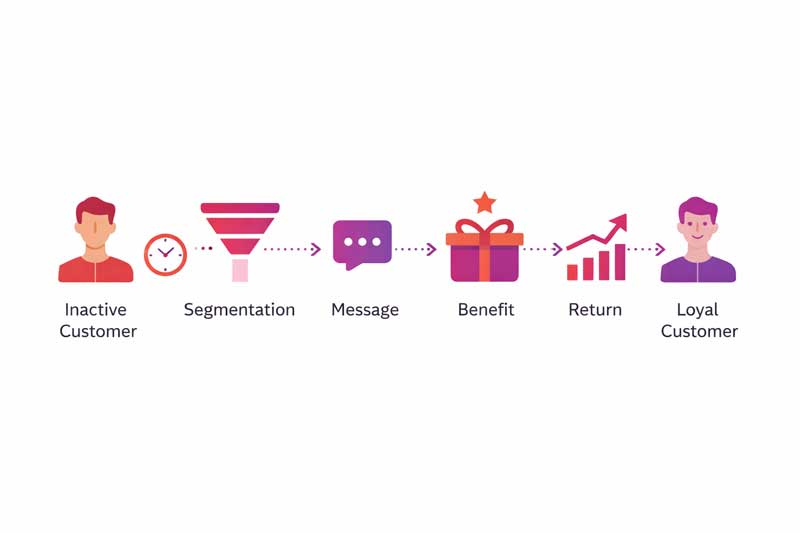
Unlike customer acquisition—where trust is still being built—reactivation relies on existing history: the customer already knows your brand, has interacted with it before, and has left clear behavioral signals.
That’s why win-back campaigns often deliver faster results and a lower cost per conversion.
In practice, three main groups are typically defined:
-
Dormant customers – no purchases for a certain period, but still a realistic chance of returning
-
Churned customers – the relationship has been broken or frozen for a long time, requiring a stronger reason to come back
-
Active customers – purchasing at an expected pace and not included in reactivation flows
Understanding these differences is the foundation of any serious reactivation strategy, because different customer types require different messages, timing, and offers.
When Is a Customer “Inactive”? Set a Rule—Not a Gut Feeling
One of the biggest mistakes in customer reactivation is relying on intuition.
Inactivity isn’t defined by feelings but by data—and it always depends on the business model, purchase frequency, and the behavior of specific segments.
In practice, inactivity thresholds vary by category:
-
Fast-moving consumer goods (FMCG) – 7 to 30 days without a purchase
-
Fashion and lifestyle – 60 to 180 days
-
Services and subscriptions – 30 to 120 days
-
B2B sales – 90 to 365 days, depending on the buying cycle
To define a realistic threshold for your own business, analyze the average and median time between two purchases by segment. If your best customers typically buy every 40 days, a “dormant” signal might appear around day 60. If the usual gap is six months, inactivity starts much later.
Another key point: the same customer can be inactive in one product category while remaining fully active in another. If you run multiple product lines or services, reactivation must be driven by behavior within each category—not at the database level as a whole.
By setting clear inactivity rules, you create the foundation for precise segmentation, timely win-back campaigns, and performance measurement that actually makes sense.
Why Do Customers Stop Buying?
Customers rarely disappear for just one reason. In most cases, it’s a mix of changing habits, offers that no longer hit the right moment, and communication that no longer fits their rhythm. The key to reactivation is understanding why a customer slowed down—and that insight comes from data, not guesswork.
Product and Experience-Related Reasons
A customer may drop out of the cycle because the offer no longer fits their needs, habits have changed, or a past customer experience left a weak impression. Sometimes the issue is slow assortment development, a lack of new items in the categories they usually buy, or a checkout process that’s no longer as smooth as it once was.
Communication-Related Reasons
Too many messages, generic content, or the same offer sent to everyone quickly exhaust a database. The problem gets worse when the message arrives through the wrong channel or at a time when the customer isn’t ready to buy. Reactivation requires a shift in rhythm: fewer mass campaigns, more precise, behavior-based communication.
Price and Competition-Related Reasons
Customers often leave because another brand offers a better deal—but that doesn’t mean they’re gone forever. In many cases, it’s habit or a temporary benefit rather than deep loyalty to a competitor. That leaves room for a return—if the offer appears in the right context with clear value.
“Silent” Reasons
Some customers don’t leave actively. They simply stop thinking about your brand because nothing triggers them to come back. Without reminders, relevant recommendations, or the right signal at the right time, the relationship slowly fades.
That’s why reactivation is most effective when you have insight into last purchase date, preferred categories, purchase frequency, and total relationship value. This type of customer analysis forms the backbone of RFM and CLV approaches—without which win-back campaigns remain assumptions instead of precise decisions.
The RFM Model Looks at Three Things
-
Recency – how long it’s been since the last purchase
-
Frequency – how often the customer buys
-
Monetary Value – how much they spend in total
By combining these three factors, you gain a clear picture of who your most valuable customers are, who is starting to slow down, who buys occasionally, and who is nearing churn. For reactivation, the most interesting segments are high-value customers with declining recency—because that’s where winning them back has the biggest financial impact.
Customer Lifetime Value (CLV) goes one step further. It estimates the total revenue a customer can generate over the entire relationship with your brand. CLV helps you decide where to invest your reactivation budget—who deserves extra incentives, deeper personalization, or longer win-back journeys.
Together, RFM shows who is cooling off, while CLV tells you who is worth prioritizing. Combined, they form the foundation of smart, profit-focused customer reactivation—not just chasing the number of returned users.
If you want RFM and CLV to stop being “analysis sitting in a spreadsheet,” Spotlight is a practical choice because it turns them into an operational system: you segment customers by behavior and value, then launch multi-channel win-back flows (email, SMS, Viber, push) from a single place, with automations triggered by clear signals (e.g., 30/60/90 days without a purchase, post-purchase, birthdays, reminders). In practice, that means fewer generic campaigns and more precise messages that bring dormant customers back into rhythm—while letting you track long-term loyalty and lifetime value, not just clicks
What Is Customer Reactivation Rate and Why Is It Important?
Customer reactivation rate represents the percentage of inactive clients who re-enter the purchasing cycle within a defined period after win-back activities are executed.
This metric shows how much reactivation campaigns actually changed customer behavior—not how many messages were sent.
For marketing and growth teams, the reactivation rate is a quality signal: it reveals whether segmentation, messaging, and timing are on point. When the rate is low, the most common causes are poor targeting or an unclear value proposition.
How Is Reactivation Rate Calculated?
Depending on how strictly you want to measure customer return, two formulas are commonly used.
Formula 1 (most common):
Reactivation rate = (Number of reactivated customers in a period / Number of targeted inactive customers) × 100
Formula 2 (stricter):
Reactivation rate = (Reactivated customers / Total inactive customers at the beginning of the period) × 100
Mini example:
If you targeted 2,000 inactive customers in a campaign and 180 of them made a purchase within the next 30 days, the reactivation rate is:
180 / 2,000 = 9%
Which Metrics Should Be Tracked Alongside Reactivation Rate?
To understand the true business impact of win-back campaigns, reactivation rate should always be analyzed together with additional indicators—and always by segment.
-
Incremental revenue – revenue generated specifically because of the campaign, not sales that would have happened anyway
-
Average order value after return (AOV) – how much reactivated customers spend on average
-
Repeat purchase rate – whether returned customers continue buying or remain one-time buyers
-
CLV lift by segment – how much long-term value increased after reactivation
-
Cost per reactivated customer – how much it costs to bring one inactive customer back into the buying cycle
Viewed together, these metrics reveal whether reactivation is driving sustainable growth or just short-term sales spikes.
The 80/20 Rule in CLV and Reactivation: Where Does Your Profit Really Come From?
In most businesses, a small percentage of customers generates the majority of profit.
This is the essence of the 80/20 rule in CLV: roughly 20% of the base often accounts for around 80% of total value.
That’s why customer reactivation should not be a mass operation—it’s a strategic focus on the segments where returning customers delivers the biggest financial impact.
The goal is not to bring back every inactive customer equally. Much faster results come from targeting high-CLV clients who have only just started to slow down—those who were buying regularly until recently but have slipped outside their normal rhythm. This “almost churned” segment usually has the highest probability of return and the strongest campaign ROI.
By focusing on these groups, reactivation stops being about “saving the database” and becomes a precise profit-growth tool.
How to Identify That Top 20%
To apply the 80/20 logic in practice, you need to clearly identify customers who generate the most value—and those beginning to drift.
Common criteria include:
-
Total customer value, frequency, and recency – how much they’ve spent, how often they buy, and how long it’s been since the last transaction
-
Higher-margin categories – whether they return for products or services that generate more profit
-
Purchase patterns – for example, they used to buy every 30–45 days and now it’s been 70+
-
Signals of slowdown – fewer visits, ignored campaigns, lower engagement
When these indicators are combined with RFM and CLV analysis, you get a clear priority list: which segments to activate immediately and which to leave for later reactivation phases.
How to Reactivate a Customer: A 6-Step Win-Back Strategy
Customer reactivation works best when run as a process rather than a one-off campaign. The strongest strategies combine segmentation, the right triggers, message sequences, and continuous performance measurement. Below is the framework growth teams use to turn win-back into a steady revenue channel.
Step 1 – Segmentation (Don’t Send the Same Thing to Everyone)
Every database contains different types of inactive customers, and blasting one message to all almost always reduces results. Minimum segments include:
-
Top customers who slowed down – high value, declining recency
-
Occasional buyers – low frequency, sensitive to timing
-
One-time buyers who disappeared – early-stage relationship, need a value reminder
-
Discount seekers – activated by well-timed incentives
-
Category-focused buyers – purchase almost exclusively from one product group
Step 2 – Choose the Trigger (What Brings Them Back)
Reactivation starts with a reason that makes sense for each segment—not a generic offer. Common triggers include:
-
routine or replenishment reminders
-
a new launch in a favorite category
-
a clear benefit (not necessarily a discount)
-
social proof—what similar customers are choosing
-
service signals: faster shipping, gifts, loyalty points, priority access
Step 3 – Build a Win-Back Sequence (3–4 Messages)
Instead of a single message, use a short sequence that unfolds over time:
-
Message 1: reminder + return reason (no discount)
-
Message 2: personalized recommendation based on last purchase
-
Message 3: limited incentive—points, gift, free shipping, or smart discount
-
Message 4: “last call” + quick question about why they didn’t respond
Step 4 – Personalize the Content
Personalisation is where average reactivation turns into outstanding performance. Messages should be based on:
-
last purchase—what, when, and how much
-
tailored recommendations—complements or routine restarts
-
tone of voice—premium segments require a different approach than promo-driven buyers
Step 5 – Choose the Channel
Match the channel to message complexity and customer habits:
-
Email for education, storytelling, and catalogs
-
SMS/Viber for fast, direct triggers
-
Push notifications if you have an app
-
Retargeting as support—not the main mechanism
Step 6 – Measure Incrementally
Without proper measurement, reactivation stays at gut-feeling level. Serious programs always include:
-
control groups (holdouts)
-
before-and-after comparisons
-
focus on profit and lifetime value—not just transactions
When run manually, win-back processes quickly become unsustainable. That’s exactly where Spotlight serves as the operational backbone for customer reactivation: the platform unifies purchase data, behavioral signals, and communication channels into a single system, automatically builds RFM- and CLV-based segments, and launches reactivation flows through clear triggers. Teams move from occasional campaigns to continuous re-engagement programs—supported by analytics that reveal which segments drive profit, how lifetime value evolves over time, and where messages and incentives should be further optimized.
Campaign Templates That Most Often Work
The most successful win-back campaigns don’t start with percentages—they start with understanding customer habits.
When a message hits the real reason for returning, discounts often become secondary.
Below are patterns that consistently prove to be reliable drivers of reactivation in practice.
“Habit Reminder” (for consumable products)
This template works when there is a clear purchase routine.
The logic is simple: “it’s time” + a smart recommendation + an easy path back to checkout.
The message reminds the customer that they’ve likely used up the product, suggests a familiar option or alternative, and leads them directly to the purchase step—without friction or lengthy explanations.
“New Collection in Your Category”
Customers often come back because of novelty, not percentage-off deals.
If you know which category a customer follows, a new product line or upgraded version of an existing offer can be a powerful trigger. The message focuses on their proven interest—not on a broad promotion.
“Benefits Instead of Discounts”
Discounts aren’t the only way to spark a return.
In many cases, these work even better:
-
double loyalty points
-
a free gift with purchase
-
free shipping
-
priority delivery
These benefits protect margins, strengthen relationships, and give customers a concrete reason to come back.
“Loyalty-Based Reactivation”
Loyalty programs are long-term return mechanisms.
When communication is tied to status, tiers, or personalized rewards, customers feel it pays to stay “inside.” Reactivation then becomes more than a single purchase—it becomes re-entry into a lasting value system.
“Feedback Win-Back”
Some customers respond best to a different approach.
A short question like “What stopped you?” opens dialogue while offering a solution: improved service, a different offer, or a return incentive. This template often delivers valuable insights that later improve the entire reactivation strategy.
Most Common Reactivation Mistakes (and How to Avoid Them)
Reactivation rarely fails because of missing tools—it fails because of flawed assumptions. That’s why this section is critical: it shows what most often blocks results in practice and how to systematically remove those obstacles.
Sending the Same Message to Everyone
Mass communication dilutes impact. High-value customers, occasional buyers, and one-time purchasers don’t respond to the same triggers.
Fix: clear segmentation and behavior-based messaging—not database averages.
Jumping to Discounts Too Quickly
Discounts can drive returns but eventually erode margins and condition customers to wait for promos.
Before reaching for percentages, test benefits, category novelties, or loyalty points—they often generate better profit at the same activation rate.
Overlong Sequences Without a Clear Goal
Win-back flows without defined outcomes lose focus. Every message must have a role: reminder, recommendation, incentive, or feedback request.
If customers don’t respond after several attempts, pause.
Tracking Opens Instead of Business Impact
Open rates and clicks look good in reports, but they don’t show whether reactivation paid off.
Focus instead on incremental revenue, repeat purchases, and CLV growth—only then do you see real ROI.
Burning Your Database Without Breaks
Too many win-back messages exhaust customers and increase unsubscribes.
Spacing out sequences preserves relationships and restores campaign effectiveness.
Not Differentiating Top Customers from One-Time Buyers
Your most valuable clients need a different approach than bargain-driven one-time shoppers. Treating them the same wastes budget where long-term return is unlikely.
When these mistakes are removed systematically, reactivation stops being random and starts functioning as a predictable growth engine.
Customer Reactivation in Practice: What It Looks Like With the Right System
Reactivation becomes more than an occasional campaign only when it’s run as a continuous process. That means four things: precise segmentation, automated flows, message personalization, and performance measurement by segment—cycle after cycle.
In smaller databases, parts of this can still be handled manually. As customer volume grows, that approach quickly becomes a bottleneck: lists update slowly, messages lag, and performance is measured in averages instead of where real profit is created.
That’s why serious teams use customer analytics and loyalty platforms that unify purchase and communication data.
Solutions like Spotlight allow segments to be built automatically, win-back flows triggered by clear signals (e.g., days since last purchase, behavioral changes, loyalty tier status), offers adapted to real habits, and results tracked at the segment level.
When reactivation is run through such systems, teams stop thinking in campaigns and start building a stable growth channel that is continuously optimized with data.
How Quickly Can You Expect Results?
The speed of reactivation depends on how far customers have drifted from regular buying patterns and how long communication gaps have lasted. In practice, results usually appear in waves—from quick returns to longer-term win-back journeys.

Fast Results (7–30 Days)
Dormant customers who have only just crossed the inactivity threshold tend to respond the quickest. Your brand is still fresh in their minds, they purchased relatively recently, and often all it takes is the right reminder, a new item in their preferred category, or a well-timed benefit to trigger a return.
Mid-Term Results (30–90 Days)
In this window, one-time buyers and occasional customers most often come back. These segments usually need more education, value reminders, and personalized recommendations to re-ignite the relationship and move toward a steadier purchasing rhythm.
Long-Term Results (90+ Days)
The longest path applies to churned customers—those whose relationship with your brand has been inactive for a long time and who require a stronger reason to return. That may include an improved offer, a new service model, special benefits, or a different communication approach.
Understanding these time frames helps you plan campaigns realistically, with clear expectations by segment and phase of reactivation.
FAQ: Most Common Questions About Customer Reactivation
1) How often should reactivation campaigns run?
In most businesses, win-back flows perform best when they are always-on through automation—paired with clearly defined pauses between sequences. Instead of large, occasional campaigns, a responsive system that activates as soon as a customer enters a risk zone is far more effective.
2) Can poor reactivation damage a brand?
Yes. Over-messaging, generic communication, and aggressive discounting can create pressure and erode perceived value. That’s why segmentation and frequency control are core parts of any strategy.
3) Is it better to reactivate customers or invest in acquisition?
It’s not an either–or choice. The strongest results come from developing both in parallel, but reactivation often delivers faster ROI because it builds on existing trust.
4) How can you tell whether a customer returned because of the campaign—or would have anyway?
The most reliable method is using control groups (holdouts): part of the base receives no message, and their behavior is compared to those who did. That’s how you measure true incremental impact.
5) Which industries benefit most from customer reactivation?
E-commerce, retail, SaaS, telecom, financial services, and subscription models see the biggest gains—anywhere repeat purchasing and behavioral data exist.
6) When should you stop trying to reactivate a customer?
If someone doesn’t respond after multiple sequences over a longer period, it makes sense to shift them into a low-touch mode or archive them for future testing. This protects both budget and brand reputation.
7) Does reactivation work without a loyalty program?
It can—but loyalty programs significantly accelerate returns by adding extra buying incentives: points, status tiers, personalized perks, and long-term rewards.
Customer Reactivation Is Growth You Already Have
The difference between average and top-tier performance lies in systems. When data is connected, communication is automated, and results are measured by segment, reactivation stops being an occasional experiment and becomes a reliable growth channel.
If you want this approach working in practice, reach out and we’ll show you how Spotlight solves this challenge in real-world conditions.