
A marketing strategy that starts with channels instead of customers wastes budget without delivering results. Here is where you should actually start.
A marketing strategy is not a list of channels where you plan to advertise. It is a document that defines your goals, target audience, and decision-making criteria. One of the biggest mistakes companies make is choosing Instagram, Google Ads, or SMS first, and only then thinking about who their customers are and what they actually know about them.
A good strategy starts the other way around — with customers and data, and only then moves toward channels.
Companies spend months choosing channels and weeks thinking about customers. The result is predictable: the marketing budget goes into advertising, sales increase briefly, and then return to previous levels as soon as the campaign ends. A marketing strategy should prevent exactly that — but only if it is truly a strategy, rather than a list of tactics with the word “strategy” written at the top.
A marketing strategy is a document that defines why you are carrying out certain marketing activities, who they are for, and how you measure whether they work.
In this article, we will go through everything a marketing strategy should include, the different types of strategies and when each one is used, and — most importantly — where most companies go wrong from the very first step.
What Is a Marketing Strategy — and What Isn’t?
A marketing strategy is a high-level document that defines business goals, target audience, brand positioning, and the criteria used to make long-term marketing decisions.
It does not say, “We post on Instagram every Tuesday” — that is a tactic. It says, “Our goal is to increase repeat purchases by 20% through personalized communication with existing customers” — that is the strategic direction from which tactics are developed.
Let’s be clear: much of what is called a “marketing strategy” is actually a marketing plan, and quite often it is simply a list of channels. The difference is not merely academic.
A plan without a strategy changes every time someone suggests a new trend in a meeting. A strategy does not change every month — the tactics within it do.
Put simply, there are three levels:
- Strategy — why we are doing marketing, who we are doing it for, and what the ultimate goal is
- Plan — what exactly we will do over the next 6–12 months, including the budget
- Tactic — an individual activity: a campaign, social media post, or email
If you skip the first level and go straight to tactics, you end up with chaos that looks busy but does not lead anywhere specific.
The Most Common Mistake: A Strategy That Starts With Channels, Not Customers
Most advice about marketing strategy starts with the same question: which channel should we choose — Google Ads, Instagram, SEO, email?
That is the wrong question to ask first.
The right question is: which customers do we already have, what do we know about them, and what would make them come back?
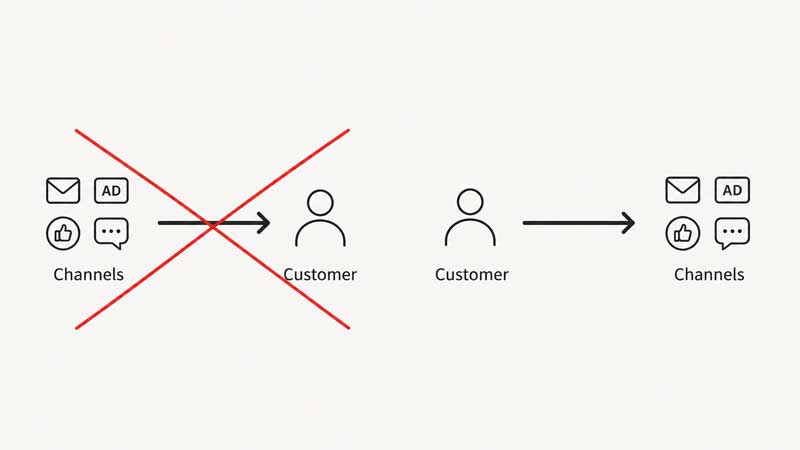
And this is where the problem begins. A company invests in acquisition, new customers, new visits, and new followers, while existing customers — people who have already bought and shown trust — quietly disappear without receiving a single message aimed at them. Purchase data exists in the cash register system or webshop administration, but nobody uses it to make decisions. It simply gathers dust.
This is not “just another tactic to add” — retention and customer understanding are the foundation on which the entire strategy is built, because they determine both who you are talking to and what you are saying through whichever channel you ultimately choose.
The channel is the delivery mechanism. The customer and customer data are what should drive the decision.
A company that first identifies its most valuable customers and understands why they return, and only then chooses the channels through which to communicate with them, builds a strategy that lasts.
A company that chooses channels first and then hopes to somehow reach the right people builds campaigns that disappear the moment the budget stops.
Elements Every Marketing Strategy Should Include
A marketing strategy that works contains six elements: a clear goal, a defined target audience, positioning, tone of communication, a channel plan, and a way to measure success. Without any one of these, you end up with a list of activities without direction.
Goal — it must be measurable and tied to a business outcome, not simply to “greater visibility.” “Increase repeat purchases by 15% by the end of the year” is a goal. “Be more present on social media” is not.
Target audience — who your customers actually are. Not a textbook demographic profile, but real segmentation based on consumer behavior: who buys frequently, who purchased once and disappeared, and who waits for a discount before taking action.
Positioning — why someone should choose you instead of a competitor. This must be specific, not “quality and trust” — every website says that.
Tone and messaging — how you communicate, including the language and style you use, so that your message remains recognizable regardless of the channel.
Channels — only in fifth place. Your choice of channels depends on where your customers are, not on what happens to be popular at the moment.
Measurement — which metrics actually show whether the strategy is working, rather than simply making something “look active.”
Listing these six elements alone solves nothing. What turns them into a strategy is the order in which they are addressed. When you start with the goal and the audience, everything else naturally follows. When you start with channels, everything else has to be guessed in reverse.
Types of Marketing Strategies and When to Use Them
There are four basic directions a marketing strategy can take, depending on whether you are changing the product, the market, or both. The direction you choose determines the level of risk and the type of resources you will need.
- Market penetration — the same product, the same market, with the goal of selling more to existing and similar customers. This carries the lowest risk. Most B2B and retail companies fall into this category — you do not necessarily need a new product; you need to make better use of your existing customer base.
- Product development — a new product or service for the same market. A restaurant introducing delivery, for example, or a pharmacy adding advisory services.
- Market development — an existing product introduced to a new market or a new customer segment. This involves greater risk because you are entering unfamiliar territory.
- Diversification — a new product for a new market. This carries the greatest risk and the greatest potential, and it rarely makes sense until the first three options have been exhausted.
For a small or medium-sized company, it is realistic for around 80% of the strategy to focus on market penetration — making better use of the existing customer base — while the rest focuses on careful expansion. This is also why a loyalty program is not an “add-on” to the strategy, but one of the most direct ways to execute a market penetration strategy: existing customers buy more instead of forcing the company to search for new customers at any cost.
How to Build a Strategy in Practice — Step by Step
Building a marketing strategy involves five steps: defining the goal, analyzing existing customers, segmentation, selecting channels and messages, and setting up a measurement system. The order matters — every step depends on the one before it.
- Define the goal — make it specific, measurable, and connected to a business outcome.
- Analyze the customers you already have — who buys, how often they buy, how much they spend, and when they last made a purchase. This is the step most companies skip because the data is scattered across the cash register system, Excel spreadsheets, and webshop administration, and nobody sits down to bring it all together.
- Segment your customers — divide them according to behavior, not assumptions. Valuable customers, customers at risk of leaving, and new customers you need to retain.
- Choose your channels and messages — only now, once you know who you are talking to.
- Set up measurement — track repeat purchases, not just clicks.
In practice, steps two and three are where most companies get stuck. Manually combining data from the cash register, webshop, and Excel spreadsheets does not scale — it may work for fifty customers, but not for five thousand.
This is where a system such as Spotlight comes in — a marketing platform that automatically combines purchase and behavioral data into a single customer profile and performs segmentation using the RFM model, instead of requiring someone to manually filter spreadsheets every time a new campaign is created.
The point is not to introduce yet another tool. The point is to stop steps two and three from becoming the bottleneck of the entire strategy.
Marketing Strategy on a Limited Budget
A small company with a limited budget does not win by copying the budget of a larger competitor. It wins by building its strategy around existing customers, who are less expensive to retain than new customers are to acquire.
If your budget is limited, your first investment should not be another acquisition channel. It should be a system that tells you who your most valuable customers are and prevents them from quietly leaving.
A coupon sent specifically to a customer who stopped buying a month ago costs less and can generate more value than an ad shown to a random audience seeing your brand for the first time.
A realistic expectation: retention does not solve acquisition. If you do not have any customers at all, you first need traffic, not a loyalty program. But once you have a customer base of several hundred people, retention becomes one of the most cost-effective uses of your marketing budget — and it does not require a large team, only a consistent system.
How Do You Measure Whether the Strategy Is Working?
A marketing strategy should not be measured by likes or impressions, but by whether customers return and how much they spend over time.
Metrics such as follower count or post reach may look good in a report, but they say very little about profitability.
The metrics that matter for a strategy that actually works include:
- Repeat purchase rate — the percentage of customers who return within a given period
- Average Order Value (AOV) — whether customers are spending more per purchase
- CLV — Customer Lifetime Value — how much value one customer generates throughout their entire relationship with your company, rather than only through their first purchase
- Churn rate — how quickly customers stop buying
A spreadsheet showing your number of followers does not generate revenue. A repeat purchase does.
If your marketing strategy report does not include at least one of the four metrics above, you are probably measuring activity rather than results.
Frequently Asked Questions About Marketing Strategy
How Long Should a Marketing Strategy Last?
A strategy is usually created for a period of one to three years, while the plan and individual tactics are adjusted quarterly or monthly. If you change your strategy every month, it is not really a strategy — it is simply a reaction to whatever is happening at the moment.
Do I Need an Agency, or Can I Create a Marketing Strategy Myself?
For a smaller company that knows its customers well, a basic strategy can be created internally. Most of the work lies in analyzing existing data rather than applying textbook marketing knowledge.
An agency makes sense when you need to position the company in a broader market or when there is no one internally who can manage the system consistently.
Is a B2B Marketing Strategy Different From a B2C Strategy?
Yes, primarily because of the length of the decision-making cycle and the number of people involved in the decision.
A B2C strategy often relies more heavily on emotion and faster decision-making, while B2B marketing requires more trust and evidence over time. However, the principle that strategy should begin with understanding the customer applies equally to both.
What If the Strategy Is Not Producing Results After a Few Months?
First, check whether you are measuring the right things — repeat purchases and CLV rather than reach.
If the metrics are correct but the results are still missing, the problem is often in the segmentation stage: you are sending the same message to everyone instead of targeting the right group of customers at the right moment.
Does a Physical Store Need a Different Strategy From an Online Store?
The basic principles are the same — goals, customer understanding, segmentation, and then channels.
The difference lies in the tools used to collect customer data. An online store collects much of this information automatically through accounts and cookies, while a physical store needs a mechanism such as a loyalty card to connect a purchase with a specific customer.
The Spotlight platform brings customer data together, performs segmentation automatically, and runs automated campaigns through email, SMS, and Viber, targeting the right customers at the right time — whether you sell online, in a physical store using loyalty cards, or through both channels.
Stop building your strategy backwards from channels.
Start with the customers you already have.
Collect the right data about them.