The sales funnel leaks where no one is looking — after the purchase. Learn how to measure the loss and close the gap.
The Sales Funnel in Brief
The sales funnel has four classic stages: awareness, interest, decision, and action.
Most companies measure the funnel only up to the point of purchase — and that is exactly where they lose the most money without even realizing it.
The real loss is not at the top of the funnel, with too many or too few visitors, but at the bottom — among customers who buy once and never return.
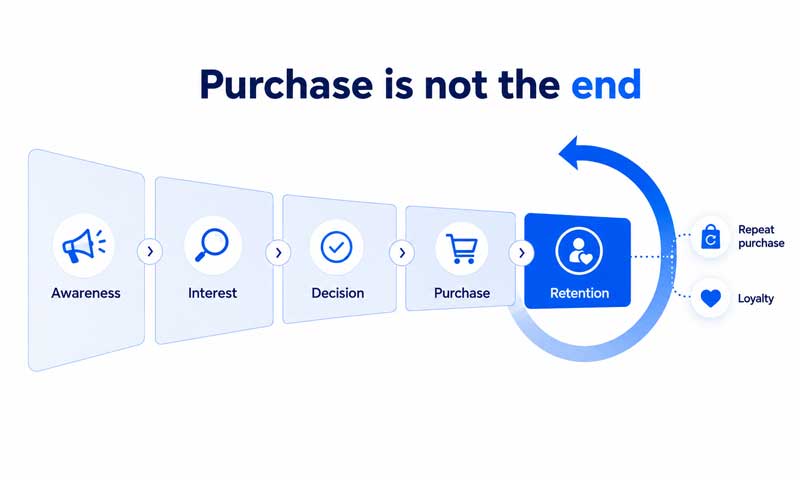
The fifth stage, which few companies measure, is retention — and it is more cost-effective and profitable than acquiring any new lead.
Companies that treat the funnel as a circle rather than a straight line build a system that keeps working even when the marketing budget stops.
Every business already has a sales funnel, even if no one in the company has ever heard the term. Someone visits the website or walks into a store, looks around, makes a decision and buys. That is the funnel — only untracked, unmeasured and left to chance.
The problem is not that companies do not know what a sales funnel is. The problem is that they see it as a straight line ending with “thank you for your purchase.” When you measure only up to that point, you see just half the picture — the less expensive half.
This article walks through the stages of the sales funnel, shows exactly where the biggest leaks occur and explains why sales optimization remains incomplete without a fifth step.
Let’s be honest — most companies know how many people enter their store or visit their website. Very few know how many of those people come back.
What Is a Sales Funnel and Why Does Every Business Already Have One?
A sales funnel is the journey a potential customer takes from their first contact with your brand to the moment of purchase — and, if you are doing things properly, to their next purchase.
It is called a funnel because many people enter at the top, while a much smaller number reach the bottom and actually buy.
The point is not to invent a funnel. It is to stop leaving it to guesswork. If you do not track where people enter, where they drop out and why, you are running your business on instinct — and instinct does not scale to thousands of customers.
This applies equally to a small shop and a large retail chain, an online store and a physical location.
A funnel exists as soon as there is any kind of sales process, even when that process consists of nothing more than a conversation at the checkout.
What Are the Stages of a Sales Funnel?
A classic sales funnel has four stages: awareness, interest, decision and action.
Awareness is when customers discover that your business exists. Interest is when they search for information and compare options. Decision is when they choose between you and your competitors. Action is when they make a purchase.
Every stage loses some people. That is normal. The real question is how many people you lose and why.
Awareness is the widest part of the funnel. It includes SEO, social media, paid advertising, word-of-mouth recommendations and everything else that brings new people into contact with your brand.
Interest is the research stage. Customers read reviews, compare prices and follow you on Instagram, but they are not yet ready to pay. At this stage, content and trust often do more work than discounts.
Decision is the moment when the customer chooses between you and a competitor. This is where specific arguments matter: price, availability, other customers’ experiences and whether you offer a clear reason to choose your business.
Action is the purchase.
And this is where most companies stop — as though the job were finished the moment the money changed hands.
The Misconception: A Sales Funnel That Ends with “Buy Now”
Almost every article about sales funnels presents the same image: four stages, a downward arrow and a purchase at the bottom as the final destination.
That is not wrong. It is simply incomplete.
In reality, the purchase is not the end of the funnel. It is the middle of a customer relationship that has only just begun.
A company that measures funnel success exclusively through the number of transactions looks in only one direction: how many new people are entering.
It never asks how many of them return — or why.
And that is where the problem begins.
Imagine that you attract 1,000 new visitors every month and 100 of them make a purchase. That is a solid, even above-average, conversion rate.
But the question few businesses ask is this: how many of those 100 customers return the following month?
If the answer is 15, you are effectively running on a treadmill that keeps getting faster. Every month, you start again from zero and pay the same acquisition costs, instead of building a customer base that generates revenue without requiring another round of advertising spend.
High sales volume is not the same as customer loyalty.
This is one of the most expensive misconceptions because the damage is not immediately visible — at least not until someone compares the cost of acquiring a new customer with the amount that customer actually spends over time.
How Can You Measure Where the Sales Funnel Is Leaking?
A sales funnel leaks at measurable points: the conversion rate between stages, customer acquisition cost, average order value and, most commonly overlooked, the repeat purchase rate.
Without these numbers, sales optimization is simply guesswork with a better name.
More specifically, track:
-
Awareness-to-interest conversion — how many visitors stay for more than a few seconds.
-
Interest-to-decision conversion — how many add a product to their cart or request a quote.
-
Decision-to-action conversion — how many complete the purchase and exactly where others abandon the process, whether because of shipping costs, a complicated checkout or a lack of trust.
-
Repeat purchase rate — how many existing customers return within the next 30, 60 or 90 days.
When these metrics are tracked manually across several disconnected tools and an Excel spreadsheet that someone updates once a week, the business is already one step behind.
A spreadsheet captures a single moment. By tomorrow, it is already outdated, while the funnel continues to change every day.
This is where most companies hit a wall: they have data, but it is scattered across the point-of-sale system, website, social media channels and sales staff who recognize customers by face.
Spotlight solves this exact problem.
Its customer data platform connects all of these touchpoints in one place, allowing you to see the entire funnel — from the first click to the tenth purchase — without manually combining data from five different sources.
The Fifth Stage No One Measures: Retention, RFM and Repeat Purchases
Growing companies do not add another marketing tactic to the funnel — they add a fifth stage that their competitors ignore: retention.
This is the period after the first purchase, when you determine whether a customer becomes a consistent source of revenue or remains a one-time buyer.
This is not just theory. Acquiring a new customer can cost five to 25 times more than retaining an existing one, while increasing retention by just 5% can raise profits by between 25% and 95%, depending on the industry.
In other words, investing the same amount of energy at the bottom of the funnel instead of the top can generate a significantly higher return.
The problem is that retention does not happen on its own. You need to know who your most valuable customers are, which customers are at risk of leaving and what will realistically motivate each of them to return.
This is where RFM segmentation comes in. Customers are grouped according to how recently they purchased (Recency), how often they buy (Frequency) and how much they spend (Monetary). Each segment then receives a message that genuinely fits its behavior, rather than the same offer being sent to everyone.
A regular customer who buys every month does not necessarily need a discount — they need to feel recognized.
A dormant customer who has not purchased in three months needs a different message from someone who bought yesterday. If you send the same message to everyone, you risk losing both.
This is where post-purchase activities begin to make sense.
Cross-selling is not simply “adding one more item at checkout.” It means offering a product that naturally complements what the customer has already purchased, at a moment when that offer is relevant, rather than sending it randomly to everyone.
For a customer who has purchased a water heater, a message about water filters three weeks later does not feel like an advertisement — it feels like useful advice.
The same applies to all post-purchase activities: a reminder to reorder a product that runs out, an invitation to review a purchase or bonus points on a customer’s birthday. Each of these keeps the customer connected to the brand instead of leaving them in silence after the purchase until they remember a competitor.
Segments are only half the job.
The other half is making sure the right message is delivered at the right time through the right channel — email, SMS, Viber or push notification.
Marketing automation exists for exactly this reason: to ensure that the fifth stage of the funnel does not depend on someone from the team manually remembering to contact a dormant customer.
Sales Funnel Optimization: Retail vs. E-Commerce
The sales funnel works on the same basic principle whether you sell online or in a physical store. The difference lies in where and how customer data is collected throughout the funnel.
In an online store, the funnel is easier to track. Every click, cart addition and abandoned checkout leaves a digital trace.
The challenge is connecting that data with the customer’s long-term behavior, rather than viewing it only through a single session.
In physical retail, a customer enters, browses, buys and leaves — usually without leaving a digital trace, unless there is a way to connect the purchase to their identity.
This is where a loyalty card stops being merely a discount tool and becomes a source of valuable data. Every purchase made at the checkout is recorded, the customer enters the same segmentation system as an online buyer and the funnel no longer becomes invisible the moment they leave the store.
When a business operates both online and offline — which is common in Serbia, from pharmacies to fashion chains — the real advantage comes from having both channels feed the same customer data system.
A customer who purchased online and later visited a physical store should not be treated as a “new customer.” They should be recognized as part of the same continuing journey.
Frequently Asked Questions About the Sales Funnel
What Is the Difference Between a Sales Funnel and a Sales Process?
A sales funnel describes the customer’s journey through the stages from awareness to purchase, viewed from the perspective of marketing and conversion.
A sales process is the internal sequence of steps that the sales team or system follows to complete and support that purchase.
The funnel represents what the customer goes through. The process represents what the company does to guide them through it.
How Many Stages Does a Sales Funnel Have?
The classic model has four stages: awareness, interest, decision and action.
Companies that focus seriously on long-term growth add a fifth stage: retention. This is because a significant share of profit is created after the first purchase, not during it.
Does a Small Business Need a Sales Funnel?
Yes. Every business with any type of sales process already has a funnel, whether it is aware of it or not.
The difference is whether that funnel is measured.
For a smaller business, this can be simple: knowing how many people enter the store, how many make a purchase and how many return the following month.
What Is the Most Important Sales Funnel Metric?
There is no single metric that applies to every business, but repeat purchase rate is often the most overlooked and one of the most valuable.
It directly shows whether the funnel is truly working for the business or merely attracting people who buy once and disappear.
Conclusion: The Sales Funnel as a Circle, Not a Straight Line
A sales funnel is not a tool that you set up once and forget.
It is an ongoing process that requires you to understand where people enter, where they drop out and, most importantly, who comes back.
Companies that treat the funnel as a straight line — awareness, interest, decision, purchase, end — keep spending more at the top while the bottom quietly empties.
Real sales optimization begins when you accept that the purchase is the middle of the journey, not the end.
A customer who buys once is an opportunity. A customer who returns is revenue that does not depend on the next advertising campaign.
There is no reason to leave customer data scattered across the checkout system, website and an Excel spreadsheet that becomes outdated every morning.
Spotlight connects the entire funnel in one system, segments customers, automates communication and shows exactly where the funnel is leaking — instead of leaving you to keep guessing.