A smart marketing budget allocation reduces customer acquisition costs without increasing the total amount spent. Here is exactly how much should go where.
Every year, the same scenario plays out: the marketing budget is planned, most of it goes toward advertising aimed at acquiring new customers, while only a small portion—if any—is allocated to people who have already made a purchase. The result is predictable. You pay more and more to acquire new customers, while existing ones quietly leave because no one contacts them after their first purchase.
A marketing budget is not just about deciding how much money to spend overall. The first question is where that money actually goes—toward customer acquisition or customer retention—and whether that allocation has anything to do with what truly generates profit.
The reality is that customer retention often receives only a fraction of the budget, even though it is mathematically more cost-effective. That is where the problem begins.
marketing budget in short:
- Most companies still put the bulk of their marketing budget into acquisition, even though retaining an existing customer costs up to 5 times less.
- The right marketing budget size depends on business stage — a startup and an established company shouldn’t spend the same way.
- The retention portion of the budget doesn’t have to be expensive if the channels (email, SMS, Viber, loyalty card) run automatically, based on customer behavior.
- Automation doesn’t just make work easier — it lowers the cost per retained customer, which changes the entire logic of the marketing budget.
What Is a Marketing Budget, and Why Are Acquisition and Retention Not the Same Expense?
A marketing budget is not a single expense. It is the combination of two very different types of costs: what you spend to acquire a new customer and what you spend to encourage that same customer to purchase again.
These two categories have completely different costs and follow different business logic. Treating them as one number is one of the reasons marketing budgets are often spent inefficiently.
Customer Acquisition Cost vs Customer Retention Cost
Customer acquisition includes everything you pay for to attract a new customer: advertising, campaigns and first-purchase discounts. Customer retention includes everything you do to encourage that customer to buy again and remain loyal to your business.
The cost difference is significant. Acquiring a new customer generally costs three to five times more than retaining an existing one.
New customers are, of course, essential. No business can grow by relying only on existing customers. However, when 70–80% of the marketing budget goes toward acquisition and less than 30% goes toward retention—which is still common among many companies—the question is whether this is truly a strategic decision.
In most cases, it is simply a habit. Acquisition is easier to measure and easier to present in reports.
The impact of retention is less visible at first glance, but the numbers are clear: increasing customer retention by just 5% can raise profits by 25–95%, depending on the industry. That difference alone is enough to justify redirecting at least part of the marketing budget.
A returning customer already trusts your business. You do not have to convince them from the beginning. You simply need to give them a reason to stay.
When that trust is tracked over time, it translates directly into customer lifetime value—a metric that shows how much revenue one customer actually generates throughout their entire relationship with your business, rather than only through their first purchase.
What Is a Realistic Marketing Budget for Your Company?
There is no universal figure, but there is a useful framework. A company in an early growth stage will typically allocate 15–25% of its revenue to marketing, while an established company with a recognised customer base may realistically spend 5–15% of revenue—but with a completely different internal allocation.
Marketing Budget by Business Stage
A company in the early stages of growth, which is still building brand awareness, may realistically allocate 15–25% of its revenue to marketing, with a strong focus on customer acquisition. This makes sense because the company is still building its customer base.
An established company with a significant number of repeat customers may reduce its total marketing budget to 5–15% of revenue, but reverse the emphasis. A larger share should go toward customer retention and strengthening relationships with existing customers rather than constantly searching for new ones.
This is not just theory.
If your company already has a base of regular customers but continues to spend its marketing budget like a start-up—almost entirely on acquisition—you are effectively paying twice: once to acquire new customers and again through the loss of existing customers who receive no communication after making a purchase.
Why Do Companies Still Allocate Their Marketing Budgets Incorrectly?
Most companies direct their marketing budgets toward acquisition out of habit rather than strategy.
Campaigns aimed at attracting new customers are easier to measure through clicks, conversions and sales. Retention, on the other hand, requires companies to track customer behaviour over time, which is rarely done properly without an automated system.
The Misconception That Drains Marketing Budgets
The misconception is old and persistent: more customers automatically mean more sales.
It sounds logical, but it is not true if those new customers never return. High sales volume is not the same as customer loyalty.
An acquisition campaign has a clear beginning and end, along with a clear number of clicks and conversions. Retention is slower, less immediately visible and requires someone to monitor who purchases regularly, who has stopped buying and who may be close to leaving.
Without a system that monitors this automatically, the work is rarely done properly. Instead, companies continue doing what is easiest to measure: running more advertisements and investing even more in acquisition.
This leads to the second part of the problem. A retention budget without customer segmentation often means giving the same discount to everyone—and that is one of the most expensive forms of retention.
For retention to work effectively, a company must first identify its most valuable customers. This is where a loyalty programme becomes a mechanism for tracking customer value automatically.
This is exactly where Spotlight changes the way retention works.
The system automatically tracks when a customer last made a purchase, how often they return and how much they spend. It then assigns each customer to the appropriate segment and triggers personalised communication through email, SMS, Viber or a loyalty programme.
Instead of reducing retention to occasional mass messages, Spotlight turns it into a continuous process driven by actual customer behaviour.
How Should You Allocate Your Marketing Budget Across Channels?
For a business with physical retail locations, the marketing budget should be divided into three main areas: acquisition through advertising and visibility, retention through channels customers already use—such as email, SMS and Viber—and a loyalty card as a separate channel that connects customer data with both acquisition and retention activities.
Most guides divide the marketing budget into digital and traditional channels: advertising, SEO, content and events. That distinction is valid, but incomplete for businesses that also operate physical stores, because it leaves out the channel that directly connects acquisition and retention: the loyalty card.
The Role of Loyalty Cards in a Physical Retail Marketing Budget
For a business with physical retail locations, a realistic marketing budget allocation might look like this: the majority still goes toward acquisition through advertising and visibility, including Google Ads, Meta Ads and local advertising. However, the portion dedicated to retention should be invested in the channels customers already use every day—email, SMS and Viber—with loyalty cards serving as a source of data about their purchasing behaviour.
These channels are not expensive on a per-message basis, but they become ineffective when used manually. Sending the same message to everyone, regardless of whether someone is a VIP customer or made a single purchase a year ago, wastes both time and budget.
The goal is not simply to add another line item to the marketing budget. The goal is to make the channels you already use work more intelligently.
Customer segmentation is only half the job. The other half is making sure the right message is sent to the right person at the right time. This is precisely where manual work stops being cost-effective and where a system such as Spotlight—which automatically identifies customer segments and sends personalised messages across multiple channels—begins to justify its place in the marketing budget.
How Does Automation Reduce the Marketing Cost per Retained Customer?
The marketing cost per retained customer decreases when messages are sent by a system rather than manually by an employee.
Automation recognises customer behaviour—including the date of the last purchase, purchase frequency and total spend—and automatically triggers the right message at the right moment. As a result, the cost does not increase in direct proportion to the number of customers.
Manual vs Automated Retention in the Marketing Budget
Manual retention means that someone has to sit down every month and decide which message should be sent to which customer, often using a spreadsheet that is already outdated by the time it has been completed.
This approach does not scale well, and the entire process can stop as soon as that person goes on holiday.
Automated retention works differently. The system recognises customer behaviour—including the most recent purchase, purchase frequency and total spend, based on RFM logic—and automatically triggers a message at the appropriate moment.
This may include:
- a birthday message;
- a message after seven days of inactivity;
- an abandoned-cart reminder;
- a notification that the customer has reached the threshold for the next loyalty level.
None of these messages requires someone to send it manually every time.
This is where the cost difference comes from. When messaging is automated, the marketing cost per retained customer decreases as the customer base grows. The system can send one thousand personalised messages as efficiently as it sends ten.
Manual work cannot scale at the same rate. Marketing automation can.
What Does a Marketing Budget Allocation Example Look Like?
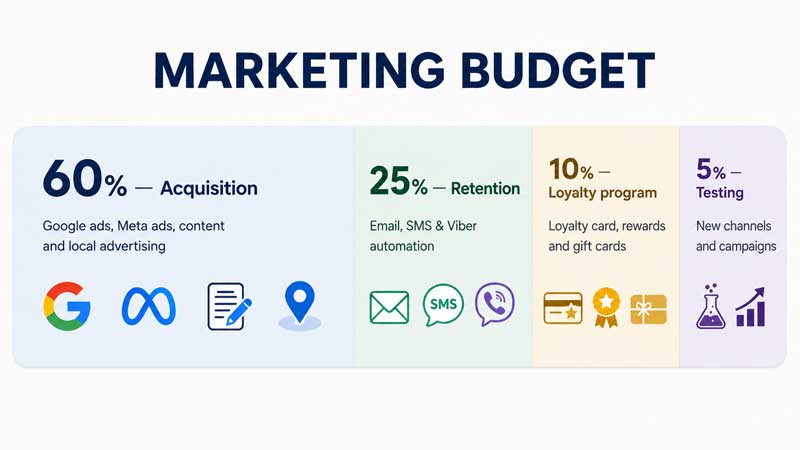
For a company with a monthly marketing budget of $ 30 000, a realistic allocation that gives customer retention the attention it deserves could look like this:
- 60% for acquisition;
- 25% for automated retention;
- 10% for the loyalty programme;
- 5% as a testing reserve.
Marketing Budget Allocation in Exact Figures
Imagine a company with a monthly marketing budget of $ 30 000—such as a small retail chain or a medium-sized online store.
A realistic allocation, with greater emphasis on customer retention, could look like this:
60% —$ 18 000 for acquisition
Paid advertising, local advertising and content that attracts new visitors.
25% — $ 7500 for retention through automated channels
Email, SMS and Viber campaigns based on customer behaviour rather than mass messaging.
10% — $ 3000 for the loyalty programme and gift cards
Mechanisms designed to give customers a reason to return.
5% — $ 1500 as a reserve
Testing new channels or responding to unexpected opportunities.
What changes this allocation from one month to the next is not necessarily the total size of the marketing budget, but whether the retention portion is being spent intelligently.
The same amount spent on sending a generic message to everyone will produce much weaker results than when it is directed through customer segmentation and automated triggers.
Realistic Expectations from Marketing Automation
Automation does not deliver results entirely on its own from the first day.
You need basic customer data, and the system needs time to identify meaningful behavioural patterns. However, once the process is established, the cost per retained customer decreases, while the marketing budget that was previously directed almost entirely toward acquisition begins to work in two ways.
Where Should Your Marketing Budget Go Next Month?
The question is not whether you should spend your marketing budget on acquisition or retention. You need both.
The real question is whether the budget reflects how much value each side actually delivers.
If you continue to invest almost everything in acquiring new customers while existing ones quietly leave, that is not a strategy. It is an expensive habit you pay for every month.
Stop guessing how much of your marketing budget should go toward each channel.
The customer data you already have—who buys, how often they purchase and when they were last active—is enough to show you where the right balance lies.
Spotlight connects that data with the channels you use to communicate, so retention stops being something you do “when there is time” and becomes a part of the marketing budget that can justify its own cost.
Frequently Asked Questions About Marketing Budgets
Should a small business allocate part of its marketing budget to retention when it is just getting started?
Yes, but on a smaller scale. Even a small business should have at least a basic system that tracks who has made a purchase and reminds them to return after a certain period. This is less expensive than constantly acquiring new customers from scratch.
What percentage of the marketing budget should go toward a loyalty programme?
There is no fixed percentage, but 5–15% of the total marketing budget is a realistic range for businesses that already have a base of regular customers.
A higher allocation usually makes sense only once the customer base is large enough for the programme to have a meaningful impact.
Is automation worthwhile when the marketing budget is small?
It becomes worthwhile as soon as manual messaging starts taking up time that could be spent on other activities, often when a business reaches a few hundred active customers.
Below that level, the benefits may be less noticeable, but it is usually easier to implement the system while the customer base is still small than later, once it has grown significantly.
How can I tell whether I am spending too much of my marketing budget on acquisition?
Compare your customer acquisition cost, or CAC, with the value that the customer is expected to generate over time.
If CAC is close to or higher than the customer’s expected lifetime value, acquisition is consuming more of your marketing budget than it returns.
Does allocating part of the marketing budget to retention make sense for physical stores, not just online stores?
Yes—potentially even more so.
In a physical store, a loyalty card provides customer behaviour data that an online store receives automatically through customer accounts. This information is often underused, even though the business already has access to it.