
Churn rate shows how many customers you are losing, but the real problem usually starts much earlier. Learn how to recognize churn signals and bring customers back in time.
A regular customer rarely leaves all at once. Before that happens, they usually slow down, buy less often, spend less, stop using benefits, stop opening messages, and stop reacting to offers that used to work.
On paper, that customer is still in your customer database. In reality, they already have one foot at your competitor’s door.
That is why churn rate is not just a metric for a report. It is a signal that part of your customer base is moving away from your brand. If you track it in time, you can react before a customer becomes completely inactive — and that is a much better position than trying to win them back later with a large discount.
What is churn rate?
Churn rate is the percentage of customers a company loses within a specific period.
It is most commonly used in SaaS, telecom, and subscription-based models, but it is also highly relevant in retail, eCommerce, and loyalty programs. In these industries, a customer does not have to formally “cancel” a service. It is enough that they simply stop buying.
In practice, churn may mean that a customer has:
- stopped buying,
- reduced their purchase frequency,
- stopped using loyalty benefits,
- stopped opening messages,
- switched to a competitor,
- remained in the database but no longer generates revenue.
That is why churn should not be viewed only as a number. It should be viewed as customer behavior.
A customer who exists in your CRM but no longer buys is not a loyal customer. They are a contact you have not yet removed from the system.
How is churn rate calculated?
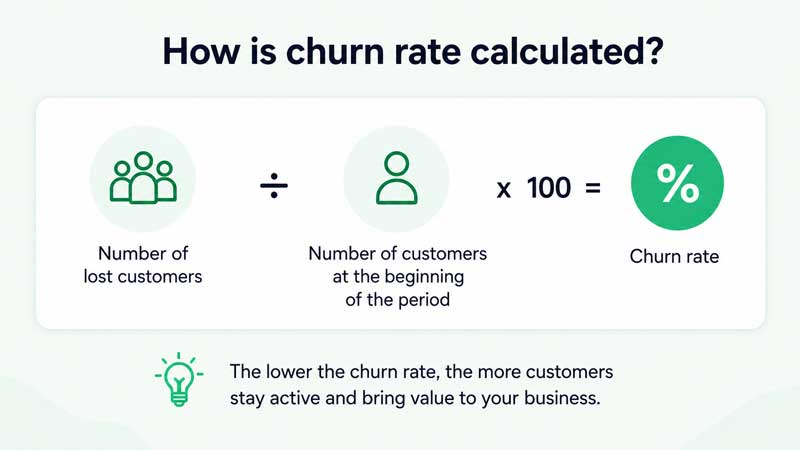
The churn rate formula is simple:
Churn rate = number of lost customers / number of customers at the beginning of the period × 100
For example:
If you had 10,000 active customers at the beginning of the month, and 800 of them stopped buying during that month, the churn rate is:
800 / 10,000 × 100 = 8%
That means you lost 8% of your customers during that period.
However, there is an important detail here.
Before calculating churn rate, you first need to define what a “lost customer” means for your business.
- For a supermarket, a customer who has not bought anything for 60 days may be considered inactive.
- For a furniture store, that would not make sense. People do not buy furniture every month.
- For a pharmacy, drugstore, fashion retailer, pet shop, or eCommerce business, the threshold depends on product category and customer habits.
So first, answer these questions:
- How often is your product usually purchased?
- After how many days without a purchase does a customer enter the risk zone?
- When do you consider them inactive?
- When do you consider them lost?
- Are you measuring all customers or only loyalty program members?
- Are you looking at online purchases, offline purchases, or both channels together?
Without this definition, churn rate can be misleading.
You may think you are losing customers when you are actually looking at the wrong period. Or worse: you may think everything is fine while your most valuable customers are slowly disappearing.
What churn rate is acceptable?
There is no universal number that applies to every business.
An acceptable churn rate depends on the industry, business model, average purchase frequency, competition, seasonality, and customer value.
Some companies may be satisfied with a churn rate of 5%, while for others, even 30% may be normal depending on the industry and business model. This means churn rate should never be interpreted without context.
For retail, a more useful question is:
Is your churn rate increasing?
If churn was 12% last quarter and is now 21%, there is a problem — even if another industry has a higher churn rate.
An even more important question is:
Which customers are leaving?
It is not the same if you lose customers who bought once during a promotion and customers who came regularly, spent more, and used loyalty benefits.
That is why total churn rate should be analyzed together with customer segments.
Pay special attention to:
- new customers,
- regular customers,
- VIP customers,
- customers with a high average basket value,
- customers who used to buy frequently,
- customers with unused points or vouchers,
- customers who stopped reacting to campaigns.
Not every lost customer has the same value.
If you lose 100 customers who bought once at a discount, that is a problem. But if you lose 20 customers who generated stable revenue for years, that may be a much more serious signal.
That is why, in addition to customer churn, you should also track revenue churn — how much revenue leaves with lost customers. The number of lost customers does not always show the real financial damage.
Churn rate does not start when the customer leaves
This is the most important part.
Many companies notice churn only when the customer has already disappeared.
They have not bought anything for three months.
They have not used a voucher.
They have not opened a single message.
They have not returned after a seasonal campaign.
They have not renewed their membership.
Then the win-back campaign starts.
And that is fine. Win-back campaigns make sense, but there is a better moment to react.
Before the customer leaves.
A customer usually shows much earlier that they are moving away — you just need to know where to look.
This is where Spotlight becomes more than just a campaign-sending tool. If purchase data, loyalty program data, webshop activity, and communication data are scattered across different systems, it is easy to see the consequence, but not the pattern that came before it. Spotlight connects this data into one clear customer view, so you can identify who is buying less often, whose average basket is decreasing, who is not using benefits, and who is no longer responding to messages.
That means you do not have to wait until a customer becomes inactive. You can place them into a risk segment and launch a message, offer, or loyalty incentive while there is still a chance to bring them back. For some customers, a reminder about an unused benefit will be enough. For others, it may be a personalized recommendation or a different communication channel. The point is not to give everyone the same discount, but to give each customer a reason that makes sense based on their behavior.
That is why Spotlight is especially useful for companies that do not only want to measure churn rate, but reduce it.
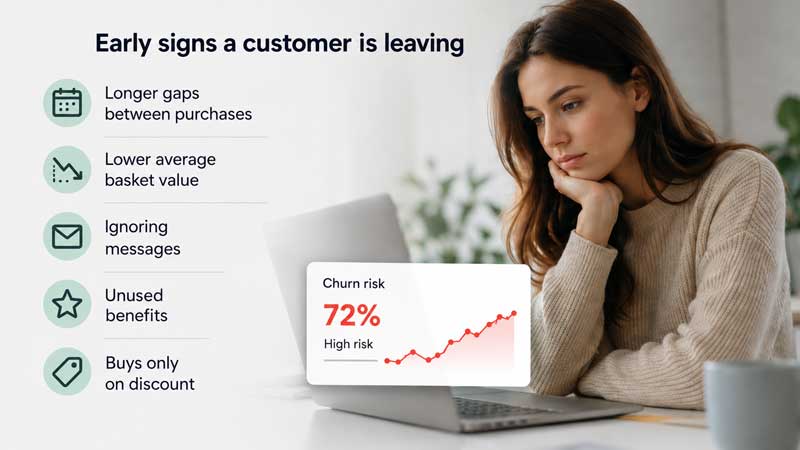
How to recognize a customer who is about to leave
Customer churn does not always look dramatic. There is no big warning sign or message saying: “Dear company, from today I am buying from your competitor.”
Instead, you see small patterns.
1. They buy less often than before
If a customer used to buy once a month and now has not appeared for three months, that is a signal.
It does not necessarily mean they are lost forever, but it does mean their rhythm has changed.
Example:
A customer used to buy pet food every 25 to 30 days. Now they have not bought anything for 70 days.
There is a high chance the pet is still eating — just maybe not food bought from you.
You cannot see this signal if you only look at total sales. You see it only when you track behavior at the individual customer level.
2. Their average basket value is decreasing
The customer is still coming back, but spending less.
This may mean that:
- they are buying only the basics,
- they are buying part of what they need from a competitor,
- they are waiting for promotions,
- they no longer see the same value,
- they are not responding to previous incentives.
This is often an early sign that loyalty is weakening.
The customer has not left yet, but they are no longer equally attached to your brand.
3. They stop using loyalty benefits
If a customer has points, cashback, a voucher, or a personalized benefit and does not use it, that is an important signal.
An even stronger signal is when a customer:
- collects points and then stops buying,
- receives a coupon but does not activate it,
- joins the loyalty program but does not use the benefits,
- gets close to a higher loyalty tier and then stops.
This shows that the benefit itself is not enough.
Maybe it was not explained well.
Maybe it was not sent at the right time.
Maybe it was not relevant enough.
Maybe the customer no longer sees a reason to return.
4. They ignore messages they used to open
If a customer used to open emails, respond to Viber marketing, or use SMS offers, and then suddenly stops, something has changed.
That does not immediately mean the customer is no longer interested in the brand.
Maybe the channel is wrong.
Maybe messages are being sent too often.
Maybe the offer is not relevant.
Maybe you are sending the same campaign to everyone.
But if the drop in response keeps repeating, it is a signal that the customer is sliding toward inactivity.
The point is simple: a campaign should not go to everyone, but to the right segment at the right moment.
5. They buy only when there is a big discount
This is a specific type of risk.
The customer is not completely inactive. They appear — but only when the price is low enough.
At first glance, that may seem good. The campaign worked, a purchase happened, revenue came in.
But if the customer reacts only to discounts, the question is how loyal they really are.
Maybe they are not choosing your brand. Maybe they are choosing the lowest price.
That is why the goal is not to bring every risky group back with the same promotion. The goal is to understand why they are moving away and what can actually motivate them.
Why does a win-back campaign often come too late?
A win-back campaign usually starts when the customer has already become inactive.
That means the company is then trying to bring them back with:
- a stronger discount,
- a special offer,
- a “we miss you” message,
- bonus points,
- a limited-time benefit.
All of that can work, but the problem is that the customer may have already found another option.
If they have been buying from a competitor for three months, their habit has already changed — and habits are harder to recover than attention.
That is why it is smarter to build a system that identifies at-risk customers before they become lost customers.
In other words:
The best win-back campaign is the one you do not have to launch too late.
How does Spotlight help you detect churn before it becomes a problem?
To reduce customer churn, you first need to see what is happening.
The problem is that data is often not in one place.
- Sales data is in the POS system.
- Online purchases are in the webshop.
- Loyalty activity is in a separate program.
- Email campaigns are in one tool.
- SMS and Viber are in another.
- Reports are in spreadsheets.
When data is scattered, it is hard to see the pattern.
A customer may look active in one system, but show declining interest in another. They may have bought in a physical store but no longer react online. They may have points, but never receive a good reminder to use them.
The Spotlight platform connects loyalty programs, marketing automation, Customer Data Platform, eCommerce integration, and analytics. It enables customer data collection and analysis, personalized offers, segmentation, multichannel communication, and campaign performance tracking.
This matters for churn rate because you cannot seriously monitor customer churn if you do not have a single customer view.
How to bring inactive customers back
Inactive customers are not all the same. That is why the first mistake in customer reactivation is sending one campaign to the entire database.
A “We haven’t seen you in a while” message may work in some cases, but if you send it to everyone, you miss a much better opportunity.
- A customer with 2,000 unused points does not need the same message as a customer who once bought a product worth 900 dinars.
- A customer who used to buy every two weeks does not need the same message as a seasonal customer.
- A customer who opens Viber messages does not need the same channel as a customer who never clicks on Viber but responds to email.
That is why reactivation should follow several steps.
1. First, separate different types of inactive customers
Make a distinction between:
- customers who are just entering the risk zone,
- customers who are completely inactive,
- high-value customers,
- low-value customers,
- customers with unused benefits,
- customers who stopped responding to messages,
- customers who buy only during promotions.
This immediately changes the approach.
Some customers need a reminder.
Some need a reason.
Some need a better offer.
Some need a different channel.
Some do not need a discount, but a more relevant recommendation.
2. Do not bring every customer back with a discount
A discount is the fastest tool, but not always the best one.
If every win-back campaign is based on a discount, you teach customers to wait for a sale.
This may increase short-term sales, but reduce margins and long-term customer value.
Instead, test other incentives as well:
- bonus points,
- personalized recommendations,
- early access to a new collection,
- a gift with purchase,
- free delivery,
- exclusive loyalty status,
- a reminder about products the customer usually buys,
- activation of an unused voucher.
The best offer is not the loudest one.
The best offer is the one that makes sense for a specific segment.
3. Adapt the channel to the customer
Some customers respond to email.
Some respond to SMS.
Some respond to Viber.
Some react only when they see a benefit through the loyalty program.
If you do not track the channel at the customer level, you are sending messages blindly — and that kind of communication often leads to even more ignoring.
Spotlight enables companies to manage different channels and automated flows from one system, which is especially important when you want to connect the segment, message, channel, and result.
4. Measure what happened after the campaign
Reactivation does not end when the message is sent.
The real questions are:
- How many customers came back?
- How quickly did they return?
- How much did they spend?
- Did they buy only once?
- Did they continue buying?
- Which segment responded best?
- Which channel delivered the best result?
- Which offer had the best balance between sales and margin?
If you do not measure this, you do not know whether you reduced churn or only temporarily bought the customer’s attention.
The most common mistakes in tracking churn rate
Measuring only total churn rate
Total churn may look acceptable while your best customers are leaving.
That is why churn should be tracked by segment, customer value, and behavior.
Marking customers as inactive too late
If you mark a customer as inactive only after six months, you may have missed the best moment to react.
The inactivity threshold should follow the real purchase cycle.
Not distinguishing between new and regular customers
New customers naturally drop off more often.
But if regular customers are leaving, that is a much more serious signal.
Sending the same win-back campaign to everyone
One message for all inactive customers sounds simple, but it rarely delivers the best result.
Segmentation is not overcomplication. It is a way to avoid spending budget on messages that are not relevant to the customer.
Not connecting churn with revenue
If you look only at the number of lost customers, you do not see the full picture.
You may have lost a small number of customers, but a large share of revenue.
That is why you should also track revenue churn, average basket value, CLV, and purchase frequency.
Which metrics should you track alongside churn rate?
Churn rate is important, but it is not enough on its own.
To understand why customers leave and how to keep them, you should also track other metrics.
Retention rate
This shows how many customers stay with your brand during a specific period.
If churn rate shows customer loss, retention rate shows your ability to keep customers.
Repeat purchase rate
This shows how many customers return and buy again.
It is especially important for retail and eCommerce, because the first purchase does not mean much if there is no second one.
Purchase frequency
This shows how often customers buy.
A drop in purchase frequency is often one of the first signs of churn risk.
Average order value
This shows the average purchase value.
If a customer is still coming back but spending less, they may be moving away.
Customer lifetime value
This shows how much a customer is worth over time.
CLV helps you avoid treating all customers the same. Some customers deserve more attention, a stronger benefit, and a dedicated communication flow.
Redemption rate
This shows how many customers use loyalty benefits.
If customers receive benefits but do not use them, the problem is not only the customer. The issue may be timing, message, channel, or offer relevance.
Engagement rate
This shows how customers respond to campaigns.
A drop in engagement often comes before a drop in purchases.
Churn rate should not be analyzed only when sales have already dropped. By then, the reaction is more expensive.
It is much more useful to view churn as an early warning system.
It shows you:
- which customers are slowing down,
- which segments are losing interest,
- where loyalty is weakening,
- which campaigns are no longer working,
- which benefits are not being used,
- which channels are losing impact,
- where revenue may start leaking.
When churn is tracked through data, segments, and behavior, it stops being just bad news in a report and becomes a tool for smarter decisions.
This is where Spotlight delivers the greatest value: not only as a campaign-sending system, but as a platform that helps you understand customers, detect risk, and react while there is still time.
You do not have to wait until a customer becomes lost. You can recognize them while they are still at risk. You can send them a relevant message. You can remind them of a benefit. You can give them a reason to return before they change their habit.
Spotlight helps you do exactly that: turn scattered data into a clear customer view, inactivity into a signal for action, and churn rate into a metric you do not track only when it is already too late.
Want to see which customers are already at risk of stopping their purchases?
Schedule a Spotlight demo and see how data from your loyalty program, sales, and campaigns can work together.