
How to grow your customer database without wasting budget? If you’re doing what everyone else does – you’re already losing. Here’s what actually works!
In many companies, a customer database still means the same thing as a contact list. A few phone numbers, email addresses, maybe a company name and a contact person, along with a note on who bought something and when. The problem is that this approach only looks organized at first glance. In practice, it fails to answer far more important questions: who your most valuable customers are, who buys frequently, who is drifting away, who responds to a certain type of offer, and where your database is actually growing—and where it only seems like it is.
That’s why it’s important to clarify one thing right away:
A customer database is not an administrative record. It should be an operational system for sales, marketing, and customer retention.
When set up this way, it doesn’t just serve to “store data,” but to help you make better decisions, create more relevant offers, and build longer-lasting relationships with your customers. Modern approaches to customer data management are based on consolidating data from multiple sources into a unified customer profile, which can then be used for segmentation, automation, and personalized communication.
If you’re wondering how to build a customer database, the answer is not to collect as many contacts as possible as quickly as possible, or simply bring in more new people. In both cases, the key is the same: you need a system that can recognize the customer, connect their activities over time, and turn data into the next logical action.
What Is a Customer Database and Why Does It Matter?
A customer database is an organized set of data about existing and potential customers that allows you to understand their behavior, track their relationship with your brand, and plan your next business moves based on real signals—not assumptions. In modern practice, it is not just a place where you store contact details, but a central point where purchases, campaign responses, loyalty status, previous interactions, and behavior patterns are visible. This transforms the database from a simple archive into the foundation of sales and marketing activities.
The importance of a customer database becomes even more evident as your business grows. When the number of customers is small, many things can be managed “by feel.” The team knows who buys the most, who is loyal, who needs extra attention, and who is worth sending a special offer to. However, as the number of customers increases, this approach becomes unsustainable. Manual tracking of customer relationships quickly turns from flexibility into chaos. That’s why modern loyalty and engagement systems are built on the idea that a company must have a unified customer database with a clear overview of segments, activities, and next actions.
A customer database doesn’t impact only marketing. It affects sales, budget planning, the work of commercial teams, promotion profitability, and service quality.
When you know who your most valuable customers are, who buys occasionally, and who is on the verge of leaving, it becomes much easier to allocate resources, reduce marketing costs, and create activities that actually make sense. Growth also becomes more measurable, because you’re no longer relying solely on one-off campaigns.
A Customer Database Is Not the Same as a Contact List
A contact list is static. It tells you who exists in your directory.
A customer database is dynamic. It shows you how those customers behave.
It connects basic data with purchase history, frequency, average transaction value, interest categories, points, coupons, activity status, and responses to communication. Only then does a company gain the ability to segment customers and approach each group differently.
A contact list is a record. A customer database is infrastructure for growth.
How to Build a Customer Database From Scratch?
When a company starts building a customer database from the ground up, the most common mistake is starting with tools instead of goals. The first question should not be “Which software should we use?” but “What do we want to know—and what do we want to do with that data?”

If you want a database that actually delivers business value, you need to define which information you need for decision-making. In most cases, that comes down to four layers of data.
- The first layer is identification data: name, contact details, location, store or channel through which the customer entered your system.
- The second layer is transactional data: when they made their first purchase, when they last purchased, how often they buy, their average order value, and which categories interest them the most.
- The third layer is engagement data: whether they open messages, use coupons, collect points, respond to specific types of offers, and whether there are repeating behavior patterns.
- The fourth layer is status data: whether the customer is new, active, at risk, dormant, or a VIP customer.
This structure allows your database to become more than just rows and columns—it becomes a tool that leads to the next action. If you don’t know what you’ll do with a piece of data once you collect it, there’s a good chance you don’t need that data at this stage.
Why Does a Customer Database Need to Be Unified?
One of the biggest real-world problems isn’t the lack of data—it’s fragmentation.
Data lives in your POS system, webshop, loyalty cards, newsletter tools, Viber campaigns, Excel sheets, and sales team messages. Everyone sees part of the picture, but no one sees the whole picture. That’s when a common problem appears: everyone is doing something useful, but the overall result stays weak because the data isn’t connected.
A Customer Data Platform approach solves this by bringing data from multiple sources into a single customer profile.
If you don’t unify your data, you’ll likely make mistakes like these: sending the same message to someone who just purchased and someone who hasn’t bought in three months, offering a benefit to someone who already received a better one, ignoring customers who buy frequently but in small amounts, and underestimating those who return rarely but spend significantly more. The issue isn’t that your team doesn’t know what they’re doing—it’s that your system doesn’t provide the full picture.
When Excel Is No Longer Enough as a Customer Database
Excel isn’t the problem by itself. The problem starts when a company expects a spreadsheet to function as a customer relationship management system.
In early stages, a spreadsheet can be enough for basic tracking. But the moment you have multiple sales locations, multiple communication channels, loyalty logic, campaigns, segments, and a need to track customer behavior over time, spreadsheets become a bottleneck.
This usually shows up through very clear symptoms:
- The team cannot quickly identify inactive customers
- It takes too much manual work to create a campaign for a specific segment
- There’s no clear view of who your most valuable customers are and who is at risk of leaving
- Messages are sent to everyone the same way because it’s easier than creating precise filters
- At the same time, database growth looks bigger than it actually is—because the number of contacts grows, but the number of active customers does not follow the same trend
When a company reaches the point where its customer database is no longer just a record, but the foundation for loyalty, segmentation, reactivation, and automation, it becomes clear that it doesn’t need another disconnected tool. It needs a system that brings everything together.
A Better Solution?
Spotlight – a platform that connects customer data, loyalty, and engagement logic
How to Grow Your Customer Database?
When people talk about growing a customer database, they usually think only about acquiring new customers. That is an important part of the equation—but it’s not enough.
A customer database grows in a meaningful way only when you do three things at the same time: bring new customers into the system, retain existing ones, and reactivate those who have stopped buying.
That’s the key difference between “more contacts” and a “stronger database.” If you only focus on acquisition while a large percentage of your existing customers become inactive, your database may grow on paper—but its business value stays flat.
Relevant industry sources consistently highlight personalized communication, loyalty programs, and understanding the customer journey as core drivers of repeat purchases and long-term revenue.
Spotlight follows the same principle: it connects purchase frequency, reactivation, loyalty mechanisms, and automation into a single growth system.
How to Attract New Customers Into Your Database?
The first step in growing your database is making entry simple—and meaningful.
People don’t share their data because they enjoy filling out forms. They do it when they see a clear benefit.
That means your sign-up process must be short, clear, and tied to real value. The customer should immediately understand what they get: points, exclusive benefits, a welcome coupon, access to member perks, personalized recommendations, or an easier way to track their rewards through a loyalty program.
When registration boils down to “leave your data so we can store it,” conversion rates drop—and so does the quality of the relationship.
This is exactly why loyalty programs play a key role in database growth. They don’t just reward existing customers—they give new customers a clear reason to join your system.
Why Loyalty Helps Your Database Grow
Many companies try to grow their customer database by constantly increasing acquisition efforts. This can deliver short-term results, but in the long run, it often leads to more expensive growth.
If you’re not working on customer loyalty at the same time, your database starts to leak: new customers come in, others drop out, and the company keeps spending resources just to replace what it loses.
That’s why loyalty is not just a retention tool—it’s a stabilizer for your database.
When customers see that their purchases are tracked, that they’re progressing through benefits, receiving relevant offers, and that their relationship with your brand has continuity, they are more likely to stay active.
At that point, growth no longer depends only on new registrations—but on how many existing customers stay engaged and increase their value over time.
The goal is not random discounting, but building relationships through a structured reward system and smart activation.
How Segmentation Helps Your Database Grow Smarter
One of the most expensive mistakes in managing a customer database is treating everyone the same. On paper, it may seem efficient: one campaign, one message, one offer.
In reality, it means ignoring the real differences between your customers.
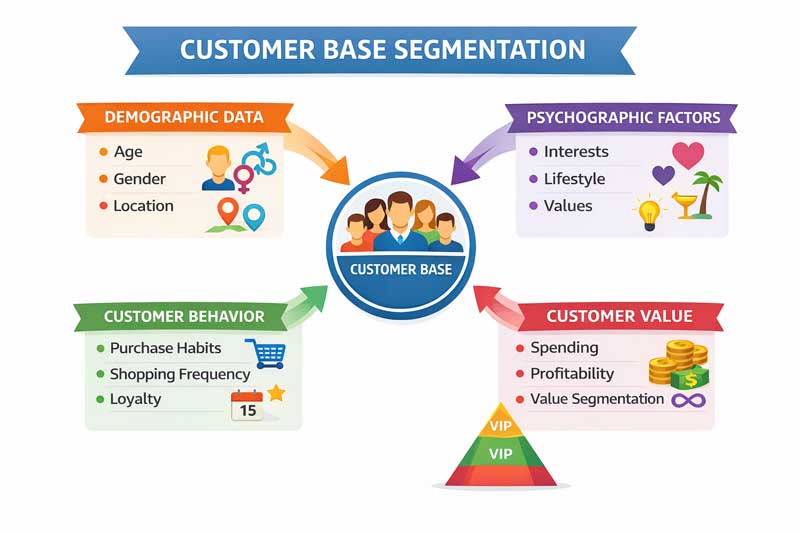
Segmentation solves exactly that problem. It divides your database into groups that share similar characteristics or behavior patterns, so communication and offers can be more relevant. These groups can include new customers, active customers, high-value customers, at-risk customers, those who respond only to specific categories, or those who haven’t purchased in a long time.
From a business perspective, this matters because you don’t grow your database just by adding new people—you grow it by activating the existing base more, increasing frequency, and improving relevance.
Segmentation allows you to offer your most valuable customers an experience that keeps them engaged, send reactivation messages to dormant ones, and guide new customers through a communication flow that leads to their second and third purchase.
How Messaging and Automation Help Your Database Grow
Once you have a customer database, the next question is no longer just “what do we know about our customers,” but “what do we do with that knowledge?” This is where marketing automation comes in.
In professional sources, marketing automation is defined as technology that automates repetitive marketing tasks and manages campaigns across multiple channels, with the ability to personalize communication at scale. In other words, you don’t have to manually track who made their first purchase, whose coupon is about to expire, who hasn’t bought in 45 days, or who is close to the next loyalty reward. The system can recognize these signals and trigger the appropriate communication.
Spotlight enables campaign management across email, SMS, Viber, and push channels, including birthday campaigns and other automated scenarios.
For growing your customer database, this is extremely important. Automation ensures that the right message reaches the right customer at the right time—without your team having to start from scratch every time.
Why Should Reactivation Be Part of Your Customer Database Growth Strategy?
Another common mistake is looking for growth only in new customers, while inactive ones are practically written off. That approach is expensive—and often unnecessary.
Customer reactivation matters because it shifts the focus back to people who already know you, who have already interacted with your brand, and who are far more likely to purchase again than someone discovering you for the first time.
Growth shouldn’t come only from new campaigns, but also from recognizing where your database is “leaking,” which segments are slowing down, and which messages need to be sent at the right moment.
A customer database doesn’t grow only through acquisition—it grows by reducing churn. When you bring dormant customers back, you increase the active portion of your database. And the active portion is what drives revenue—not the total number of names in your system.
How to Measure Whether Your Customer Database Is Actually Growing?
The easiest metric to track is the total number of contacts. It’s also the most misleading one when viewed in isolation.
To understand whether your database is truly growing, you need to track additional metrics: the number of new registrations, the number of active customers, repeat purchase rate, purchase frequency, average order value, reactivation rate, and engagement across segments.
Only then can you see whether your database is actually becoming stronger—or just bigger.
A customer database is not a list you build just to say you have one. It’s a business infrastructure designed to help your team understand customers, recognize patterns, retain valuable segments, and increase the frequency and quality of repeat purchases.
That’s why the question “how to build a customer database” shouldn’t be reduced to technical data management—and “how to grow a customer database” shouldn’t be reduced to bringing in more people. In both cases, what matters more is the logic behind the system: are your data connected, are your segments clear, are messages timely, and do you have a system that can maintain customer relationships as your database grows?
When a company solves this, the customer database stops being an archive. It becomes a growth engine.
Spotlight is a marketing platform that unifies customer data, enables clear segmentation, and drives automated communication through loyalty mechanisms and campaigns. It allows your customer database to function as a single, connected system—not a collection of disconnected tools.
Instead of your team spending time extracting data and manually filtering, the focus shifts to what actually makes a difference: understanding customers, acting at the right time, and driving continuous growth.
If you want your customer database to stop being passive and start driving sales, it’s time for a different approach.
Contact us. Let’s make your customer database work for you.