Birthday messages to customers are more than just a thoughtful gesture. The right timing, segmentation and relevant benefit can turn them into an effective sales channel.
Every company with a customer database knows the birthdays of at least some of its customers. The question is what it does with that information. In practice, usually nothing—or everyone receives the same discount whenever someone finds the time to prepare the message.
That is a missed opportunity, not a minor detail.
What Are Birthday Messages to Customers?
Birthday messages are automated marketing messages sent based on a customer’s date of birth, with the aim of turning a personal occasion into a sales opportunity.
When properly timed and segmented, they achieve significantly higher open and conversion rates than standard promotional messages.
A birthday is one of the rare occasions when customers expect to hear from you, so the message feels like a thoughtful gesture rather than an intrusion.
Birthday messages to customers in brief:
- Automated birthday messages can achieve open rates of over 40%.
- Research shows that their purchase rates can be several hundred percent higher than those of regular promotional messages.
- The question is not whether to send a birthday greeting, but when to send it, through which channel and with which offer.
- Sending the same generic message to everyone wastes almost all of this potential.
Birthday messages can generate transaction rates several times higher than standard promotional messages, while Omnisend’s 2026 statistics report open rates of over 40% for automated birthday messages—far above the average for regular campaigns.
One misconception should be addressed immediately:
A birthday message is not simply a “nice gesture” designed to make customers feel appreciated. It is one of the most profitable triggers in marketing automation—when executed properly.
Why Is a Birthday Message More Than a Thoughtful Gesture?
Birthday messages perform better than almost any other campaign because they combine three elements that rarely come together: customers expect them, they are personalized with minimal effort because you already have the date, and they arrive when customers are more emotionally open to buying themselves a small gift.
The results are therefore hardly surprising—yet few businesses use their full potential. Most companies send a generic SMS saying, “Happy birthday! Enjoy 10% off,” and leave it at that. There is no segmentation, channel strategy or measurement to determine whether the message actually generated sales.
The reality is that a birthday message becomes a serious sales channel only when it stops being an isolated gesture and becomes part of a system that knows who the customer is, what they buy and which channel they respond to best.
When Exactly Should You Send a Birthday Message?
The best results usually come from combining two messages: one sent a few days before the birthday and another sent on the day itself. The first introduces the benefit and builds anticipation, while the second serves as a reminder and closes the sale while the occasion is still fresh.
Timing also depends on the type of product.
- For products that customers research and plan to purchase, such as cosmetics, clothing and technology, sending the announcement three to five days in advance gives them time to consider the offer, visit the store or place an online order.
- For more impulse-driven categories, such as food, beverages and fast fashion, a message sent on the birthday itself or the following day usually performs better, while the celebratory mood is still present.
The most common mistake we see is a message arriving a week after the birthday, when the customer has already moved on. If the system does not send messages automatically based on the exact date, this is almost inevitable.
Learn more about automated message sending.
Which Channel Works Best for Birthday Messages?
There is no universal answer—but there is a clear logic.
SMS and Viber have the highest open rates and work best for short, direct messages with a clear coupon and expiration date.
Email provides more room for storytelling, visuals and a wider product selection, making it a better option for more complex offers.
A push notification can provide a useful third layer, particularly as a reminder one day before the birthday benefit expires. However, it rarely performs well as the only channel because it depends on the customer having the app installed and notifications enabled.
A practical approach: announce the offer by email, if you have the customer’s address and enough content to tell a story, then send an SMS or Viber message on the birthday itself as a direct reminder containing the coupon. A combination of channels almost always outperforms a single channel because it reaches customers wherever their attention happens to be.
Should Every Customer Receive the Same Offer?
They should not, although that is what most companies do. A birthday is an excellent opportunity to reward loyalty by differentiating the offer, not just the message.
- A VIP or regular customer who spends more deserves a more valuable benefit—a larger discount, an exclusive product or early access to a new collection.
- A new customer with only one or two purchases should receive a smaller but still worthwhile incentive to return for a third purchase.
- A customer who has been inactive for months can receive a stronger birthday coupon as an incentive for reactivation. The objective is to bring them back, not merely encourage them to spend slightly more.
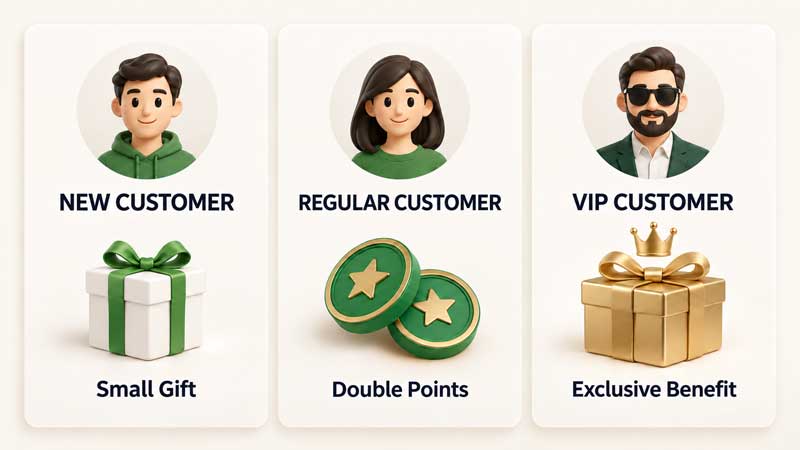
The problem is that almost nobody can manage this manually across a database of several thousand customers. You need to know each customer’s tier and birthday and automatically send the right version of the message to each person. This is exactly where spreadsheets and manual processes begin to fail.
A system such as the Spotlight program, with built-in marketing automation, identifies each customer’s tier automatically and sends the appropriate version of the message—without requiring someone from the team to sort customers manually every morning.
The goal is not to have yet another messaging tool, but a system that knows who the customer is before the message is even sent.
What Can You Offer Instead of a Discount?
Discounts work, but they are not the only option—and often not even the best one. Every discount directly reduces your margin, while alternative benefits can create the same feeling of appreciation at a lower cost.
Effective alternatives include:
- Double points on a birthday purchase
- A complimentary product with orders above a specified amount
- Exclusive early access to a new collection or sale
- Free delivery on the customer’s birthday
For subscription or tier-based models, temporarily upgrading a customer’s status on their birthday—for example, providing one day of VIP treatment—can also work well. It gives the customer a sense of privilege without creating a substantial direct cost for the company.
The best results usually come from a combination: a small guaranteed benefit, such as double points, plus an optional larger discount that remains valid for a limited time to preserve a sense of urgency.
The Most Common Mistakes in Birthday Campaigns
The same mistakes appear repeatedly among companies that treat birthdays as an afterthought rather than a genuine campaign:
- Sending the same message to everyone, regardless of tier or purchase history
- Offering a discount without an expiration date, allowing customers to postpone using it until they “need it” and ultimately forget about it
- Choosing the wrong channel—sending an email to someone who never opens emails instead of an SMS they would actually read
- Sending the message too late, after the date has passed and the celebratory momentum is gone
- Failing to measure results—sending the message without checking whether it generated any sales
Each of these mistakes reduces the campaign’s effectiveness. Combined, they can destroy almost all the potential of a birthday message. To be honest, most of these mistakes result from manual processes that cannot remain consistent, not from a lack of good intentions.
How Can You Measure Whether a Birthday Campaign Works?
Three metrics provide the clearest picture:
- Coupon redemption rate
- Average purchase value during the birthday campaign compared with the standard average
- The percentage of customers who return for another purchase within the following 60 days
If the redemption rate falls below the usual level for your industry, the problem is probably the timing or channel rather than the offer itself.
If the average basket value remains unchanged, the offer is probably not valuable enough to influence customer behaviour.
Measuring these figures requires every birthday message to be connected to a specific transaction rather than simply sent and forgotten. This once again depends on whether you have customer analytics that automatically tracks this type of data.
When birthday campaigns are measured regularly, it quickly becomes clear what actually works for your customer base. You can then adjust the offer instead of repeating the same formula year after year without checking the results.
Frequently Asked Questions About Birthday Messages to Customers
Should a birthday message always include a discount?
No. A discount is the quickest solution, but double points, a complimentary product or exclusive access can often perform equally well while having less impact on your margin. The right choice depends on what your customer base values most.
How many days before a birthday should the announcement be sent?
For planned purchases such as clothing, cosmetics and technology, sending the announcement three to five days in advance gives customers enough time to decide. For more impulse-driven categories, a message sent on the birthday itself usually performs better.
Does a birthday campaign make sense for a small business with only a few hundred customers?
Yes—potentially even more than for a large chain. With a smaller database, each birthday message can contribute more visibly to sales growth. Manual sending remains manageable until the database grows beyond a few hundred customers.
What if the customer has not provided an accurate date of birth?
Without the correct date, meaningful automation is impossible. The best time to request this information is during registration for a loyalty program, accompanied by a clear explanation that providing it unlocks a specific benefit. Few customers refuse when they understand why the information is being requested.
How long should a birthday coupon remain valid?
A short validity period—usually seven to ten days—maintains urgency and prevents customers from postponing the offer until later and then forgetting about it. An excessively long validity period almost always reduces the redemption rate.
If you already have customer data and their dates of birth, there is no reason to let birthdays remain a missed opportunity.
The Spotlight marketing platform automatically identifies each customer’s tier, birthday and preferred channel—and handles the process for you consistently, every day of the year.