
What is upselling, and how can it increase sales without bringing in new customers? We explain the techniques and how to recognize the right time to use them.
Upselling at a glance
- Upselling means offering a customer a more expensive or advanced version of a product they are already considering. Cross-selling, by comparison, adds a complementary product.
- Techniques such as bundling, social proof, and highlighting benefits work when they are used at the right time, rather than offered to every customer in the same way.
- The right time is revealed by patterns in purchase history: frequency, consistency of choice, and rising value over time.
- Loyalty data makes those patterns clearer than a salesperson’s guess, especially in a physical store where other signals are limited.
- Success should be measured by customer segment. An overall average hides who actually responds to an offer.
Most stores approach upselling in the same way: they show everyone a more expensive version of a product at the same point in the purchase journey, regardless of who the customer is. Sometimes it works. More often, it feels pushy. The customer walks away, and the salesperson concludes that “upselling doesn’t work for us.”
The problem is rarely the technique itself. Upselling depends on whom you offer the upgrade to and when. An argument that sounds reasonable to one customer can feel like pressure to another. The difference lies in the customer’s relationship with your business.
Let’s be honest: most companies do not know which customers are ready for a higher-tier offer. They rely on a salesperson’s instinct or send the same message to everyone.
This article explains what upselling is, which techniques are commonly used, and, most importantly, how to recognize the right moment using data you already have.
What Is Upselling, and How Is It Different From Cross-Selling?
Upselling is a sales technique that offers a customer a more expensive or advanced version of the product or service they are already considering. It offers a better version of the same choice, rather than an additional product.
The goal is to increase the value of a purchase, not the number of items in the basket. That distinction often gets blurred in practice.
Cross-selling adds to the purchase: alongside a printer, you offer toner and paper.
Upselling changes the choice: instead of a basic printer, you offer a model with twice the capacity. It is the same customer, but a different approach.
Both aim to increase order value without acquiring a new customer, but they require different information.
Cross-selling depends on knowing which products work well together. Upselling depends on knowing whether a customer is ready to pay more for a better option. That requires some knowledge of the customer, not just the product.
Which Upselling Techniques Are Most Common?
Across industries, upselling usually relies on a few familiar approaches:
- Highlighting a specific difference: Explain exactly what the customer gets for the higher price, such as a longer warranty, greater capacity, or faster service.
- Social proof: Showing what other customers chose can build confidence without adding pressure.
- Bundling: Offer a package whose value is clearer than the value of its individual components.
- A time-limited incentive: Offer a discount on an upgrade for a limited period.
In electronics, it might be a newer phone model. In cosmetics, a larger size or a premium range. In hospitality, it could be an upgraded option for an order already placed. The principle is the same: offer a better version of something the customer already wants.
These techniques can work, but only when offered to the right customer at the right time.
Why Aren’t Techniques Enough Without the Right Timing?
The same technique can produce two different outcomes.
A customer who has bought from your store three times and regularly chooses products in the mid-price range may see a premium option as a logical next step.
A customer visiting for the first time may hear the same offer and think, “They’re trying to sell me something more expensive, and they don’t even know what I need.”
The point is to know whom you are addressing. Many companies time an upsell according to the transaction: as soon as a customer reaches the basket or checkout, they are offered an upgrade. But reaching checkout tells you little about whether that customer is ready for one.
What Does the “Right Moment” for an Upsell Look Like?
The right moment becomes clearer when you look at a customer’s behavior over time: how often they buy, whether they consistently choose from the same category, and whether the value of their purchases is increasing.
You cannot see that in a single transaction. You see it in their history.
The useful question is not, “Has this customer just added something to their basket?” It is, “Over the past few months, has this customer shown signs that they may want more than our current offer gives them?” That signal comes from data.
Which Purchase History Signals Suggest a Customer Is Ready to Upgrade?
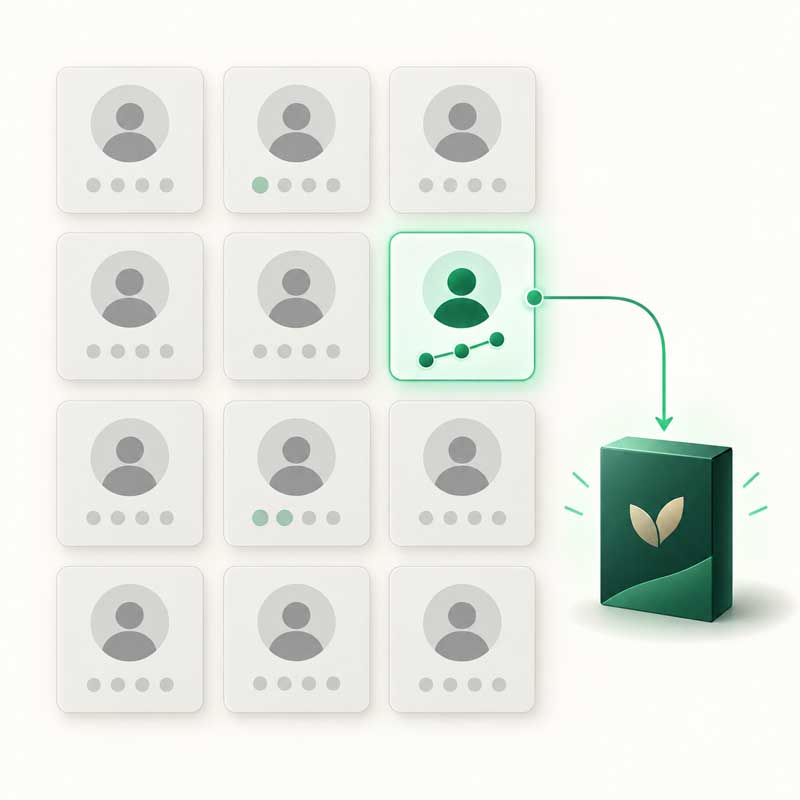
A few specific patterns are worth watching:
- A customer has bought the same entry-level product from a category three or more times. They may be more open to an advanced version than someone who bought it once.
- Both purchase frequency and purchase value are rising over time. Their RFM position is improving as a trend, rather than because of a single unusual purchase.
- A customer is close to the next loyalty tier. An upgrade offer may feel relevant at that point.
The “average customer” tells you little here. An average combines people who would buy the more expensive option without an offer and people who have no interest in it. Without better insight, companies send both groups the same message.
This creates an operational problem. The signals already exist in purchase histories, but no one can track them manually for every individual customer. A spreadsheet becomes difficult to manage once the customer base grows beyond a few hundred people.
Segmentation based on RFM principles helps identify where a customer stands in their relationship with your business and whether their behavior suggests they may be ready for a higher-tier offer.
Spotlight uses this principle. The value is in making the data you already collect through your loyalty program useful.
For example, a pharmacy customer buys the same supplement from a basic range three months in a row, roughly every 25 days. In Spotlight, that consistency and frequency change their RFM position: they move from an occasional to a regular customer in that category, and the system recognizes the pattern automatically.
After the pattern appears for the third time, Spotlight can trigger an SMS or Viber message: “You regularly choose [product X]. The pharmacy now also offers a premium option in the same category.”
The message goes to that segment, not to every pharmacy customer. It arrives when the pattern has been established, rather than at a random time or during every visit.
The result is a relevant offer sent to a customer whose purchase history gives you a reason to make it. The pharmacist or store owner does not have to keep track of that pattern mentally or in a spreadsheet.
Upselling in a Physical Store Is Different From Upselling Online
An online store can see clicks, pages viewed, and products left in a basket, then use those signals to understand customer behavior. A physical store without a loyalty card sees far less. A customer comes in, buys something, and leaves. Often, the only record is an anonymous receipt total.
A loyalty card changes that. Each purchase can be linked to the same customer over time, whether they buy online or in-store. This gives a physical retailer a way to see the purchasing patterns described above through actual transactions.
Which Mistakes Hold Back Successful Upselling?
A few mistakes recur among companies that try upselling and then give up:
- Offering a more expensive version to a new customer before they have developed confidence in the basic offer.
- Sending every customer the same message, regardless of segment.
- Offering an upgrade without explaining the extra value behind the higher price.
- Repeating the same offer too often after a customer has already declined it. Repetition is more likely to irritate them than persuade them.
Upselling does not work instantly or for every customer. It is more likely to be relevant when a customer has shown a pattern that supports the offer. Without that insight, the techniques above amount to guesswork.
How Can You Measure Whether Upselling Works?
Upselling is often measured through average order value (AOV) and the conversion rate of upgrade offers. Those figures are more useful when viewed by customer segment than as an average across the entire customer base. The average can hide who responds to an offer and who would have chosen the more expensive option anyway.
Some retail research reports average upsell conversion rates of around 18–20%. On its own, however, that figure says little about the effect of your offers. If most conversions come from customers who were already likely to choose the higher-priced option, the campaign may simply be recording purchases that would have happened anyway.
A more useful measure is whether customers who previously stayed with the lower-priced option begin choosing the upgrade after receiving a targeted offer.
Frequently Asked Questions About Upselling
Does Upselling Make Sense for Small Stores, or Only for Large Chains?
Yes, it can make sense for small stores. They often know their regular customers well, but that knowledge tends to live in a salesperson’s head rather than in a system that can be used as the customer base grows.
What Is the Difference Between Upselling and Moving Through Loyalty Tiers?
Loyalty tiers reward customers based on their overall spending or activity. Upselling is a specific offer of a more expensive version of a product. A customer’s progress toward a new tier can be one signal that an upgrade offer may be relevant, but the two are not the same thing.
When Should You Avoid an Upsell?
Be cautious with a customer making their first purchase, when you have no history to help assess whether an upgrade is relevant. Avoid quickly repeating the same type of offer to a customer who recently declined it.
Can Poorly Timed Upselling Harm a Customer Relationship?
Yes. A poorly timed offer can make it seem as though a company does not understand its customer, which is the opposite of what a loyalty program should help achieve.
How Often Should You Offer the Same Customer an Upsell?
There is no universal number. The offer should follow a meaningful change in customer behavior rather than a fixed calendar. If their purchase pattern has not changed since the last offer, repeating it gives them no new reason to consider it.
Upselling techniques are widely available: bundling, social proof, and explaining the difference in value. Their usefulness depends on knowing whom to approach and when.
That answer comes from the purchase history your business already has: loyalty card activity, transactions, and patterns that repeat over time.
Stop guessing who may be ready for a higher-tier offer. Use their behavior to identify a relevant opportunity and reach them while that opportunity matters.
Spotlight turns purchase history into signals you can use.