
Do you know that most companies lose customers after the first sale? Discover how properly structured post-sale activities retain customers and build sustainable growth.
The customer has purchased.
The transaction is complete.
And for most companies — that’s where the story ends.
There’s no message, no next step, no clear plan for what comes next. The customer leaves, and you hope they’ll come back on their own someday. Or, which is far more common, you immediately start chasing new customers.
This is exactly where post-sale activities begin. They directly determine whether you will sell again to the same customer, continuously spend time and budget on acquiring new ones, or build stable, predictable revenue that doesn’t depend on constant sales pressure.
That’s why it’s important to understand one thing:
The sale doesn’t end with the purchase. That’s when it truly begins.
What are post-sale activities?
Post-sale activities are all planned and intentional actions a company takes after a purchase is completed, with the goal of continuing, developing, and turning the customer relationship into long-term value.
They include everything that happens after the transaction, such as:
-
communication with the customer after the purchase
-
post-sale support and problem resolution
-
education and guidance related to the purchased product or service
-
encouraging repeat purchases through meaningful follow-up
-
activities that build loyalty and continuity in the relationship
Post-sale activities begin immediately after the purchase.
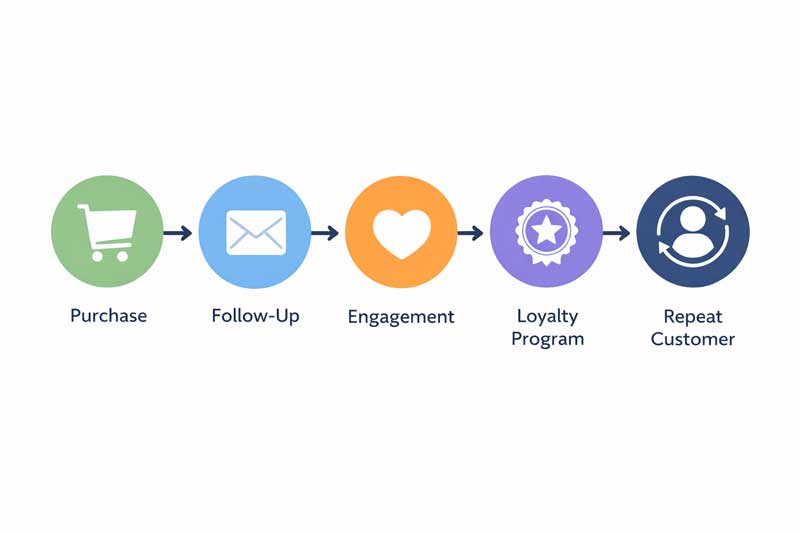
Not after the second purchase, not when a problem arises, but at the very moment the customer decides to place their trust in you and completes the transaction. This is the point where expectations rise — and silence can very quickly feel like a lack of interest.
The goal of post-sale activities is not short-term sales, but:
-
increasing customer lifetime value over time
-
creating conditions where repeat purchases happen naturally, not by force
It’s important to clearly distinguish between two terms that are often confused:
Post-sale as a process refers to the entire relationship with the customer after a purchase — how the company thinks about that relationship, plans communication, and tracks behavior.
Post-sale activities are the concrete actions within that process: the messages that are sent, the support that is provided, the benefits that are offered, and the steps that guide the customer toward their next purchase.
In other words, post-sale is the strategy, and post-sale activities are its execution in practice.
Why are post-sale activities more important than the sale itself?
Sales are the moment when a customer makes a decision. Post-sale activities determine whether that decision will continue — or remain a one-time event. From a business perspective, the difference between these two approaches is measured in money, time, and growth stability.
A new customer is always more expensive than an existing one
Acquiring a new customer requires advertising, content, discounts, sales time, and often multiple touchpoints before a purchase happens. Once the transaction is completed, that cost has already been incurred.
If you don’t invest in the customer after the purchase, that cost is never recovered. Every next sale starts from zero again.
Post-sale activities allow you to use already invested resources more intelligently, because bringing back an existing customer is always easier, faster, and cheaper than acquiring a new one.
Post-sale directly impacts key business metrics
Post-sale activities have a direct and measurable impact on the indicators that define long-term business value.
Customer lifetime value (LTV) increases when customers return and purchase repeatedly. Without post-sale activities, LTV remains low because everything depends on a single transaction.
Purchase frequency depends on whether customers have a reason — and a reminder — to come back. When silence follows a purchase, returns become accidental rather than planned.
Brand trust isn’t built only through product quality, but through the experience after the purchase. Customers judge reliability based on communication, support, and how they are treated once they are no longer in the decision-making phase.
In other words, post-sale doesn’t affect only marketing or sales — it shapes the entire customer relationship and its long-term value.
Customers rarely leave because of the product — they leave because of silence
In practice, customers rarely walk away because the product is bad. A much more common reason is simple: no one reaches out anymore.
Without post-sale activities:
-
the customer doesn’t feel noticed
-
they don’t know whether their experience matters
-
there is no clear next step
Over time, the brand becomes invisible. When the need for a repeat purchase arises, the customer chooses whoever shows up first or is easiest to remember at that moment.
Post-sale activities prevent exactly this — a good product and a strong first impression disappearing due to a complete lack of communication after the purchase.
Most common post-sale activities in practice
Post-sale activities don’t look the same in every company, but the logic is always the same: the customer is not left alone after the purchase. Instead of communication stopping, it continues in a meaningful way, aligned with the customer’s behavior and needs.
Post-sale communication with customers
Post-sale communication is the first and most common form of contact after a purchase. It can take place through different channels:
However, the channel itself is not the key factor. The real difference lies in the purpose of the communication, not the technology used to deliver it.
Good post-sale communication:
-
confirms that the purchase was successfully completed
-
removes uncertainty around delivery or product usage
-
reassures the customer that they haven’t “disappeared” from the system
-
introduces the next logical step, without pressure
Poor post-sale communication is reduced to a generic automated message with no context — or worse, complete silence. In that case, the customer is left alone with their experience, and the company misses a critical opportunity to build a relationship.
Post-sale services and support
Post-sale support is an extension of the customer experience, not a technical add-on to the business. How you respond after the purchase often leaves a stronger impression than the sale itself.
Post-sale services and support include:
-
answering questions after the purchase
-
resolving issues with orders or product usage
-
complaints, returns, and exchanges
-
clear and accessible communication with the support team
Three factors make the biggest difference here:
-
Speed – customers don’t want to wait days for a simple answer.
-
Continuity – they don’t want to explain the same issue from scratch every time.
-
Consistency – they expect the same rules and level of service every time.
When post-sale support is done well, it doesn’t just “fix a problem” — it strengthens trust. At that point, the customer is evaluating not just the product, but the entire brand.
Post-sale marketing and how it differs from traditional marketing
Post-sale marketing is often mistakenly confused with classic promotional campaigns. The difference is fundamental.
Post-sale marketing:
-
is not aggressive
-
is not a mass campaign sent to all customers
-
does not rely on constant discounts
Instead, it is based on the customer’s previous behavior. That means the message depends on:
-
what the customer purchased
-
how often they buy
-
whether they return or have “disappeared”
-
how much time has passed since the last purchase
The goal of post-sale marketing is not to “force one more sale,” but to:
-
remind the customer at the right moment
-
offer relevant value
-
naturally connect the previous purchase with the next one
When done properly, post-sale marketing feels natural — not intrusive.
Post-sale activities focused on loyalty
The most mature form of post-sale activities are those that build customer loyalty. Here, the relationship shifts from a single transaction to long-term cooperation.
Post-sale activities focused on loyalty include:
-
benefits for returning customers, not just first-time buyers
-
a sense of recognition, where the customer knows they’re not “just another order”
-
continuity of the relationship through consistent communication and rewards
At this stage, it becomes clear that loyalty can’t be managed manually. As the customer base grows, a system is needed that can:
-
identify the customer
-
track their behavior
-
connect purchases over time
-
enable meaningful follow-ups and rewards
This is where loyalty solutions like Spotlight naturally fit in — not as a marketing add-on, but as a way to unify all post-sale activities into one clear, measurable, and sustainable system.
When post-sale communication, support, marketing, and loyalty work together, post-sale stops being improvisation and becomes a stable driver of business growth.
Where do most companies go wrong in post-sale?
Most companies don’t fail because they lack good products or because they don’t want to retain customers. Post-sale mistakes usually happen because post-sale is treated as a secondary activity, rather than as an integral part of the sales process.
Because of this, the same mistakes are repeated over and over again — and often go completely unnoticed.

One-time purchases are treated as the end of communication
The most common scenario looks like this: the customer buys, receives an order confirmation, and communication stops there. There’s no message after delivery, no question asking if everything is okay, no clear next step.
The company assumes that a satisfied customer will come back on their own. In practice, the opposite happens — the customer has no reason to think about the brand until the product is needed again, and at that moment they often choose whatever is most visible or most convenient.
All customers receive the same message
Another common mistake is the complete lack of segmentation. New customers, returning customers, and loyal customers all receive identical messages, the same offers, and the same treatment.
A customer who buys regularly doesn’t feel recognized. A customer who has purchased once doesn’t receive communication tailored to their situation. The result is the same in both cases — communication loses its meaning and stops being effective.
Focusing on discounts instead of relationships
When post-sale doesn’t exist as a strategy, discounts become the universal solution. Every attempt to bring customers back turns into another promotion, another price cut, and more pressure.
The problem is that discounts may boost sales short term, but over time they damage brand value and train customers to return only when it’s cheaper. No relationship is built — it’s constantly reset.
Manual processes that can’t scale
In smaller teams, post-sale activities often live “in people’s heads”: manual messages, customer tracking in spreadsheets, relying on memory to know who returned and who didn’t.
As soon as the business grows, this approach stops working. Post-sale becomes inconsistent, dependent on team capacity and time, and many opportunities for customer return are missed.
If you recognize yourself in these examples, it doesn’t mean you’re doing something wrong — it means post-sale still isn’t set up as a system. And that’s exactly where the biggest opportunity for improvement lies.
What does a good post-sale strategy look like?
A good post-sale strategy doesn’t have to be complex, but it must be consistent. It’s not based on intuition or improvisation, but on a clear logic: knowing what happens after the purchase and reacting at the right moment, with the right message.
1. Tracking behavior after purchase
The first step of any post-sale strategy is understanding what customers do after they buy. Without this insight, every message becomes a guess.
In practice, this means knowing:
-
whether the customer returned after their first purchase
-
how much time has passed since the last purchase
-
how often they buy
-
whether they buy the same products or change their choices
This data isn’t about control — it’s about understanding. When you understand customer behavior, you stop treating them as anonymous transactions and start building a meaningful continuation of the relationship.
2. Customer segmentation
Once behavior is understood, the next step is segmentation. You don’t need complex models — just clear, logical segments with different needs.
The most common and useful segments are:
-
new customers who have just completed their first purchase
-
returning customers who have come back a few times
-
loyal customers with regular, stable behavior
-
customers who have stopped returning
Each of these segments requires a different approach. A message that makes sense for a loyal customer often has no effect on a new customer — and vice versa.
3. Timely communication
In post-sale, it’s not only what you say that matters, but when you say it. Timing is often the deciding factor between a helpful message and one that gets ignored.
Timely communication includes:
-
reaching out immediately after purchase to confirm the customer’s decision
-
contacting the customer after delivery to check if everything is okay
-
communicating after a certain period, when a repeat purchase is realistically possible
-
reminding customers who are drifting away before they disappear completely
The goal isn’t constant presence, but communication that fits naturally into the customer’s behavior cycle.
4. Rewarding consistency, not randomness
One of the key differences between good and poor post-sale strategies is how customers are rewarded. When only the first purchase or occasional returns are rewarded, habits don’t form.
A strong post-sale strategy encourages:
-
regular returns, not one-off comebacks
-
long-term relationships, not short-term sales spikes
-
a sense that loyalty pays off — without relying on constant discounts
When consistency is rewarded, customers start planning their return instead of reacting only to promotions. That’s when post-sale becomes a stable driver of growth, not just an occasional reactivation effort.
How a loyalty program connects all post-sale activities
When post-sale activities are handled individually — a bit of communication here, some support there, an occasional promotion — the result is often inconsistent. Some things work, others are forgotten, and most depend on the team’s current capacity. That’s where the core problem appears: post-sale exists, but it isn’t connected into a system.
That’s why one thing matters above all else:
A loyalty program is not “just another card” or a marketing add-on. Loyalty is the system that gives structure and meaning to all post-sale activities.
Loyalty is not a card — it’s relationship logic
In practice, loyalty is often misunderstood as a technical solution or a points-based program. The essence is far simpler — and far more important.
A loyalty program acts as a central layer that:
-
remembers the customer, regardless of when they last purchased
-
connects purchases over time, instead of treating each one as an isolated event
-
enables meaningful follow-ups, because communication is based on real behavior
In other words, a loyalty program creates continuity where there would otherwise be only disconnected customer touchpoints.
How loyalty connects communication, support, and marketing
Without a loyalty framework, post-sale activities tend to operate in silos. Communication is sent the same way to everyone, support reacts only when a problem appears, and marketing tries to “guess” the right moment.
When a loyalty system is in place:
-
communication has context, because it knows who the customer is and what they’ve done before
-
support sees the relationship history, not just the latest transaction
-
post-sale marketing is driven by behavior, not assumptions
As a result, post-sale activities stop being a series of disconnected actions and become a single, logical flow.
Spotlight makes it possible to:
-
recognize and track customers over time
-
connect post-sale activities into a meaningful whole
-
treat communication, loyalty, and customer return as parts of the same process
When do post-sale activities start delivering results?
One of the most common questions about post-sale activities is: when do results become visible? It’s important to be realistic — post-sale is not an instant solution and doesn’t work overnight. But it’s also not a strategy that takes years to prove its value.
Not immediately, but noticeably
Post-sale activities don’t change things after a single message or one campaign. Their impact is built through repetition and consistency. The first signs usually appear as:
-
a higher number of returning customers compared to the previous period
-
shorter time between purchases
-
fewer customers who are “completely lost”
These aren’t dramatic spikes, but they are clear signals that customer relationships are becoming more stable.
Faster than most expect
Unlike strategies that rely solely on acquiring new customers, post-sale activities work with an existing CRM base. Customers already know you, have already purchased, and already have experience with your brand.
Because of that, results often come faster than expected:
-
there is no awareness phase
-
no need to persuade from scratch
-
no high acquisition costs
As soon as communication, support, and follow-up are set up in a meaningful way, customers start responding — because the context is already familiar.
Built on existing customers
The greatest strength of post-sale activities lies in the fact that they don’t try to create interest where none exists. They rely on people who have already shown interest through a purchase.
That’s why post-sale doesn’t need to be aggressive. It only needs to be present, relevant, and consistent
This isn’t a trick — it’s a process
Post-sale activities are not a marketing trick or a short-term sales tactic. They are a process that improves over time.
As the process matures:
-
customers get used to continuity
-
returning becomes expected, not accidental
-
results become more stable and predictable
That’s exactly why post-sale delivers the most value to those who treat it as a long-term investment in customer relationships — not as a one-off attempt to “push” sales.
Frequently Asked Questions about post-sale activities (FAQ)
Do post-sale activities make sense for small businesses?
Yes. In fact, small businesses often benefit the most from post-sale activities because they have smaller customer bases and more room to build relationships. Even basic steps — clear communication, tracking returning customers, and simple rewards for continuity — can make a noticeable difference without large investments.
Are post-sale activities the same as customer support?
No. Customer support is just one part of post-sale activities. Post-sale also includes communication, post-purchase marketing, loyalty, and encouraging repeat purchases. Support reacts when there is a problem, while post-sale activities operate even when everything goes smoothly.
How often should customers be contacted after a purchase?
There is no universal rule, but one principle applies: less often and with purpose is better than frequent and without context. Every contact should have a reason — confirmation, experience check-in, useful information, or a logical next step. Too much communication without clear value can have the opposite effect.
Can post-sale activities work without discounts?
Yes — and in many cases, they work better without constant discounts. Customers don’t return only because of lower prices, but because of continuity, recognition, and the value they get from the relationship with the brand. Discounts can be part of post-sale, but they shouldn’t be the only tool.
How do you know if post-sale activities are actually working?
The success of post-sale activities isn’t measured by total sales alone. Clear indicators include:
-
growth in the number of returning customers
-
shorter time between purchases
-
more stable revenue
-
fewer customers who disappear after the first purchase
If these indicators are improving, post-sale activities are doing their job.
Do post-sale activities make sense in B2B sales?
Absolutely. In a B2B context, post-sale activities are often even more important because relationships are longer-term, decisions are more complex, and the value of a single customer is significantly higher. Ongoing communication, support, and structured relationship management after the first deal directly impact contract renewals and additional projects.
If you focus only on sales, you’re always chasing the next transaction. Every new customer requires new budget, new time, and new effort. Once the sale is complete, the cycle starts all over again.
When you develop post-sale activities, things change. Instead of constantly pursuing new customers, you begin building a base of people who return, remember you, and have a reason to stay connected with your brand. Sales stop being a series of disconnected attempts and become a more stable flow.
In that context, the Spotlight loyalty program is the tool that makes post-sale meaningful, connected, and sustainable — a framework that gives post-sale continuity and clear direction.