
High revenue does not necessarily mean a valuable customer. Learn how Customer Lifetime Value (CLV) is calculated, why averages can be misleading, and how to realistically increase it in practice.
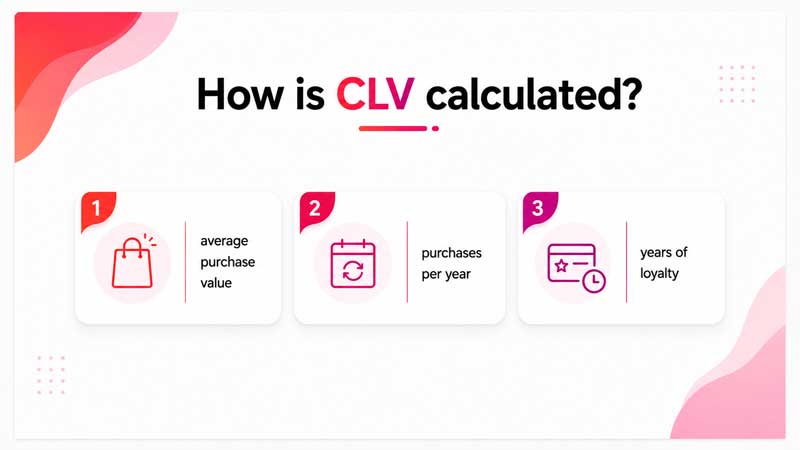
Customer Lifetime Value (CLV) is the total profit a single customer brings to your business throughout the entire relationship with you — not just from one purchase. It is calculated as average purchase value × number of purchases per year × number of years of loyalty. CLV increases through retention, more frequent purchases, and a higher basket value. But the key lies in data: you cannot increase what you do not measure per customer.
Most companies know exactly how many customers they have. Very few know which customers actually make them money. And that is where the problem begins: the budget goes into attracting new customers, while those who already come back quietly leave. Customer Lifetime Value is precisely the number that reveals this — how much one customer is worth to you through all future purchases, not just today at the checkout.
Let’s be honest: high revenue and a valuable customer are not the same thing. You can have a lot of revenue from people who buy once and disappear, and a small group of customers who keep coming back for years.
The first group fills your reports.
The second fills your bank account.
CLV is the metric that tells you which is which — and why that should change your decisions about marketing, discounts, and where you invest.
What is Customer Lifetime Value (CLV)?
Customer Lifetime Value, or CLV, is the total value — most often profit — that one customer brings to your business throughout the entire duration of their relationship with you. Not in a single transaction, but through all the purchases they make while they remain your customer. The same metric is also often referred to as LTV, or Lifetime Value.
The shift in perspective is the whole point. If you look at a single purchase, a guest who drinks a coffee for 5 dollars is worth 5 dollars to you. But if you look at CLV, that same guest who stops by five times a week for three years is worth hundreds of thousands of dollars.
In other words: CLV forces you to look at the relationship, not the amount on the receipt.
How to calculate CLV — formula and example
The basic formula is simple:
CLV = average purchase value × number of purchases per year × average number of years of loyalty
Let’s take a neighborhood grocery store as an example. The average basket value is 150 dollars. The customer visits roughly four times a month, which is 48 times a year. They remain loyal to the store for an average of five years.
The calculation is:
150 × 48 × 5 = 36 000 dollars
That is the value of a “small” 150-dollar customer when you look at the entire relationship.
This is a rough, revenue-based version of CLV. A more precise picture comes when you factor in two things: margin, because what matters is not revenue but profit, and customer acquisition cost, or CAC — how much it cost you to attract that customer in the first place. That gives you net CLV, a more realistic measure of profitability.
The point is not to have perfect data immediately. The point is that even a rough estimate changes the picture. Once you see those 36000 dollars, you start thinking differently about how much you can afford to invest in keeping that kind of customer.
CLV and CAC — Why the Ratio Changes the Picture
Customer Lifetime Value only really makes sense when you compare it with CAC, or Customer Acquisition Cost — the cost of acquiring a customer.
The rule is simple: a customer has to be worth significantly more than it costs you to acquire them.
In practice, a healthy benchmark is often considered to be around 3:1 — meaning the customer is worth at least three times more than what you paid to attract them.
This is where many companies fail. They spend 8000 dollars on ads to acquire a customer who buys once for 1500 dollars and never comes back. On paper, they are “growing.” In reality, they are losing money on every such customer. CLV is the number that destroys that illusion.
And retention is where the biggest gains are made.
Research by Frederick Reichheld of Bain & Company, published in Harvard Business Review in 2014, shows that increasing customer retention rates by just 5% can increase profits by 25% to 95%.
Not revenue — profit. In other words, the cheapest growth does not come from new customers, but from the ones you already have.
Average CLV Is Misleading — the Real Value Is in Segments
Average CLV is an almost useless number. It combines your best customer, the one who spends and returns for years, with someone who bought once during a sale, and gives you a number somewhere in the middle that describes no one.
In reality, your customers behave completely differently. A small share of them usually brings in the largest share of profit. If you send everyone the same message and the same discount, you give your most valuable customers less than they deserve, while giving your least profitable customers discounts that eat into your margin.
That is why serious work with CLV means calculating it by segment, not as an average. The most common framework for this is RFM analysis — segmenting customers by how recently they bought, how often they buy, and how much they spend: Recency, Frequency, and Monetary value.
Only when you see CLV by segment do you know where to invest your attention — and who to let go.
“I Don’t Have That Data” — How to Measure CLV in Retail
All CLV formulas assume that you know who the customer is, how often they come back, and how much they spend.
In an online store, you have that data because every account leaves a trace.
But in a physical store?
A grocery store, pharmacy, boutique, or café — the customer comes in, pays, and leaves. No name, no history, nothing.
And that is where the problem begins. You cannot increase customer value if you do not even know how to measure it. And to measure it, you have to connect purchases to a specific customer over time. In retail, that practically means one thing: a loyalty card as a source of data.
It turns an anonymous checkout purchase into data linked to a specific customer — and suddenly you have frequency, basket value, and customer lifespan, meaning all the ingredients needed to calculate CLV.
This is where a loyalty card as a data source stops being a “discount trick” and becomes the foundation of measurement. The problem is that tracking this manually across thousands of customers does not scale. An Excel spreadsheet is a snapshot of one moment; by tomorrow, it is already outdated.
That is where a system like the Spotlight platform comes in. It brings together a loyalty program, customer database, and segmentation in one place — and works for physical stores, not just online shops.
In other words: instead of guessing who your valuable customers are, the system shows them to you through their actual behavior.
How to Increase Customer Lifetime Value: 5 Levers That Actually Work
You increase Customer Lifetime Value by acting on the components of the formula: how often a customer buys, how much they spend per purchase, and how long they stay with you. There is no single magic lever — there are five that, when combined, move the number.
- Retention. This is the strongest lever. Every customer who does not leave extends their customer lifespan and increases CLV. This is where you get the biggest return with the least effort.
- Purchase frequency. Reminders, triggers such as birthdays or product replenishment, and a real reason for the customer to come back sooner than they normally would.
- Higher average basket value. Cross-selling and upselling — recommending a complementary product at the right moment, without being pushy.
- Longer customer lifespan. Reward tiers, points, and the feeling that loyalty pays off. A reason to stay with you instead of going to a competitor.
- Reactivation of “dormant” customers. A customer who has disappeared is not lost until you try to bring them back. Make one good attempt — and if they do not respond, let them go.
For these levers to work in practice, the message has to be right and it has to arrive at the right time. Across thousands of customers, that can only be done through automated campaigns by segment, not manually. Segments are half the job; the other half is sending the right message to the right customer.
And the most common mistake? One-off promotions. A big discount once a month attracts discount hunters, but it does not build the habit of returning.
CLV increases through consistency, not through an occasional campaign.
Mistakes That Make CLV Meaningless
The biggest mistake is confusing revenue with profit. A customer with a large basket who never returns and who was expensive to acquire can have a CLV close to zero — or even a negative one.
Revenue says everything is fine. CLV tells the truth.
The second mistake is relying on averages instead of segments, as we already discussed. Average CLV can hide both your best and your worst customers.
The third mistake is ignoring churn. You can be great at attracting new customers and still lose existing ones faster than you bring new ones in. That is like filling a bucket that has a hole in it. CLV without churn tracking gives you only half the picture.
And the final mistake: treating CLV as a one-time calculation. Customer behavior changes. CLV should be recalculated regularly — quarterly, or whenever prices, costs, or strategy change significantly. Otherwise, you are measuring the past.
Frequently Asked Questions About Customer Lifetime Value
What is the difference between CLV and LTV?
Practically speaking — there is no difference. CLV, or Customer Lifetime Value, and LTV, or Lifetime Value, refer to the same metric: the total value a customer brings during the entire relationship with your business. LTV is just a shorter term, more commonly used in SaaS and tech contexts. The essence is the same.
What is a “good” CLV?
There is no universal number — a “good” CLV is relative to CAC. A commonly used benchmark is that a customer should be worth at least three times more than it costs to acquire them, meaning a ratio of around 3:1. If your CLV is lower than your CAC, you are losing money on every customer.
How often should CLV be calculated?
CLV is not a one-time calculation. It should be recalculated regularly — most often quarterly — or whenever there are significant changes in prices, acquisition costs, retention rate, or product offering. That way, the number reflects current customer behavior instead of outdated assumptions.
Is CLV only for e-commerce and large companies?
No. Smaller businesses often benefit the most from CLV because their resources are limited, so every dinar invested in the wrong customer hurts more. With a loyalty card as a data source, CLV is just as applicable in physical retail — grocery stores, pharmacies, boutiques — as it is in online stores.
How does CLV affect the marketing budget?
CLV tells you the upper limit of how much you can spend on acquiring and retaining a customer while still remaining profitable. Without that number, the marketing budget is spent blindly. With it, you invest where the return is highest — most often in retaining existing customers, not only in acquiring new ones.
Customer Lifetime Value is not an academic metric reserved for large corporations. It is the most practical question a small or medium-sized business can ask itself. If you already have customers who come back — and you do — there is no reason to let their data gather dust. Stop guessing who your most valuable customers are. Let them show you through their behavior, and respond before your competition does.
The Spotlight platform is a system that handles both measurement and action for you — in physical stores and in webshops.