
A marketing plan is not a wish list. It is a map of sales, customers, and campaigns. See how to create a plan that can be measured, adjusted, and turned into results.
A marketing activity plan is not a list of tasks that need to be “somehow completed.” It is a way to know exactly who you are speaking to, why that group of customers matters, what you want to change in their behavior, and how you will know whether the campaign delivered results.
That is why a good marketing plan is not created only in a document. It is also created in a system that can execute it.
- If the plan says you want more repeat purchases, you need a way to identify customers who have not returned.
- If the plan says you want more loyal customers, you need a loyalty program that makes sense for your business.
- If the plan says you want personalized campaigns, you need a customer database that does not live in five disconnected spreadsheets.
A good marketing plan does not start with the question: “What are we going to post?” It starts with a much more important question: “What do we want the customer to do after this communication?”
Make a first purchase? Come back? Choose a higher-priced package? Use a loyalty benefit? Not leave for a competitor as soon as they see a discount? React again, even though they have not purchased for months?
When you set up a marketing plan this way, it stops being an activity calendar and becomes a growth system.
A marketing plan should not be viewed separately from customer data. The plan can say what you want to achieve, but the data shows where you currently stand: who buys often, who does not return, who responds to campaigns, who uses benefits, and who has the highest value for your business.
Without that insight, a marketing plan can easily slip into assumptions. And assumptions can sound very confident, right up until the numbers prove them wrong.
Spotlight is a complete marketing platform that helps reduce that gap. Through a customer database, segmentation, a loyalty program, automated communication, and analytics, the plan is no longer just “what should be done.” It becomes something that can be executed, tracked, and improved.
What is a marketing plan?
A marketing plan is a document that defines how marketing will contribute to business goals. It clearly determines who you are addressing, what you want to achieve, which channels you will use, how much you will invest, and how you will measure results.

The real value of a marketing plan is not that everything is neatly written in one place. Its real value is that it helps the team make better decisions.
For example, it is not the same to write: “We will launch a campaign for existing customers” and to know that you are targeting customers who purchased once but have not returned in the last three months. The first sentence sounds like an activity. The second already has direction, logic, and a way to measure results.
A good marketing plan must connect three things: the goal, the customer, and the action.
If one of these three elements is missing, the plan becomes weak. You can have an excellent goal but the wrong audience. You can have a good channel but an unclear message. You can have a large campaign but no clear indicator of whether it delivered results.
A marketing plan is not the same as a marketing strategy
A marketing strategy defines the direction. A marketing plan shows how the team will move in that direction.
A strategy may say that you want to build long-term relationships with customers, reduce dependence on discounts, and increase repeat purchases. That is a good direction. But the marketing plan has to answer how this will actually be done.
Will you segment your customers? Will you introduce a loyalty program? Will you communicate differently with new, active, and inactive customers? Will you measure revenue from existing customers, instead of only counting the total number of campaigns?
This is where the difference becomes clear between a plan that sounds good and a plan that can actually be executed.
Companies already have a lot of useful first-party data, but they often do not use it in a connected way. One part is in sales, another in the webshop, a third in campaigns, and a fourth in some spreadsheet. When data is scattered, the marketing plan becomes scattered too. When the data is connected, it suddenly becomes much clearer who you are speaking to and why.
Why should creating a marketing plan start with the customer?
Many marketing plans start with channels. Instagram, Google Ads, newsletters, SEO, TikTok, Viber campaigns. All of these can be part of the plan, but they should not be the starting point.
The channel is only the route. The customer is the reason you are taking that route.
If you do not know what happens with the customer before and after the purchase, it is easy to create campaigns that have form but no depth. There will be posts, discounts, newsletters, and seasonal promotions, but no clear connection to customer behavior.
That is why it is better to start with the question: which customers do we want to move from one stage to another, and what does the single customer profile look like?
Some customers need a reason to make their first purchase. Some need a reminder to come back. Some need a personalized recommendation. Some need to feel that loyalty pays off. Some do not need a discount, but a relevant offer at the right moment.
When you know this, the marketing plan becomes more precise. You are not trying to say the same thing to everyone. You are not spending marketing budget on an audience that is not ready. You are not sending generic messages to people who have already shown what they are interested in.
That is why segmentation and customer data are an important part of every serious marketing plan. Not because they sound modern, but because they stop marketing from becoming random.
How to create a good marketing plan?
First, you need to understand where the business currently stands. Do you have a problem attracting new customers or retaining existing ones? Do customers come back on their own, or do you constantly have to bring them back with discounts? Do campaigns generate sales or only clicks? Do you know which customers have the highest long-term value?
This is the moment when marketing stops being only creative work and becomes a business decision.
For example, if you see that a large number of customers buy only once and disappear, it is not enough to plan “more content.” The problem is not necessarily visibility. Maybe the problem is that after the first purchase, there is no communication that leads the customer toward a second one. Maybe there is no clear loyalty benefit. Maybe everyone receives the same message, so no one gets a relevant enough reason to return.
In that case, the marketing plan should focus on repeat purchases and post-purchase activities, not only on new campaigns.
The Spotlight marketing platform can help here because it connects customer data with concrete activities. When you know which customers have not returned, which ones are active, which ones respond to specific offers, and which ones have the highest potential, it becomes much easier to create a plan that does not depend on guesswork.
Goals in a marketing plan must be specific enough
One of the most common weaknesses of a marketing plan is a goal that sounds good but does not mean enough.
“We want higher sales” is a wish. It is not yet a plan.
It is better when the goal says exactly what you want to change, within what timeframe, and for which group of customers.
For example: increase the number of repeat purchases over the next three months, or increase revenue from existing customers through segmented campaigns and loyalty benefits.
That kind of goal immediately guides the rest of the plan.
If you want repeat purchases, you will not put the entire budget only into acquisition.
If you want higher revenue from existing customers, you will not send the same promotion to everyone.
If you want to activate inactive customers, you need to know who they are and how long they have not purchased.
A good goal forces the marketing plan to be precise.
A weak goal leaves too much room for almost any activity to later be declared useful.
What should a marketing plan include?
At its core, it should cover several key parts: analysis of the current situation, target audience, goals, channels, budget, activities, deadlines, and KPIs.
But the most important thing is that these parts do not stand separately.
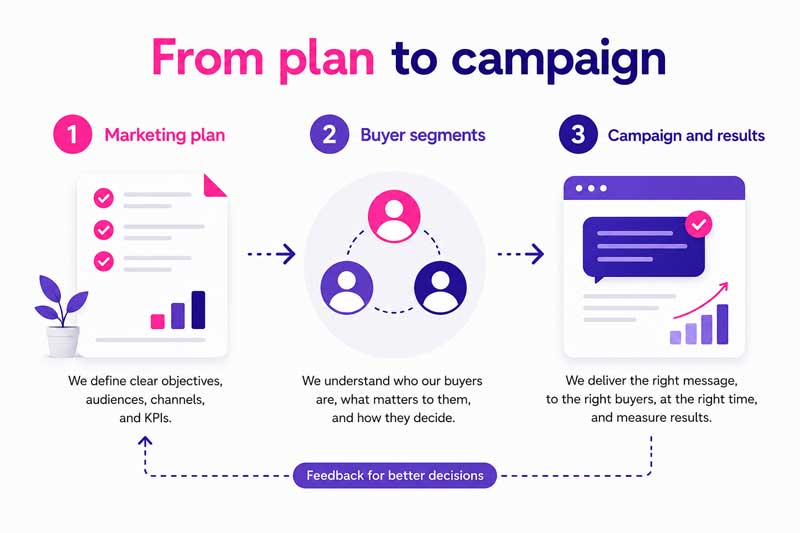
The target audience must be connected to the channel. The channel must be connected to the goal. The goal must be connected to the metric. The metric must be connected to the decision about what you do next.
If a campaign has a good open rate but does not generate sales, what do you change?
If loyalty members buy more often, how do you activate them further? If a certain segment does not return, do you change the offer, the channel, or the timing of the communication?
A marketing plan should also anticipate that part: not only what you launch, but how you learn from the results.
Marketing channels: do not choose them because they are popular, but because they have a job to do
When creating a marketing plan, it is easy to fall into the channel trap. One channel is currently popular, another is something “everyone uses,” and a third seems mandatory because competitors post there every day.
But a marketing channel has no value on its own. It gains value only when you know what role it plays in the relationship with the customer.
- SEO can bring in people who are still researching a problem.
- Ads can speed up the arrival of new customers.
- A newsletter can nurture the relationship with those who have already shown interest.
- A loyalty program can give the customer a reason to come back.
- Automated campaigns can react at the moment when a customer starts to cool off.
That is why a good marketing plan does not simply say “we are running an email campaign.” It says why the campaign is being sent, who it is being sent to, and what you expect to happen after it.
If a customer who purchased for the first time receives the same message as a customer who has been buying from you for years, you are missing the opportunity to communicate more intelligently. One customer needs trust. Another needs recognition. A third needs a reminder. A fourth needs a concrete reason to come back right now.
That is why channels should follow the stage the customer is in, not the internal feeling that “we need to send something out.”
In Spotlight, this is an important part of the platform’s logic: communication is not isolated from data. If you know who the customer is, what they bought, and how they behaved before, the message becomes more precise.
Spotlight connects customer data, automation, and marketing so that segmentation can move from theory into campaigns with a clear purpose.
Marketing plan budget: where does money most often leak?
The budget is the part of the marketing plan that often reveals how serious the plan really is.
If the budget is simply distributed across channels, without any connection to goals, you quickly end up in a familiar situation: money is spent on ads, content is created, campaigns are sent, but no one can clearly say which part of the investment brings the most valuable customers.
The problem is not investing in new customers. Of course new customers matter. The problem appears when all the focus goes to acquisition, while existing customers are left without a plan.
That is expensive for two reasons.
First, you are constantly paying to bring in people who do not know you yet.
Second, you are neglecting those who have already said “yes” to your brand once — and a customer who has already purchased often has a shorter path to the next purchase than a completely new person who is only just getting to know you.
That is why a good marketing plan should also allocate budget for customer retention. This includes a loyalty program, segmented campaigns, personalized offers, win-back communication, and all activities that increase the value of the existing customer base.
KPIs: how do you know the marketing plan is working?
A marketing plan without KPIs can easily become a matter of impression.
A campaign “went well” because it had a nice design. A newsletter was “solid” because it had opens. A post “worked” because it had reactions. But a marketing plan should not rely on the mood inside the team. It should rely on data that helps you make the next decision.
A KPI is not just a number you put in a report. It is a signal.
- If the goal is to increase repeat purchases, then it is not enough to look only at the number of clicks. You need to know how many people came back, how much they spent, and whether purchase frequency is changing.
- If the goal is to activate inactive customers, a good open rate is not enough. What matters is whether those customers actually returned to the store, app, or webshop.
- If the goal is a stronger loyalty program, it is not enough to count how many people joined. What matters more is how many members actually use the benefits, how often they buy, and whether they are more valuable than customers who are not in the program.
This is where it becomes clear why a marketing plan must be connected to analytics. Without it, you can have a lot of activity, but very little certainty.
The study “Marketing Planning, Market Orientation and Business Performance,” published in the European Journal of Marketing, confirms that high-quality marketing planning has greater value when it is connected to an understanding of the market and customers, rather than existing as an isolated activity.
In practice, that is exactly what a good marketing plan should do: connect planning with real customer behavior.
Example of a marketing plan for repeat purchases
Imagine a company that has a solid number of first purchases, but customers do not come back often enough. At first glance, the team may conclude that they need more ads. That is the fastest answer, but not necessarily the best one.
If people are already buying once, the question is not only how to bring in new customers. The question is why existing customers are not returning.
Maybe after the first purchase they do not receive any communication. Maybe there is no clear benefit for the second purchase. Maybe they receive generic promotions that have nothing to do with what they bought. Maybe the brand expects them to remember it on their own at the exact moment they need the product again.
A good marketing plan would approach this differently.
First, it would look at customers who made their first purchase. Then it would analyze how many of them return, after how much time, and which campaigns they respond to. Based on that, the communication would be created in a way that does not feel like a mass message, but like a meaningful continuation of the relationship.
For example, after the first purchase, the customer may receive a message that helps them use the product better, then a personalized recommendation, and then a loyalty benefit with a clear reason behind it. If they do not return after a certain period, they can enter a win-back campaign that does not immediately start with the strongest discount, but first tries to rebuild interest.
The Spotlight marketing platform makes it possible to run this kind of plan without managing everything manually. The platform brings together a loyalty program, Customer Data Platform, marketing automation, and analytics, which means that a customer profile can be turned into a concrete campaign — not just a nice insight in a report.
The most common mistakes in marketing planning
The biggest mistake is creating the plan from the company’s point of view, instead of the customer’s.
The company wants sales, more campaigns, better visibility, and a stronger brand. The customer, on the other hand, is not thinking about your quarterly plan. They respond when the message makes sense to them, when the offer arrives at the right moment, and when they feel they have a reason to come back.
The second mistake is too many activities without a clear priority. If the plan tries to cover everything, it often fails to hit anything strongly enough. It is better to choose a few goals that are directly connected to the business and build activities around them.
The third mistake is ignoring existing customers. Many companies invest huge energy into attracting new people, while customers who have already purchased are left without attention. It is like constantly filling the store with new visitors, but never asking why no one is coming back.
The fourth mistake is measuring the wrong things. Clicks, likes, and opens can be useful signals, but they are not enough if you do not know whether they led to a purchase, a repeat purchase, or a higher customer value.
A marketing plan should reduce these kinds of mistakes. Not by hiding them behind nice-looking tables, but by making them visible in time.
Mini marketing plan template
If you want a simple framework, you can build a marketing plan around several questions.
First: what is the business goal that marketing needs to support? Not a general goal, but a concrete shift you want to see.
Second: who is the customer this plan applies to? Define the buyer persona not only demographically, but also based on behavior, the stage of their relationship with the brand, and their potential for future purchases.
Third: what message makes sense for that customer at that moment? If the message can be sent to everyone, it is probably not sharp enough.
Fourth: which channel will be used to send that message, and why that specific channel?
Fifth: how will you measure the result? Not only whether the campaign was sent, but what happened after it.
And sixth: what will you do with that insight? If the result does not change the next decision, then it is not analysis — it is an archive.
If you want your marketing plan to stop being a wish list and become a system that moves customers, Spotlight can be the right place to start. Through a customer database, loyalty program, segmentation, automation, and analytics, the plan gets what it most often lacks: a connection with the real behavior of the people who buy from you.