
What are an ideal customer and a buyer persona? Why is there often a large gap between the person you imagine and the person who actually buys from you and how can you close it? Find out.
Imagine this conversation. You ask the owner of a small sports equipment retail chain who their ideal customer is. Without hesitation, they answer: a man, 28–40 years old, active, into running and cycling, with middle to higher income, living in the city.
A month later, you analyze the actual purchase data. It turns out that the highest-value customer segment is a woman aged 45–58, buying for her husband, son, or grandson. She visits less often, but spends twice as much per visit.
Our sports equipment store owner never saw her as their ideal customer. They never spoke to her at all.
This is not a made-up example. It is a pattern that repeats across businesses of all sizes, in every industry. And this is exactly where the problem with the classic approach to defining the ideal customer begins.
Every business has a buyer persona in its head. Very few have proof that the persona is accurate.
What is a buyer persona, what is an ideal customer and why these two terms should never be confused
In marketing jargon, these two terms are often used interchangeably, as if they meant the same thing. They do not.
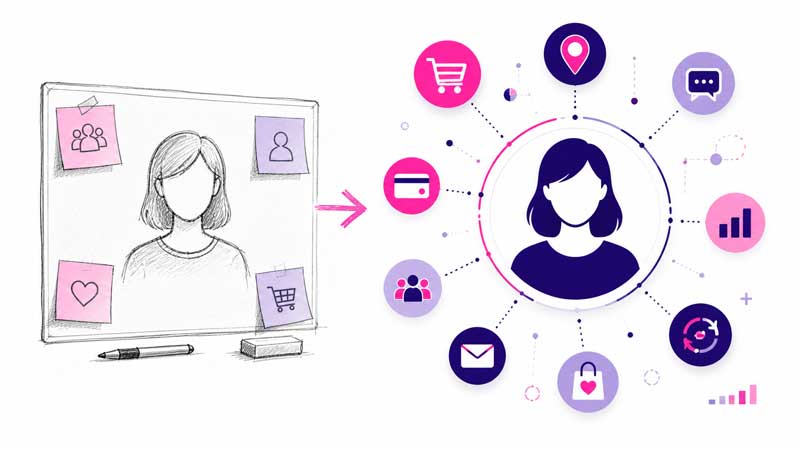
Buyer persona is a semi-fictional profile you create based on market research, surveys, interviews, and available data. It is a structured hypothesis — organized and documented, but still only an assumption about who your customer might be.
An ideal customer is something different. It is a persona that has passed through the filter of reality — validated through actual behavior, real purchases, and real interactions with your brand. It is not imagined. It is recognized.
The difference is the same as the difference between a house blueprint and a house that has actually been built. The blueprint can be perfect. The house will always be somewhat different.
Both concepts are useful, but the problem starts when the blueprint is treated as the finished building — when a business makes decisions about communication, campaigns, and product development based on a persona that has never been tested against reality.
If you want to see what it looks like when all customer data is connected into one whole, take a look at how a single customer profile works.
There is also a third element that is often overlooked: the negative buyer persona. This is the profile of the customer you do not want — someone who is not profitable, who is not satisfied with your offer no matter how much effort you invest, or who consumes resources without bringing value. Defining a negative persona is just as important as defining the ideal one, because it allows you to consciously direct your resources where they actually bring a return.
What a buyer persona includes: elements you should not skip
A good buyer persona is not a list of data points. It is a story about a person. And like every good story, it has structure.
Demographic data is the starting point. Age, gender, location, education, occupation, income, marital status, number of children. These are details you can collect relatively easily — through website analytics, social media insights, or a short survey. They give you the framework into which everything else is added.
Psychographic data is where the persona starts to feel real. The values this person holds, the interests that motivate them, the lifestyle they lead, and their attitudes toward certain topics. This is harder to collect, but it is often crucial for defining the tone of communication. Two people with the same age and income can have completely different values and respond to completely different messages.
Pain points describe the problem your customer wants to solve. It is not enough to know what they buy — you need to know why. What problem brought them to you? What frustrates them about alternative solutions? What would be the perfect outcome for them? The answers to these questions form the foundation of every message that converts.
Motivators and fears are two sides of the same coin. Motivators are what push the customer toward a purchase — saving time, status, security, comfort, price. Fears are what hold them back — the risk of making a mistake, losing money, distrust, lack of information. A business that understands both sides can create a message that increases motivation while reducing fear.
Habits and channels determine where and how the customer spends time, where they look for information, and where they make decisions. Do they read blogs or watch videos? Are they on Instagram or LinkedIn? Do they buy impulsively or research thoroughly? Do they care more about a friend’s recommendation or online reviews? This directly determines where and how you should appear.
The pre-purchase objection is an element many people forget, but it is extremely valuable for the sales team and for every piece of content you write. What will the customer say to themselves or to their partner before making a decision? “It’s too expensive.” “I’m not sure I really need this.” “Does this actually work?” If you know that objection in advance, you can address it before it appears.
This is exactly why it is important to understand not only who your customer is, but also how they behave — which is the basis of every serious customer behavior analysis.
How to create a buyer persona — step by step
Step 1: Collect data about your existing customers, if you have them
Start with the people you already have. Google Analytics, Instagram Insights, your customer database, sales records — all of these contain information about who actually buys from you. Look for patterns: which age groups dominate, where they come from, which products are repeatedly purchased first.
Step 2: Talk to your customers
Analytics tells you what. Conversation tells you why.
Select ten to fifteen customers — ideally a mix of new customers, loyal customers, and those who have stopped buying — and ask them a few key questions. Why did they choose you? What triggered their first purchase? What would they change? Which alternatives did they consider? The answers will surprise you.
Step 3: Analyze your competition
Who follows your competitors on social media? Who leaves reviews? What do they complain about in the comments, and what do they praise? Other people’s customers are a goldmine of information about what the market wants and what it lacks.
Step 4: Build the profile
Once you have enough data, it is time to synthesize it. Give the persona a name — not a category, but a real name. “Ana” or “Mark” is easier to remember and easier to think about than “segment 35–45.” Add a short biography — one paragraph describing their typical day. Then include all the elements listed above: demographics, psychographics, pain points, motivators, and channels.
Step 5: Check whether the persona holds up
Before declaring it official, ask yourself one question: would this person recognize themselves in the content we currently publish? Would they respond to it? Would they click on our ad, email, or message? If the answer is not a clear “yes,” either the persona or the communication needs to be adjusted.
Buyer persona template
This is the basic structure you can adapt to your business:
Name and photo — fictional, but specific. A photo helps the team experience the persona as a person, not as a spreadsheet.
In one sentence — who is this person and why do they buy from you? One sentence that summarizes everything.
Demographics — age, gender, location, education, occupation, income, family situation.
Typical day — a short description of their morning routine, workday, and evening routine. When do they have time to research and buy? When are they stressed? When are they open to new information?
Goals — what do they want to achieve in life or business where your product can help?
Challenges and frustrations — what problems are bothering them? What was missing from previous solutions?
How they look for information — Google, recommendations, social media, expert content, YouTube?
Pre-purchase objection — what will they say before clicking “buy”?
What wins them over — what kind of message, proof, or offer pushes them to make a decision?
How a buyer persona is built — and where almost everyone gets it wrong
The methods are usually correct. The problem is in the data that flows into the persona.
Mistake one: relying on instinct instead of data. “We know our customers” — this sentence has been heard by more failed businesses than almost any other. Intuition is a good starting point, but not a sufficient endpoint.
Mistake two: treating the buyer persona as a one-time project. Customers change. Markets change. A buyer persona created three years ago may describe someone who is no longer even your customer. A persona that is not revised becomes fictional.
Mistake three — and the most subtle one: confusing the buyer with the user. The person who pays is not always the person who uses the product.
If you sell children’s clothing, the buyer is the parent, while the user is the child.
If you sell HR software, the buyer is the manager, while the user is the employee who fills in the time records.
If you speak to the wrong person, even the most precise message will not convert.
But there is also a deeper structural mistake that often goes unnoticed: interviews and surveys tell you what the customer thinks they want — not what they actually do. Sales psychology has long known that there is a gap between stated preferences and real behavior.
A customer who says they choose a product because of quality often chooses it because of price. A customer who claims innovation matters to them often buys the most proven solution.
Words can be misleading. Customer behavior cannot.
The turning point: when must an assumption become data?
There comes a moment in every business when the buyer persona stops being a theoretical tool and becomes an operational necessity. That is the moment when you have enough customers that you can no longer know each of them personally, but you still need to act as if you do.
At that point, businesses split into two groups.
The first group continues to communicate with an imaginary customer — with a persona created from first impressions, a few conversations, and logical assumptions. Campaigns are generic. Messages are too broad. Conversions stagnate.
The second group decides to listen to the data. Not just transactional data, not just who bought what and when, but behavioral data: how often a customer returns, what motivates them to stay, what makes them leave, when and why they recommend the brand to others.
In practice, businesses that successfully move from “we think our customer is…” to “our data shows that our customer is…” did not do it thanks to better surveys. They did it because they established a system that records real customer behavior in real time.
Marketing platforms such as Spotlight play a key role here because they are not just a record of transactions, but a tool that builds each customer profile based on what the customer actually does: when they visit, what they buy, what they respond to, and when they come back. Your buyer persona stops being a document created once and then forgotten. It becomes a living, updated profile that becomes more precise with every new interaction
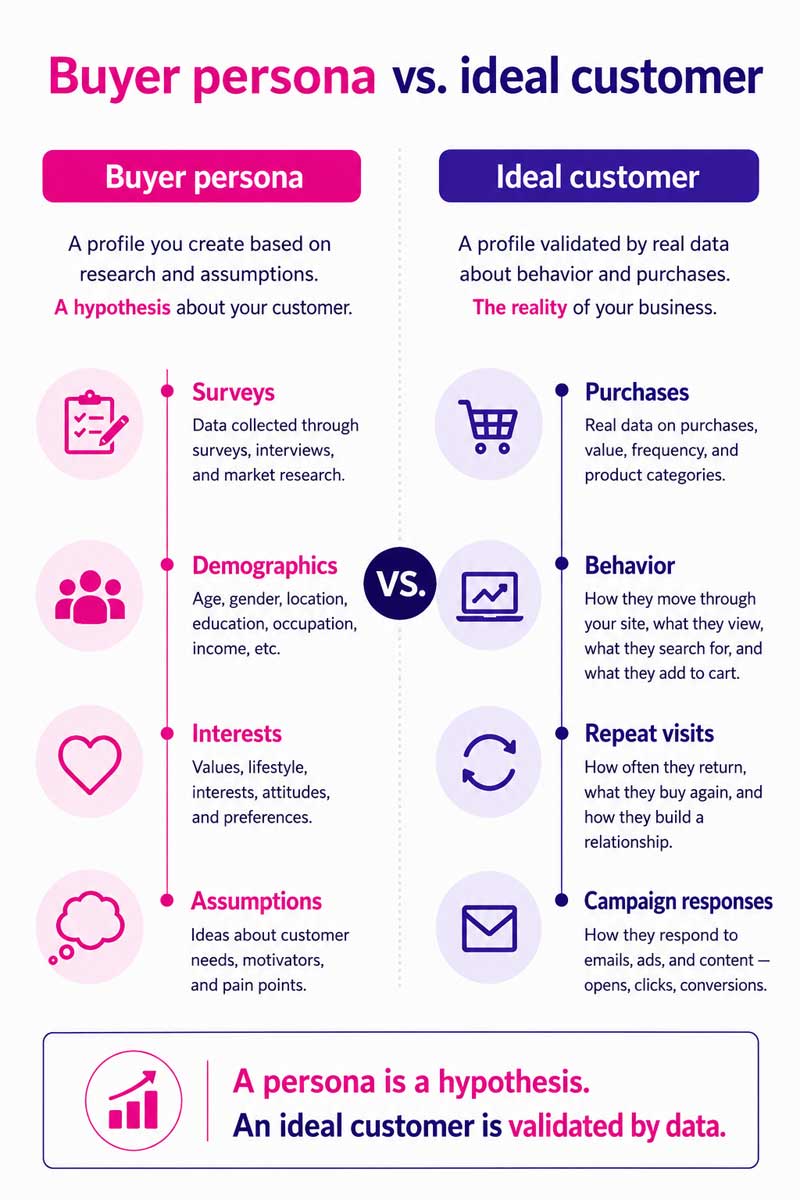
Every business goes through a phase where it creates a persona because “that’s what you’re supposed to do.” Very few businesses take the next step — putting that persona to the test and being ready to change it when the data says otherwise.
And data always says something.
The difference between a business that grows and a business that stagnates is rarely that one had better intuition about its customers. More often, the difference is that one decided to listen, while the other decided to assume.
Every targeting mistake starts with the same sentence: “We know who our customer is.” Businesses that truly know this no longer say it based on impressions.
Is your buyer persona based on data or on assumption? If you are not sure, it is probably time to check.
Frequently asked questions about defining a buyer persona
Can a buyer persona be used for B2B sales?
Yes. A buyer persona is useful in B2B sales as well, but it must distinguish between the person who makes the decision, the person who uses the product, and the person who approves the budget.
How many buyer personas should one business have?
In most cases, 2 to 4 buyer personas are enough. If you have too many, communication becomes scattered and it becomes difficult to know who you are actually addressing.
When does an ideal customer stop being ideal?
An ideal customer stops being ideal when they generate revenue but require too many discounts, too much support, or too much additional time, reducing profitability in the long run.
Does the ideal customer always spend the most?
Not always. The ideal customer is not only the one with the highest basket value, but the one who returns, responds to communication, recommends the brand, and has long-term value.
How do you know your buyer persona is wrong?
Your buyer persona is probably wrong if campaigns are not delivering results, customers are not responding to your messages, and actual purchase data shows a different profile from the one you imagined.
Imagining your customer costs time. Knowing your customer brings revenue.
A buyer persona without data is guesswork. A useful starting point — but a poor foundation for decisions that cost money.
The Spotlight marketing platform collects data about your customers’ real behavior, builds their profiles in real time, and gives you the tools to speak to the right person, at the right time, with the right message. No guessing.
See who really buys from you — and why they come back.