How can sending SMS messages to customers become a sales channel rather than just a notification? This guide walks you through SMS marketing – strategy, segmentation, and automation.
When we talk about SMS marketing and sending SMS messages to customers, we’re talking about the most direct channel you have: the message arrives instantly, it’s opened instantly, and, most importantly, the customer sees it before they check Instagram, email, or the weather app. That’s why SMS still has an open rate other channels can only dream of.
But today, SMS marketing is no longer about “send the same discount to everyone and hope for the best.” If you do that, customers will either ignore you or unsubscribe entirely.
Today’s customer expects relevance, timely information, and a message that truly matters to them. And as a brand, you need to know who you’re messaging, what you’re sending, and why you’re sending it at that specific moment.
In the rest of this guide, we’ll dive into the whole strategy: from what SMS marketing really is, to how you can connect it with loyalty data, automation, segmentation, and an omnichannel approach.
Everything you need to turn SMS into a channel that actually drives sales.
What is SMS marketing today?
Modern SMS marketing is a precisely planned communication channel built on data, customer behavior, and timing.
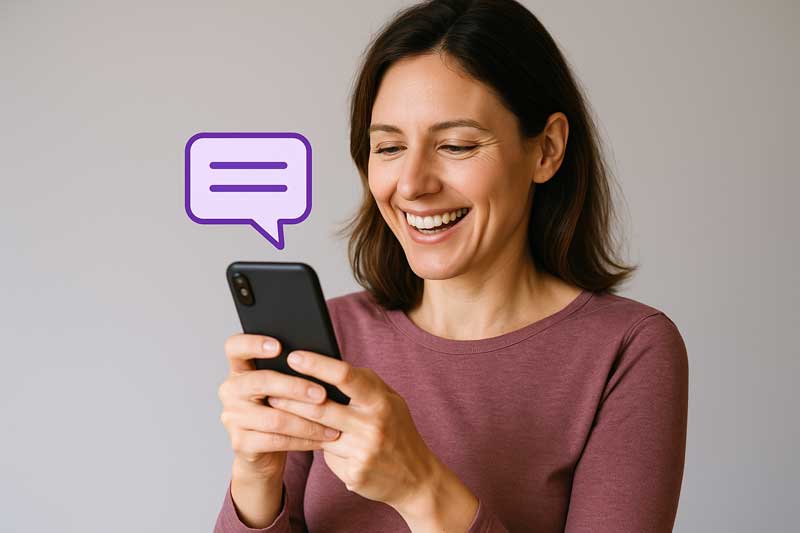
SMS is no longer just a short message – it’s a micro-moment: instant, personal, and completely free from algorithms. When you send an SMS, you know the customer will see it – and see it immediately. That’s why brands across the world and the region are returning to this channel: it delivers results even when other channels fail.
In the simplest definition, SMS marketing means sending carefully targeted SMS messages to customers with a clear intention: driving sales, reactivation, notifications, loyalty, customer care, or crisis communication.
But the key word is “targeted.”
Without segmentation, automation, and a real understanding of customer behavior, SMS becomes nothing more than spam.
The advantage of SMS is brutally simple: the message doesn’t have to “fight” an algorithm, it doesn’t land in the Promotions tab like email, and it doesn’t disappear in a feed after three seconds.
SMS has to be short, clear, and crafted for that specific customer.
Sending SMS Messages to Customers – When Does It Make Sense, and When Doesn’t It?
SMS makes sense when you need a fast reaction and guaranteed delivery.
For example: instant or holiday promotions, short-lasting discounts, the final day of a campaign, birthday coupon codes, or a promotional offer with a clear value. Customers respond especially well to flash sales, order confirmation messages, “your package has been shipped” updates, reminders about expiring points, or prompts to complete their purchase. In these moments, SMS works faster and better than any other channel.
On the other hand, SMS isn’t ideal for everything. If your goal is storytelling, education, blog distribution, or brand building, email and social media do that far better.
SMS is not a place for brand awareness.
Brands also make a mistake when they send messages just because “something needs to be sent.” With SMS, every message must have a purpose: solve a problem, deliver value, or prompt an action that makes sense to the customer.
And the most important rule:
SMS must have good timing.
Late at night? No. Early in the morning? No. Too often? Even worse.
When SMS is used well – the customer reacts.
When it isn’t – they delete it and ignore you forever.
Legal Framework and Consent – How to Run SMS Marketing the Right Way
This is what separates a brand that builds trust from a brand that risks fines, complaints, and dissatisfied customers.
Sending SMS messages to customers is allowed only if you have their explicit consent.
This means you cannot buy contact lists, borrow someone else’s database, or merge lists from different sources. That’s not marketing — that’s a violation of regulations and a guaranteed way to damage your reputation.
Proper consent is straightforward: the customer voluntarily provided their phone number and clearly confirmed that they want to receive a specific type of message (discounts, notifications, birthday greetings, delivery updates, and so on). This can happen through joining a loyalty program, signing up for a newsletter, filling out a form at checkout, or using a digital discount app. What matters is that the customer understands what they will receive – without hidden intentions or fine print masking the purpose of the communication.
An equally important part of the process is the ability to unsubscribe easily. The customer must be able to stop communication without hassle – a single STOP message is more than enough. Brands that respect this principle see higher trust and stronger loyalty because customers feel they have control over their own data.
When you follow this framework, SMS marketing becomes a channel that delivers results and strengthens trust. When you ignore it, it becomes a source of problems.
Spotlight’s philosophy is simple: communication based on consent, transparency, and value is the only long-term strategy that truly works.
Types of SMS Messages Customers Actually Read
People don’t like messages that interrupt them, but they do like messages that solve something for them in that moment. That’s the key.
The most-read messages are transactional: order confirmations, “your package has been shipped,” “arriving today,” “ready for pickup.” These messages build trust, reduce stress, and boost customer satisfaction because the customer no longer has to wonder, “Where is my order?”
Next are promotional messages, but only when they offer real value. Customers respond extremely well to loyalty-only discounts, personalized category offers, birthday greetings, or exclusive campaigns. The message must be clear, concrete, and focused on what matters to the customer.
Lifecycle campaigns are the third category with outstanding results: welcome messages, “thank you for your purchase,” a reminder after 30 days of inactivity, birthday vouchers, or notifications about expiring points. These messages are sent automatically, based on customer behavior.
And finally: service and informational messages, such as appointment reminders, reservation confirmations, or back-in-stock alerts. People appreciate them because they save time and prevent missed obligations.
SMS Marketing Strategy
Every strategy begins with a simple question: What do you want SMS to achieve for your business?
Is your goal a higher average order value? More store visits? Faster reactivation of customers who went “dormant”? Or do you want to increase purchase frequency?
If that goal isn’t clearly defined, you’ll end up with a series of messages sent into the void, but without a measurable result.
The second step is segmentation. It may sound complicated, but it’s actually completely logical: different customers respond to different things.
- Customers who buy often expect special perks.
- Customers who buy rarely need a reason to return.
- Those who love flash sales respond best to short, direct messages that nudge them to act immediately.
Spotlight does all of this automatically — it identifies who is who and allows you to send messages that make sense for that specific person at that specific moment.
The third step is timing. SMS shouldn’t be sent when it’s convenient for you, but when the customer is most likely to react. This depends on the industry, customer habits, and performance of previous campaigns. The Spotlight customer data platform handles much of this work for you: it shows exactly when each segment has the best response rate, allowing you to plan accordingly.
With the right strategy, SMS marketing becomes the fastest and most precise path to conversion.
Personalization in SMS Messaging
Personalization isn’t just adding someone’s name to a message. Customers see that a thousand times. Real personalization means the message is about them – about what they bought, what they like, how often they shop, and which store they visit. When a message “hits the mark,” it feels as if you read their purchase history – when in reality, you’re simply using CRM data smartly.
The most useful data points for personalization include: last purchased category, purchase frequency, average order value, loyalty points, past campaign response, and location.
Example: a customer who bought a face cream 28 days ago receives a message offering a discount on products from the same line, because you know they’re about to run out. That’s helpful, not intrusive.
Bad messages are generic:
“Today: discount on everything.” Customers ignore them.
Good messages are specific:
“Your favorite category is 20% off today. Offer valid until 6 PM.”
This is where Spotlight excels — you get the data you need to deliver messages customers actually experience as their own.
Automation – Sending SMS Messages to Customers Without Manual Work
Automated workflows in Spotlight allow you to set up the logic once, and the system does the work for you all year long – no repetition, no manual sending, no improvisation. The most common examples are well known: welcome messages, birthday SMS, win-back campaigns after 30 days without a purchase, reminders about expiring points, or post-purchase messages with a coupon for the next order. All you do is create the rule; Spotlight handles the rest.
The biggest advantage of automation is timing: the message is sent at the exact moment the customer does something that triggers communication. Not when you remember you “should send something,” but when the customer’s own action signals the right moment.
For example:
Customer abandons the cart → an automatic SMS reminder is sent.
Customer moves to a higher loyalty tier → an SMS with thanks and benefits arrives.
Customer clicks a campaign but doesn’t complete the purchase → a targeted reminder brings back their attention.
Marketing automation reduces manual work, increases message relevance, and delivers steady growth with minimal effort from your team.
Combining SMS with Viber, Email, and Push Notifications
The best results happen when channels work together, not when you treat them as competitors. Each channel has its own role: SMS is fast and reliable, Viber allows visual presentation at a lower cost, email is ideal for detailed information, while push notifications are perfect for moments when the customer is already using your app.
When you combine these channels into one coherent flow, you get conversions that no single channel could achieve on its own.
A real-world example looks like this:
You send an email announcing a weekend promotion. A day later, only to those who didn’t open the email, you send a Viber message with an image and a QR code for quick access to the offer. Finally, your most frequent shoppers receive an SMS as a personalized, last-call reminder.
That’s omnichannel at its most effective — precise, intentional, and highly relevant.
Spotlight makes this effortless: one system, all channels, all data in one place. No switching between multiple marketing tools, no manual segment syncing, no delivery mistakes. The customer always receives a message aligned with their behavior, purchase history, and what truly matters to them.
That’s why omnichannel isn’t a trend – it’s the way digital communication actually works.
Measuring Results – How to Know Whether Your SMS Marketing Works
Without measurement, SMS marketing is nothing more than guesswork — but once you start tracking performance, SMS becomes a precise science.
The key metrics that determine the success of a campaign are: delivery rate, number of clicks (if you use links), number of redeemed coupons, revenue generated after the campaign, and unsubscribe rate.
These numbers don’t just tell you whether the campaign works — they tell you why it works or why it doesn’t.

Spotlight takes this a step further, because it doesn’t measure only surface-level indicators.
The platform connects SMS messages with actual purchases. Instead of relying on click-through rates, you see exactly which segment generated the highest revenue, which type of message performs best, and at what moment customers are most likely to react. With this level of insight, optimization becomes a natural process – messages become more relevant, marketing costs decrease, and profit grows.
A/B testing accelerates learning even further. Two different texts, two offers, or two timing options — the system clearly shows which approach delivers better results. With this data, every new campaign becomes safer, more precise, and more effective than the one before it.
That’s why strong measurement is the foundation of every serious SMS marketing strategy.
The Most Common Mistakes in SMS Marketing – and How to Avoid Them
The biggest mistake is sending messages to everyone. Customers are not the same, and they expect messages that speak directly to them.
The second major mistake is sending messages too frequently. When a brand forces communication, customers unsubscribe. The line between helpful information and irritation is very thin.
The third mistake is sending messages with no clear value. If a customer reads an SMS and doesn’t understand why it’s relevant to them, the opportunity is lost.
The fourth mistake is writing long messages. SMS has to be quick, clear, and to the point.
The fifth mistake is ignoring unsubscribe rules and regulations. This risks both your reputation and customer trust.
And finally, another mistake is relying on SMS alone. Brands that depend on a single channel risk weaker results. The combination of SMS, Viber, email, and push notifications is what delivers real strength.
This is exactly why Spotlight brings all channels together in one platform, turning scattered communication into precise, coordinated, and effective marketing.
Examples of SMS Campaigns by Industry
Retail: personalized offers based on categories the customer frequently buys. For example: “Everything for breakfast – 15% off today only.” Or a reminder to use loyalty points before they expire. Customers react because the message reflects a real habit.
Fashion & Beauty: win-back campaigns perform exceptionally well. A message like “We haven’t seen you in 30 days — here’s 20% off to remind you why you loved us” brings people back. Birthday vouchers also perform great because they feel thoughtful and personal.
Pharmacies & Drugstores: seasonal promotions (vitamins, sun protection, hair care). Reminders about expiring points and exclusive benefits for loyalty members.
Service-based businesses: salons and repair services benefit most from appointment reminders. SMS reduces no-shows and increases loyalty. Gyms use messages to encourage membership renewals and re-engage members who skip workouts.
SMS campaigns aren’t the same for everyone — but the logic is universal: be useful, be accurate, be timely. Spotlight handles the rest.
How the Spotlight Platform Makes SMS Marketing Easier
Spotlight is built for brands that want SMS to become a serious revenue channel — not just a short notification.
The first thing it solves is the customer database: all data lives in one place, connected to purchases, points, history, categories, and reactions. This means you can segment with precision — from your highest-value customers to those who only buy certain products or respond to specific types of offers.
The second thing is communication from a single system. You no longer need separate SMS providers, email software, Viber platforms, or push tools. Spotlight unifies all channels. One system, one click — all messages, to all customers, in the way that suits them.
The third thing is automation. Spotlight workflows run even when you’re not working: welcome messages, win-back sequences, birthday campaigns, abandoned cart reminders, delivery updates, and notifications before loyalty points expire. You get to focus on strategy and creativity, while the platform handles the routine.
The result? Less manual work, more conversions, a consistent customer experience, and a clear connection between every message sent and every dollar earned.
SMS marketing isn’t just a short message – it’s the fastest route to the customer. When done smartly, SMS can boost sales, strengthen loyalty, and turn occasional shoppers into regular ones.
If you want SMS marketing to finally deliver real results, it’s time to connect your data, channels, and automation into one system.
Bring the Spotlight platform into your business and launch your first SMS flows that convert.