Guests return to a café or restaurant out of habit — until someone else wins them over. Here is how a loyalty program in hospitality turns occasional visitors into regular guests.
In Short: Loyalty Programs in Hospitality
A loyalty program in hospitality rewards repeat visits and turns anonymous guests into recognizable customers — with a history of visits and spending.
Hospitality lives on frequency, not on one large purchase. Without a system, you do not know who your regular guests are, or when they stop coming.
The same platform works differently for a café, where points and frequency matter; a restaurant, where reservations and average spend matter; and a hotel, where the guest may come rarely but has high value.
The biggest hidden benefit is segmented messaging that fills empty time slots and low seasons.
At the end of a shift, you know how many bills you issued, but you do not know how many of those people ever came back. That is the gap through which hospitality quietly loses money, and a loyalty program in hospitality exists precisely to close it — to turn a guest who stopped by by chance into a guest who comes back because it pays off.
Let’s be honest: most cafés and restaurants think they “know their guests”. They know faces. They do not know data. And a face will not tell you that your best Wednesday guest has not been in for three weeks — until they go to the competitor across the street.
What Is a Loyalty Program in Hospitality?
A loyalty program in hospitality is a system that records and rewards repeat guest visits through points, discounts, complimentary coffees or special benefits — while also collecting data on who comes, how often they come and how much they spend. It is not a discount trick. It is a database.
A retail store often lives on occasional, larger purchases.
Hospitality lives on frequency: small, repeated spending that builds up day by day. One coffee is not a big item. One hundred coffees in a month from the same guest — that is.
That is why loyalty in hospitality does not measure only “how much someone spent today”, but how often they come back. And you cannot track that from memory.
Why Hospitality “Doesn’t See” Its Guests
Here is a misconception worth breaking right away: “we know who our regular guests are”. You know the people who sit at the bar and chat. You do not know the quiet ones — and they are the majority.
The problem lies in how payment works. A guest pays in cash or by card, takes the receipt and leaves. The transaction has no name. You do not know whether this is their first visit or their fiftieth. You do not know whether they were across the street yesterday. And most importantly, you do not know when someone who used to come every week stops coming. There is no alarm. Just silence, and an empty table.
In other words: hospitality is data-blind until it introduces a way to recognize the guest. Until that is solved, every “retention strategy” is guesswork.
How a Loyalty Card or App Turns Visits Into Data
The solution is simple in principle: give the guest a reason to identify themselves on every visit. This can be done with a loyalty card or, more practically today, with an app on their phone. The guest scans a code, collects points, and for the first time, you can see the pattern: who, how often, at what time and how much they spend.
From that moment, everything changes. Instead of “it was busy yesterday”, you have: “the same group of guests comes on Tuesday evenings and spends an average of 450 dollars”. That is a loyalty card as a source of data, not as a piece of plastic with stamps.
The Spotlight platform is designed to run your loyalty program for you — whether for one café or a restaurant chain — without manual record-keeping and without special equipment. You choose the reward rules; the system records, recognizes and remembers the guest. The point is not to have another tool. The point is for visits that are already happening to start leaving a trace.
Café, Restaurant, Hotel: The Same Platform, Different Mechanics
Hospitality is not one single thing. The same loyalty system can be used, but the reward logic differs depending on the type of venue — and that is where most generic “loyalty” stories miss the point.
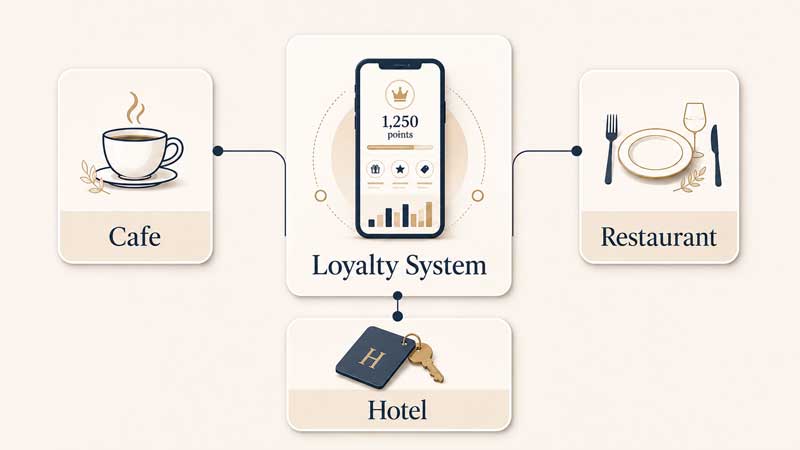
Café and quick service. Frequency rules here. Spending is small, but daily. Mechanics: points per visit, “every tenth one free”, loyalty tiers for regular guests. The goal is habit.
Restaurant. Visits are less frequent, but bills are higher. Here it pays off to track average spend, reward off-peak reservations, send a birthday greeting and offer. The goal is a higher value per visit and a reason to come again.
Hotel. The guest comes rarely, but has high value. One stay can be worth more than a hundred coffees. That is why loyalty in hospitality is linked to customer lifetime value, or CLV: the goal is for the guest to choose you again next time, and to use the spa, restaurant or late check-out during their stay — cross-sell that increases the value of one guest.
One system, three different goals. That is the difference between “we have some cards” and a loyalty program that knows why it exists.
Filling Empty Time Slots: Loyalty as a Capacity Tool
Your biggest cost is not a guest who leaves dissatisfied. It is an empty table on Tuesday at 3 p.m. and an empty room outside the season. Capacity you have already paid for, but have not sold.
When you know who your guests are and when they come, you can target exactly those dead periods. To guests who usually stop by in the afternoon, you send a message: “today until 6 p.m., second coffee on the house”. A hotel sends regular guests an offer for a slower period in the season. This is not mass spam to everyone — it is a push notification or Viber message to the right segment, at the right moment.
To make this sustainable, it has to be automated. Manually sending messages by segment does not scale even to a thousand guests. Marketing automation sets triggers once — drop in activity, birthday, empty time slot — and the system sends the message automatically. You deal with guests in the venue, not spreadsheets.
How to Recognize a Guest Who Is No Longer Returning — and Bring Them Back
The most expensive guest is the one who used to be regular and then disappeared. They did not complain. They simply did not come back. Without data, you do not see that loss for months.
With visit history, you see it immediately. A guest who used to come every week, but has not visited in 30 days, moves from “active” to “at risk”. This is the same logic used in RFM analysis: how recently, how often and how much the guest spent. When someone slips out of the active segment, that is a signal — not a quarterly report, but a trigger to react while the guest is still “warm”.
The reaction does not have to be dramatic. One voucher, one personal message, one reason to stop by. One attempt to reactivate them, and if they do not respond — let them go. But that one attempt, sent on time, brings back guests you would otherwise write off.
Does It Pay Off for a Small Venue: How to Measure It
Misconception number two: “loyalty is for big chains”. It is not. A small venue often gets even more value from a loyalty program, because every regular guest makes up a larger share of revenue and every lost guest is felt more strongly.
Profitability is not measured by feeling, but by a few numbers you do not have now — and will have later:
Visit frequency — how often the average member returns, and whether that number is growing.
Repeat rate — what percentage of guests come a second, third or tenth time.
Average spend of a member vs. a casual guest — the member’s spend is almost always higher.
Realistically, you will not see the first results overnight. The system needs time to become part of the guest experience, collect data and make messaging consistent. But the logic is clear. Keeping an existing guest is many times cheaper than attracting a new one.
Frequently Asked Questions About Loyalty Programs in Hospitality
How much does a loyalty program cost for a small café or restaurant?
It depends on the scope, but the logic is the opposite of what many expect: the smaller the venue, the more each regular guest is worth, so the program can pay off faster. Modern platforms work as a monthly service, without expensive equipment, so even a venue with one bar can get started.
Digital app or plastic card — which is better for hospitality?
A phone app is more practical: the guest does not have to carry anything, and you get a channel to send them a message. A plastic card still works for guests who prefer it. The best systems support both, because the goal is to identify the guest, not to insist on one specific method.
How do you reward regular guests without destroying the margin?
The reward does not have to be a discount on everything. More often, “every tenth one free”, a complimentary add-on or a benefit during a dead period works better — something that costs you little, but gives the guest a reason to come back. The point is value for the guest, not a clearance sale.
Does a loyalty program work for a hotel with few repeat guests?
Yes, but with a different goal. In hotels, the guest is rare but valuable, so loyalty is connected to guest lifetime value and cross-sell during the stay, such as spa, restaurant or late check-out, rather than daily frequency as in a café.
How quickly can results be seen?
Not immediately. The system needs time to collect data and make messaging consistent — realistically, several months before the patterns become clear. That is why it is important for the program to truly take root and not be abandoned after the first week.
Hospitality does not lose guests suddenly. It loses them quietly, one by one, until someone notices that a “regular customer” has stopped coming. A loyalty program in hospitality does not solve this with discounts, but by giving you visibility again: who comes, how often and when they start drifting away.
If you already have guests — and you do — there is no reason to know nothing about them. Stop guessing who your best guests are and when they leave. Let their visits show you that, and respond before the place across the street does. The system that does this for you already exists — see how Spotlight manages loyalty programs for hospitality.