RFM analysis segments customers based on how recently they bought, how often they buy, and how much they spend. Here is how to do it and what to send to each segment to bring them back.
RFM analysis ranks customers by three things: how recently they purchased (Recency), how often they purchase (Frequency), and how much they spent (Monetary). From these scores, you get clear segments: who your best customers are, who is slowly drifting away, and who you are already losing. The point is not to create a table. The point is to send a different message to each segment. That is where RFM stops being a report and becomes sales.
Most businesses know how many customers they have. Very few know which customers actually bring in money. And that is where the problem starts.
You spend money on ads to bring in new people, while your existing customers quietly leave — without a single message, without a single reason to come back. RFM analysis is the method that stops this. Instead of looking at all customers as one big mass, you segment them by real consumer behavior: how recently they bought, how often they buy, and how much money they spend.
Let’s be honest: no one buys in the same way. Someone visited yesterday and spent a lot. Someone else has not come back in six months. Sending them the same message is like shooting in the dark and hoping something lands.
The biggest misconception about RFM analysis is that it is “something for large e-commerce players with a team of analysts.” It is not. It is a logic that can be used by a local grocery store, a pharmacy, and a webshop. All you need is what you already have: data on who bought what and when.
What is RFM analysis?
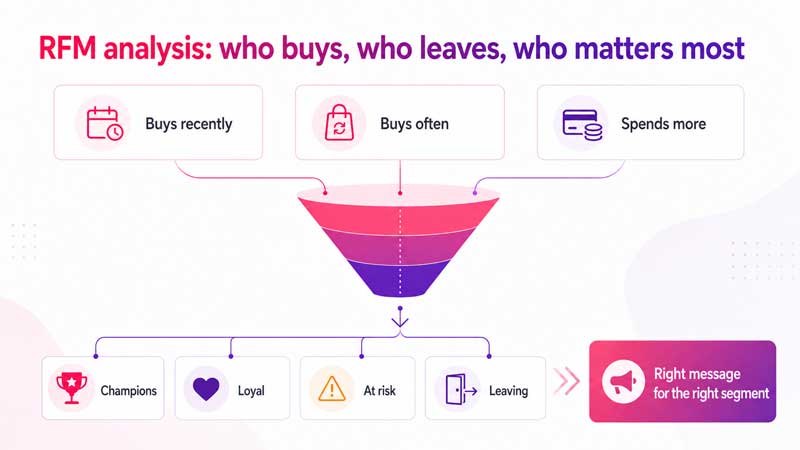
RFM analysis is a customer segmentation method that ranks customers across three dimensions:
Recency — how recently they made their last purchase,
Frequency — how often they buy,
Monetary — how much money they spend.
Each customer receives a score for all three dimensions, and those scores then place them into a group — from your most valuable customers to the ones you are practically losing.
The method is not new. It has been used for decades in direct marketing and database-driven sales, long before “personalization” became a trendy word.
At its core is an old, boringly accurate Pareto logic: roughly 20% of customers generate around 80% of revenue. RFM shows you who those 20% are — and what to do with everyone else.
In practice, Pareto logic often proves true. An analysis of more than 550 million department-store transactions showed that the top-spending 20% of customers generated 71% of revenue. RFM analysis helps you identify those customers not by gut feeling, but by behavior.
RFM does not create new customers. It shows you which customers you already have — but did not know you had.
Recency, Frequency, Monetary — the three questions that change marketing
Recency — when did the customer last buy? The more recent, the better. A customer who visited last week is far more likely to respond to your next offer than someone who has not shown up in a year. This is the strongest individual signal in the entire analysis.
Frequency — how often do they buy? Someone who comes back every month has already shown you a habit. A habit is easier to reward than to build from scratch.
Monetary — how much do they spend in total? It is not the same when someone spends 2,000 dinars a month and when someone spends 200. But be careful: a high amount alone does not mean a good customer if they bought once and disappeared.
And that is the whole point: no single dimension means much on its own. Only when you combine them do you get the full picture.
A customer with high R and F but low M is a frequent but cautious spender — offer them premium options.
A customer with high M but low R was once valuable and is now slipping through your fingers — bring them back urgently.
How is the RFM score calculated?
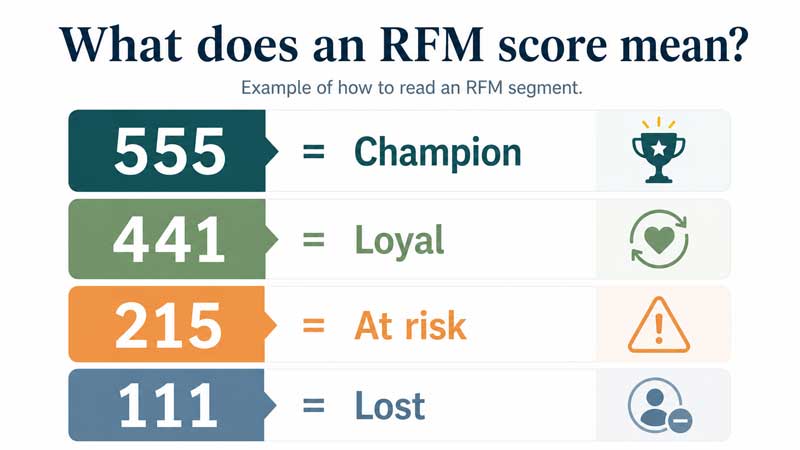
Each customer receives a score from 1 to 5 for each dimension, where 5 is the best. Those three numbers are then combined into a score — for example, “555” for an ideal customer or “111” for a customer who is practically lost. Scores are not assigned randomly, but by comparing customers with one another: the top fifth receives a 5, and the weakest fifth receives a 1.
| Dimension | Score 5 | Score 1 |
|---|---|---|
| Recency | bought a few days ago | bought a year or more ago |
| Frequency | buys regularly | bought once |
| Monetary | spends a lot | spends little |
This is where many businesses make a mistake: they think the table is the goal. It is not. The table is only a way to translate the customer into a number that tells you what to do next.
What do “555” and “111” mean?
A 555 score means the customer bought recently, buys regularly, and spends a lot. This is your champion. You do not need to convince them to buy — you need to reward them before your competitors notice them.
A 111 score is the opposite: they bought a long time ago, rarely bought, and spent little. Realistically, you should not spend much time or budget on them. Make one attempt to wake them up, and if they do not respond — let them go.
Everything in between is where things get interesting. That is where you find customers you can move upward, and that is exactly where RFM makes money.
Which segments do you get and what should you do with them?
When you combine the scores, customers naturally fall into several recognizable segments. Here are the most important ones and what each one needs from you:
Champions — your best customers. Reward them and turn them into brand ambassadors.
Loyal customers — they buy regularly. They respond well to promotions and are ideal for upselling.
Potential loyalists — they bought recently and show good frequency. Bring them into a loyalty program while they are still warm.
New customers — they have just arrived. The first impression and a strong welcome are crucial.
Need attention — they used to be solid, but are now slowing down. Time for a targeted offer.
At risk — they used to spend well, but have been absent for a long time. Send a personal message and give them a clear reason to return.
Customers you can’t afford to lose — former best customers who have gone quiet. This is where you fight.
Dormant and lost — make one reactivation attempt, then move on.
The list may look good, but on its own it is worth nothing. The question is simple: who will send the right message to each of these segments, at the right time, through the right channel? If you are doing that manually for ten thousand customers, you have already lost.
This is where RFM moves from analysis to action. Segments are only half the job. The other half is marketing automation that automatically delivers the right message to each segment: a reward to a champion, a reminder to an at-risk customer, a welcome message to a new customer, without manual table exports and copy-paste campaigns.
RFM for physical stores, not just webshops
RFM analysis does not require a webshop. It only requires purchase data — and grocery stores, pharmacies, boutiques, and cafés all have that.
Almost everything written about RFM analysis assumes an online store and an order history stored in a system. But in our market, real commerce is still largely physical retail. A store owner sees revenue, but not the customer behind that revenue. They do not know who visited yesterday, who has not shown up in two months, and who brings in half of their profit.
This is where the loyalty card comes in. It is not a discount trick at the checkout. It is a way to connect every purchase with a specific person — and those are exactly the data points that fuel RFM.
The practical rule is simple: if you have a loyalty program, you already have the raw material for RFM analysis, even if you sell exclusively in-store. Every card transaction is one row in the table: who, when, and how much. Without that, physical-customer segmentation remains guesswork.
The point is not to give customers another plastic card. The point is for the card to collect data that you can later turn into decisions.
The biggest mistake: treating RFM as a quarterly report
Here is the costly misconception: treating RFM as something you do once per quarter, print out, and forget.
RFM is not a snapshot. It is a film. A customer who is “loyal” today can become “at risk” in a month. A “new” customer can become a “champion” — or disappear after the first purchase. A static report from three months ago describes customers who are no longer in that state.
The modern approach shifts the focus from status to movement: the moment a customer moves from “loyal” to “at risk” is far more valuable than the fact that they have already been at risk for months. That transition is a signal to act immediately, while the customer is still there, not at the next quarterly meeting.
You cannot track that manually. A spreadsheet will not notify you that someone has moved. A system will.
RFM analysis in Excel vs. in a platform – where Excel breaks
For your first RFM analysis, Excel is perfectly fine. You export transactions, assign scores, and create segments. Useful, clear, free.
The problem starts with the second step. Excel is a snapshot of one moment, and tomorrow it is already outdated. It does not refresh itself, it does not track movement between segments, and, most importantly, it does not send a single message. You are the analyst, the data exporter, and the person writing the campaigns. For one hundred customers, that works. For ten thousand, it does not.
A good marketing platform solves exactly that gap.
Spotlight is a platform that applies RFM and behavioral principles to your customer data. When a customer moves from one segment to another, that transition can trigger a campaign through email, SMS, Viber, or push notifications and it works for both online and physical stores through a loyalty card.
What is the difference between RFM and RFMT analysis?
RFMT is RFM with one added dimension: T — Tenure, or how long someone has been your customer in the first place. While RFM looks at recency, frequency, and spending, RFMT adds customer age: how much time has passed since the first purchase.
Why does this change the picture? Because the same purchase does not mean the same thing for everyone. A customer who has been with you for three weeks and bought twice may look just as “active” as someone who has been loyal for three years and bought twice this month — until you look at tenure. Only then do you see that the first customer is still in the trial phase, while the second one has already built a proven habit.
Tenure separates excitement from loyalty. A new customer may look highly engaged at the beginning, but that is not the same as a customer who has been coming back for years. With one, you are building trust. With the other, you are rewarding trust that already exists.
Practical rule: if your business is built around customer relationships that last and mature over time — subscriptions, banking, insurance, loyalty programs — RFMT gives you a more precise picture. If you mostly sell one-off and impulse products, the extra dimension often does not add enough value to justify the complexity.
But watch out for the misconception: RFMT is not a “better version” of RFM that you should automatically use every time. More data does not always mean a better decision. The basic logic remains the same: you rank customers by behavior and divide them into segments. Tenure is an extra layer that only makes sense when the length of the customer relationship truly changes what you should send them.
Frequently asked questions about RFM analysis
What are the limitations of RFM analysis?
RFM looks only at past purchase behavior. It does not know why someone stopped buying, nor does it account for satisfaction, seasonality, or external circumstances. It can also favor frequent buyers, which means occasional but valuable customers can easily fall out of focus. That is why RFM is an excellent starting point, but it works best when combined with other customer data.
How many customers do you need for RFM analysis to make sense?
There is no magic number, but with only a few dozen customers, segmentation has little statistical weight — you end up with groups of two or three names. In practice, RFM starts to become useful from several hundred customers upward, when behavior begins to form clear patterns. Until then, smaller businesses can track only Recency, which is the strongest individual signal anyway.
How is RFM different from demographic segmentation?
Demographic segmentation divides customers by who they are — gender, age, location. RFM divides them by what they do — how recently they bought, how often they buy, and how much they spend. Two people of the same age and from the same city can be completely different customers, and that is exactly where RFM sees what demographics miss.
Does RFM work for services and subscriptions, not just product sales?
Yes. Instead of a purchase, you count subscription renewal, booking, treatment visit, or service usage as the key event. The logic remains the same: when the client was last active, how often they come back, and how much value they bring. A hair salon, gym, or SaaS company can use RFM just as well as a store.
Can RFM predict customer churn?
RFM does not literally predict churn, but it can signal it early. A drop in Recency score for a customer who used to buy regularly is a clear sign that they are drifting away — before they actually leave. That is why it is more valuable to track movement between segments than to wait until a customer falls to the bottom of the table.
The point is for RFM to stop being a static table and become a system that recognizes valuable customers and reacts before they leave.
RFM analysis is neither complicated nor reserved for large companies. It is the simplest way to stop looking at customers as one mass and start seeing them individually — who is valuable, who is slipping away, and who you are losing.
But a table alone does not bring in a single cent. Value is created when each segment receives its own message, at the right time, and when the system recognizes customer movement before you manage to notice it yourself.
If you already have purchase data — and you do — there is no reason to let it sit there collecting dust. Stop guessing who your best customers are. Let them show you through their behavior, and respond before your competitors do.