Do you know how first-party data can reveal purchasing patterns, improve segmentation, and enhance communication? Find out what it is and how to turn it into smarter decisions and more relevant campaigns.
Customer data is not the problem today. The problem is that most companies see it in fragments. Some of it is in the CRM, some in the webshop, some in the POS, some in email tools, and some remains locked away in reports the team looks at once a month and forgets until the next meeting.
In that kind of setup, you have plenty of data but very little insight.
You know how much you sold, but you do not clearly know who buys frequently, who buys only during promotions, who has slowed down, who responds to certain messages, and who has the potential to become a VIP customer. At that point, marketing starts to look like activity, not a system.
That is why the conversation around first-party data is not happening because the term is trendy, but because it has become a practical answer to a very concrete business problem: how to better understand customers and make more precise decisions based on what they actually do.
First-party data is the data your company collects directly through its own channels and customer touchpoints.
Its value is not just that it is “yours,” but that it reflects real behavior, real interests, and real purchasing patterns. When you connect it into one complete picture, it becomes easier to understand customers, create smarter segments, and send more relevant messages.
The problem is not whether you have data. The problem is whether you can see the customer in it
Many companies think they have a data collection problem, when in reality they have a problem with connecting and using the data they already have. That difference is not small.

You can have completed forms, an email database, purchase history, loyalty members, and campaign results, and still not be able to clearly answer several key questions: who your most valuable customers are, what motivates them, when they begin to cool off, and which communication channel actually drives a response.
That is where the whole story breaks.
When the team does not see the customer as a whole, decisions are made in fragments.
Sales looks at revenue.
Marketing looks at opens and clicks.
CRM looks at the database.
Ecommerce looks at the cart.
The customer does not live in those separate columns. They are one person, with their own behavioral patterns, purchase frequency, sensitivity to promotions, and expectations from the brand.
That is why first-party data matters not only as a “database,” but as a way to assemble one usable business picture from a wide range of signals.
What is first-party data?
First-party data includes all the information your company collects directly through its own channels.
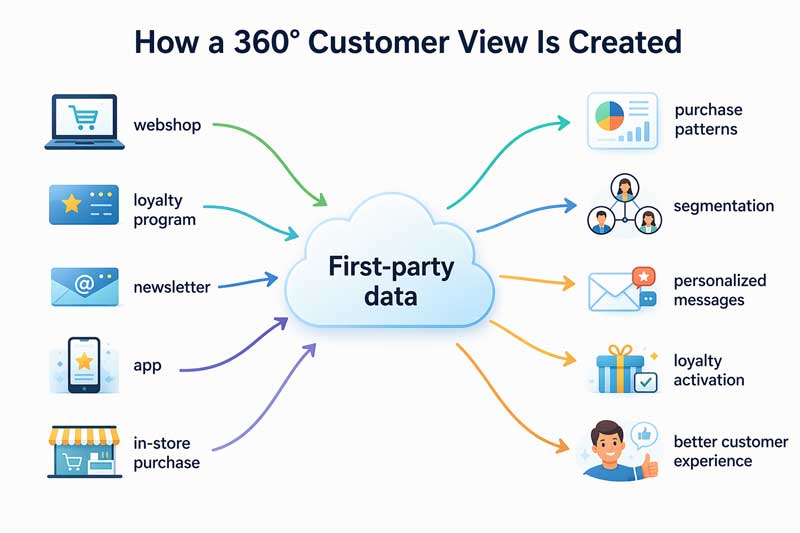
That can include purchase data, website behavior, newsletter responses, coupon usage history, app activity, loyalty program sign-ups, survey responses, and even support interactions. This is data the company collects directly from its audience, including customers, website visitors, and other users who are already in direct contact with the brand.
What matters here is not to confuse the source with the purpose.
A first-party data point is not valuable just because it exists. Its value appears only when you put it into context.
An email address alone does not say much, but when you connect it with purchase history, product categories the user browses, coupons they use, and messages they respond to, you get much more than a contact. You get a signal about interests, habits, and potential.
How First-Party Data Helps You Understand Customers Better
You see the customer as a whole, not as a sum of separate actions
One click does not mean much. One purchase does not mean much either. Even one redeemed coupon on its own does not say enough. The problem starts when a company tries to draw conclusions about a customer based on isolated actions instead of connected patterns.
When you connect first-party data, things start to make sense. Then you do not just see that a customer bought a product. You also see when they bought it, how often they buy, which categories they choose, whether they respond to promotions, whether they use loyalty benefits, whether they open email messages, and whether they respond better to the app, SMS, or newsletter. That is the difference between record-keeping and understanding.
We call this a 360° customer view: a complete profile that includes who your customers are, what they buy, how much they spend, and how they communicate with the brand. When you have that kind of view, you stop guessing and start seeing the logic behind behavior.
You recognize behavior patterns, not just outcomes
Most companies notice changes in customer behavior too late. They see a drop in sales, but not the signals that came before it.
They do not notice that a customer who used to buy every three weeks is now active only occasionally.
They do not see that one segment responds only to certain types of benefits.
They do not see that someone spends a lot, but less and less often.
First-party data is useful precisely because it reveals those patterns.
It helps you distinguish between a valuable but inactive customer and an active but low-value customer. It helps you distinguish between a user who responds to urgency and one who responds to personalization. It helps you understand that not every decline looks the same, and that not every “inactive customer” is a lost customer.
You can more easily spot buying habits that do not show up in a single report
A buying habit is not just the average basket value. It is a combination of frequency, timing, categories, reaction to promotions, and the way a customer uses the benefits you offer. That is why one dashboard is almost never enough to explain the whole story.
For example, two customers can generate similar annual revenue but have completely different behavior patterns. One buys regularly, in small amounts, and responds to loyalty benefits. The other buys rarely, but makes large purchases when they receive a highly specific offer. If you send the same campaign to both, one will probably respond and the other will ignore it. That is where the difference between generic marketing and marketing based on first-party signals becomes obvious.
When you start looking at behavior this way, you no longer ask only “how much did they buy,” but also “how do they buy.” And that is a far more useful question.
Segmentation becomes smarter, and communication becomes more relevant
Segmentation that divides a database only into “men and women,” “new and existing customers,” or “active and inactive” is often too broad today to deliver serious results. First-party data enables a much more precise approach, because you are no longer building segments from assumptions, but from real signals.
That means you can isolate customers who buy only with a coupon, customers with high potential for a higher loyalty tier, users who regularly respond to Viber messages but ignore email, or those who used to be very active but are now showing signs of leaving. Once you know that, communication stops being mass-produced and starts becoming strategically meaningful.
That is why the Spotlight marketing platform is the logical next step for any business that wants to work more seriously with first-party data.
Quick self-assessment: how well do you actually understand your customers?
Here is a simple test.
- Can you see purchase history, campaign responses, and loyalty benefit usage in one place?
- Can you quickly identify your most valuable customers, inactive customers, and those who buy only when a promotion is active?
- Do you know which communication channel delivers the best response for which segment?
- Can your team explain why some customers come back and others do not, without relying on assumptions?
If you paused on more than one question, then you probably do not have a lack-of-data problem. You have a problem because your first-party data is not yet working as a system. And until it does, it is hard to expect it to deliver full value.
What first-party data your business probably already has, but is not using smartly enough
In practice, many companies already have far more useful data than they think. The problem is that they do not view it in a unified way.
- The first category is purchase data. It is the most visible, but it is often used too superficially. Companies look at revenue, order count, and average basket value, but do not properly interpret the rhythm of purchasing, seasonality, category shifts, and the impact of different types of offers.
- The second category is loyalty program data. It can reveal much more than the number of members and redeemed points. It can show who joins the program and remains active, who registers but does not use benefits, who responds to coupons, and who responds to tiers and special perks. Spotlight’s loyalty page specifically highlights that a loyalty program offers insight into customer habits and enables personalized offers, birthday rewards, and other targeted actions.
- The third category is data from digital channels: newsletter sign-ups, website behavior, in-app interactions, clicks, opens, unsubscribes, message responses, and use of certain features. This data is valuable because it shows not only purchases, but also the interest that comes before them.
- The fourth category is campaign and communication data. It is not the same when a user ignores all messages, responds only to one type of content, or opens nearly everything but buys only occasionally. Only when you connect campaign data with purchase data do you start to understand what marketing is really doing, and what only looks like activity.
- The fifth category is preferences users directly leave through forms, category choices, communication settings, or a loyalty app. These are especially useful because they reduce the need for guesswork and help make the experience more relevant.
How to collect first-party data without damaging the customer experience
This is where many brands go wrong. They want more data, so they start asking for too much, too early, and too aggressively.
The result is paradoxical: instead of understanding customers better, they get lower response rates, less trust, and more friction in the customer experience.
A good approach is not based on pressure, but on logic and value.
Ask only for what makes sense at that moment
A customer signing up for a newsletter for the first time does not want to fill out a form that looks like a loan application. The more fields you ask for too early, the more likely you are to reduce conversion. A first-party strategy does not mean collecting everything immediately. It means collecting what is relevant for that stage of the relationship.
At the beginning, basic information is often enough, and the customer profile can be enriched over time. Some information will come from the purchase itself. Some from website behavior. Some from how the user responds to communication. Some they will provide themselves once they see a reason for it.
This approach has two advantages. First, it does not burden the user. Second, it helps you gradually build a higher-quality database instead of chasing quantity that later means very little.
Connect data collection with clear value for the user
Users are much more willing to share data when they understand what they get in return.
If you ask for preferences, explain that you will use them to send more relevant offers.
If you offer a loyalty program, show that the data is not there for “the system,” but for a better experience, more useful benefits, and fewer irrelevant messages.
If the user sees no benefit, the form will feel like a nuisance. If they do see a benefit, that same form can feel like a logical step toward a better experience.
Use existing touchpoints instead of aggressive data collection
The best first-party data often does not come from “one more popup,” but from touchpoints that already have a natural place in the customer journey. That can be a purchase, joining a loyalty program, using an app, subscribing to a newsletter, redeeming a coupon, a short post-purchase survey, or responding to a personalized message.
The advantage of this approach is that data is collected at the moment when the user already has a reason to engage.
That way, data collection does not feel intrusive. It feels like part of an experience that already makes sense for the customer.
Give the user control
Good first-party data does not come from making the user feel “captured,” but from making them feel they know what they are sharing and why.
When users can manage communication channels, frequency, or the topics they are interested in, your customer database does not just become more organized. It becomes more valuable.
This matters from a business perspective too. A bigger but uninterested database is often worth less than a smaller database that is clearly profiled and engaged. Control does not reduce the value of data. On the contrary, it often increases it because it improves accuracy and trust.
Do not confuse quantity with quality
Many companies collect a lot of data, but use very little of it. That is a classic symptom of a system that is more focused on “having data” than on “understanding.”
A first-party strategy should focus on usable data: data that helps you make decisions, build segments, activate campaigns, or improve the customer experience.
It is better to have a clear purchase history, a solid picture of campaign responses, and precise segmentation than dozens of fields no one will ever open. Data that is not used is not an advantage. It is just another row in a table.
The most common mistakes that prevent first-party data from delivering results
The first mistake is leaving data scattered across tools and teams. Then everyone has their own piece of the truth, but no one has the whole picture. That slows down decision-making, makes personalization harder, and results in communication that is not precise enough.
The second mistake is treating CRM as an archive instead of an operational tool. The database exists, but it is not used for active segmentation, signal tracking, and timely actions.
The third mistake is sending the same messages to all customers. When communication is not based on behavior, it quickly becomes generic. A generic message may reach many people, but it rarely hits precisely enough to produce serious results.
The fourth mistake is collecting data that is never actually used. That burdens both the team and the user without creating additional value. In the worst case, it creates the impression that the brand is asking for more than it knows how to justify.
The fifth mistake is focusing only on campaign metrics and not on the business meaning behind them. A strong open rate does not mean much if the message does not contribute to a better customer relationship, higher purchase frequency, or greater basket value. First-party data should move you away from that kind of superficial thinking.
When first-party data starts working as a system, not just as a table
The real shift happens when first-party data stops being a set of separate records and becomes a system that connects the customer profile, segmentation, communication, and performance measurement. At that point, data is no longer there just for reporting. It is there for decision-making.
In practice, that means several things.
- The team finally sees a unified customer profile instead of fragmented information from multiple tools.
- Segments are built based on behavior, not broad assumptions.
- Campaigns are triggered by signals that actually matter: changes in activity, purchases, interest, or loyalty benefit usage.
- Results are measured in the context of the customer relationship, not just as isolated marketing metrics.
That is why Spotlight is the perfect solution. Its CDP is already designed as a tool that unifies data from multiple sources, provides a 360° customer view, enables segmentation, and connects with marketing tools. Marketing automation then uses that data for personalized communication through email, SMS, Viber, and other channels, while the loyalty layer provides a clear framework for turning those insights into relevant benefits and more frequent repeat purchases.
That is exactly the moment when first-party data stops being “data we have” and becomes the foundation for better business results.
Frequently asked questions about first-party data
Is first-party data useful only for large companies?
No. Large companies usually have more data sources, so the problem becomes visible faster, but smaller businesses can also benefit greatly from a first-party approach. Even with a smaller customer base, it is useful to know who buys more often, who responds to specific messages, and which channel drives the best response. The point is not the amount of data, but how intelligently you use it.
Is first-party data enough without a loyalty program?
Yes, but a loyalty program can make it much more useful. Even without loyalty mechanics, you can still track purchases, website behavior, campaign responses, and user preferences. However, a loyalty program introduces additional signals: how often benefits are used, how customers respond to rewards, how they move through tiers, and the real reasons they come back. Together, they create a more complete picture.
How long does it take for first-party data to start providing concrete insights?
That depends on how organized and connected your data already is. If it is spread across multiple systems and teams, the first step is to unify and clean up the sources. If you already have a strong foundation, the first useful insights can appear very quickly, especially once you start tracking patterns such as purchase frequency, drops in activity, or responses to different types of communication.
How do you know whether the data you are collecting is actually high quality?
The easiest test is very practical: does that data help you make a better decision? If it allows you to build a more useful segment, a more precise campaign, or a more relevant offer, then it has value. If you are only storing it and it is not used in marketing, loyalty, or sales, then you probably have more quantity than quality.
Can first-party data help offline sales too?
Yes, and very concretely. In an offline environment, it helps you better understand how often customers return, how they use benefits, which promotions activate certain segments, and how behavior changes over time. When offline purchases are connected with other channels, the company finally gets a more realistic picture of the customer, rather than just a view of individual transactions.
How do you measure whether a first-party strategy is actually working?
It is not measured only by how much data you collect. Much more important metrics are whether segmentation becomes more precise, campaigns become more relevant, purchase frequency increases, customer value grows over time, and whether the team reaches usable insights faster. A good first-party strategy does not just fill a database. It reduces guesswork and improves business decisions.
Is it possible to improve the customer experience without asking for too much data?
Yes, and that is actually the better approach. Customer experience is more often improved when you ask for less, but more meaningful data. When users see a clear benefit and share data gradually, without pressure, the relationship with the brand is far more likely to improve. Aggressive data collection often creates more friction than value.
First-party data is not there to help you know more. It is there to help you miss less.
That is probably the most honest conclusion of the whole topic.
The goal is not for your team to have as many charts, tables, and dashboards as possible. The goal is to better understand customers, create smarter segments, send more relevant messages, and build a relationship that is not based only on the next discount.
First-party data is valuable when it helps you recognize what the customer does, what matters to them, and when the right moment is to reach out.
That is why a serious first-party strategy is not a technical add-on to marketing. It is the foundation of a better loyalty program, more precise automation, and a better customer experience. And when data is connected, up to date, and operational, it becomes much easier for both the team and the platform to move in the same direction.
When you want first-party data to become the foundation for smarter decisions and more concrete results, the next logical step is the right platform.
Contact us and learn more about the Spotlight solution.