A Black Friday sale can deliver record revenue and shrink your profit at the same time if every customer gets the same discount. This article is for store owners and retail marketing managers who want a different approach: a discount where it changes the customer’s decision, not where it simply rewards a purchase they would have made anyway.
Black Friday sale at a glance:
- Black Friday is always the last Friday in November, the day after American Thanksgiving, and Cyber Monday is the Monday after it.
- A blanket discount increases revenue, but a large share of it goes to customers who would have paid full price.
- A smarter Black Friday sale segments customers by purchase history and gives each group a different offer.
- The biggest value of the sale isn’t that weekend’s revenue, but new customers’ second purchase within the next 30 days.
- Success is measured by margin and incremental revenue, using a control group of customers who didn’t receive the offer.
Every year, the same scenario. In late November, shop windows fill with “-30%” signs, the tills never stop, and in December the store owner looks at the report and isn’t sure whether they earned more or just sold more. Those are not the same thing.
When is Black Friday and how much time do you need to prepare?
Black Friday is the Friday after American Thanksgiving, which falls on the fourth Thursday of November. That’s why it always lands between November 23 and 29, with Cyber Monday three days later.
Preparing a targeted Black Friday sale realistically takes four to five weeks: one to review data and build segments, two for announcements, and one for the sale itself. In other words, preparation starts in late October.
Black Friday hasn’t been limited to a single day for a long time. Retailers stretch it into a “Black Week” or the whole of November, and for many stores it’s the highest-revenue period of the year. That means competition for customers’ attention is at its peak, and customers are at their most skeptical.
Every year there are reports of retailers raising prices before the sale and then “cutting” them, so a “-50%” sign on its own no longer inspires trust.
Why does a blanket Black Friday discount often reduce profit?
A blanket Black Friday discount reduces profit because it also goes to customers who would have come without it.
From them, the store gains no new purchase; it only loses part of its margin. The new purchases have to generate enough to cover that loss, and that rarely happens.
A simplified example, in any currency: a store with an average basket of 100 and a gross margin of 40 percent. Without a sale, it has 1,000 purchases over the last weekend of November. With a 20 percent discount on everything, purchases rise to 1,600.
| No sale | 20% off for everyone | |
|---|---|---|
| Purchases | 1,000 | 1,600 |
| Average basket | 100 | 80 |
| Revenue | 100,000 | 128,000 |
| Gross margin | 40,000 | 32,000 |
Revenue is up 28 percent, while profit is down 20 percent.
The reason is simple: 1,000 customers would have come without the sale, and on them the store “gave away” 20,000 in margin. The six hundred new purchases brought back only 12,000.
In practice, baskets usually grow during a sale, so the gap isn’t always this sharp, but the logic holds: the larger the share of the discount that goes to customers who would have bought anyway, the more expensive the sale.
There’s another cost, too.
If a regular customer learns that November is the month to buy, part of their December shopping simply moves forward, at a discount. November revenue then looks great, and December looks weaker than last year.
How should you segment customers before a Black Friday sale?
Segment customers before a Black Friday sale using three data points from their purchase history: how long since their last purchase, how often they buy, and how much they spend.
That’s the basis of RFM analysis, and five groups are enough for Black Friday.
| Segment | How to recognize them | What they need for Black Friday |
|---|---|---|
| VIP customers | Buy often, spend the most, last purchase less than 60 days ago | Early access to the sale, double points, item reservation. Not a bigger discount. |
| Regular active | Buy monthly, medium basket | An offer for a category they haven’t bought before |
| Dormant customers | Previously regular, no purchase in 90 to 180 days | The strongest personal coupon, with a clear deadline |
| Deal hunters | Buy almost exclusively on sale | Public sale on selected items, no additional coupon |
| New members | One purchase or sign-up in the last 60 days | An incentive for the second purchase, not the first |
Segment thresholds (60, 90, 180 days) depend on the rhythm of your business.
A cosmetics shop or drugstore has a different cycle than a furniture store.
Look at the average time between two purchases among your regular customers and set the thresholds accordingly.
Which Black Friday offer should go to which segment?
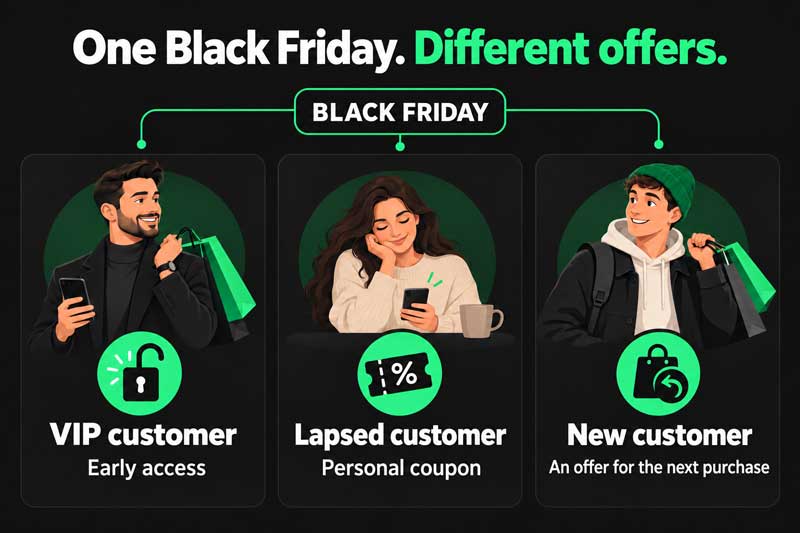
Give the strongest Black Friday offer to the segment where a discount changes behavior: dormant customers. Give the weakest, or no extra offer at all, to those who would buy without it: VIP customers and deal hunters, each for a different reason.
VIP customers don’t come for discounts; they come for their relationship with the store. For them, early access (say, from the Monday before Black Friday), the option to reserve an item before the rush, or double points in the loyalty program are worth more. That costs less than a discount, and the message is clear: you come first.
Dormant customers are the segment worth investing in. They already know the store, they’ve already bought, and something took them away. A personal coupon valid until Cyber Monday makes sense precisely here, because each of their purchases is a genuinely new purchase.
Deal hunters will come to the public sale on their own. If you also give them a personal coupon, you pay twice for the same purchase. Offer regular active customers something that expands their basket, for example a discount on a category they haven’t bought from you before. Don’t give new members another discount right away; tie it to a second purchase in December.
Where does this get stuck in practice?
All of the above assumes you know who bought what and when. The till sees receipts, not people, so without a loyalty card or another way to link a purchase to a customer, segments don’t exist.
Once the data exists, the next problem is time: manually extracting and sorting spreadsheets for several thousand members takes days, and the dormant-customer segment is out of date before the message goes out.
That’s why stores that do this regularly use a platform that builds segments directly from loyalty card data and updates them automatically. In Spotlight, for example, a customer who hasn’t bought in 90 days automatically moves into the dormant segment, and a personal message with a coupon goes out through the marketing channel you’ve chosen, with no new data export.
What does a Black Friday calendar look like for a physical store?
A Black Friday sale calendar starts five weeks ahead and doesn’t end until late December. The schedule is the same every year; only the dates shift:
- Five to three weeks before: review data, build segments, decide on the offer for each segment, and set aside a control group.
- Three to one week before: announce to loyalty program members. Offer non-members sign-up at the till, with a benefit valid during the sale.
- Monday to Thursday before Black Friday: early access for VIP customers.
- Friday to Monday: Black Friday weekend and Cyber Monday. Personal coupons for dormant customers expire on Cyber Monday.
- The following 30 days: a second-purchase campaign for new and reactivated customers.
Step two pays off twice.
Black Friday is the day the most people you don’t know walk through your store. If you don’t sign them up for your loyalty program, after the weekend you have no way to reach them again.
What should you do with Black Friday customers after the sale?
After the Black Friday weekend, the most important thing is to bring new and reactivated customers to a second purchase within 30 days.
A customer who came for the first time because of a discount isn’t your customer yet; they bought the price. Whether they come back is decided in December.
Most Black Friday plans end on Sunday evening. Yet that’s when the part begins that determines whether the sale was an investment or a cost. December is ideal for this: people are buying gifts, foot traffic grows, and the customer still remembers the store.
A second-purchase plan might look like this:
- Right after the purchase: a thank-you message showing how many points they earned and what they can get with them. No new discount.
- After 10 to 14 days: an offer related to what they bought. Someone who bought a face cream gets a serum suggestion; someone who bought a jacket gets an accessories suggestion.
- Before the holidays: a reminder about expiring points or a benefit valid until the end of the year.
Part of the discount budget is better deferred than spent right away. Instead of 25 percent off the first purchase, give 15 percent on Black Friday and 10 percent on a second purchase in December. The total cost is similar, but only a returning customer gets the second part. You pay for the behavior you want, not a one-off visit.
These messages aren’t sent manually. The trigger is the Black Friday purchase itself, and automated messages take it from there, for each customer at their own pace.
How do you measure whether a Black Friday sale succeeded?
Measure Black Friday success by margin and incremental revenue, not by revenue. Incremental revenue is revenue that wouldn’t exist without the sale, and the only reliable way to measure it is a control group.
A control group is a set of customers from the same segment (usually 5 to 10 percent) who don’t receive the personal offer. If 18 percent of dormant customers with a coupon bought something during the sale, and 6 percent of those without one did too, the coupon’s real effect is 12 percentage points, not 18. Without a control group, every purchase that weekend looks like the sale’s doing.
Five metrics worth tracking:
- Gross margin of the sale compared with the same period last year.
- Incremental revenue by segment, calculated against the control group.
- Cost of discounts given to customers who would have bought anyway, estimated via the control group.
- Reactivation rate of dormant customers.
- 30-day second-purchase rate for new customers and new loyalty program members.
The last metric is the one that will tell you next year whether Black Friday brought you customers or just visits.
What are the most common Black Friday sale mistakes?
- The same coupon for everyone. The most expensive mistake, because most of the discount ends up with customers who would have bought anyway.
- Raising prices before the sale. Customers and consumer associations track this, and trust is lost faster than it’s built.
- A sale without a control group. Without one, you don’t know what the sale actually delivered.
- A bigger discount for VIP customers. They stay for the relationship, not the price. Early access is worth more to them.
- Forgetting December. Without a second-purchase plan, new customers mostly remain one-time buyers.
- Not collecting contacts. The rush at the till is the best opportunity to sign people up for your loyalty program, and it’s the one most often missed.
Frequently asked questions about Black Friday sales
Is it better for a Black Friday sale to last one day or all of November?
A shorter sale protects margin and creates a clear reason to visit. A month-long sale trains customers not to buy at full price in November. A good compromise is early access for VIP customers a few days ahead and a public sale from Friday to Monday.
How big a discount should you offer on Black Friday?
There’s no single right percentage. The discount should be big enough to change the decision of the segment it’s meant for, without eating the margin. Calculate how many additional purchases you need to cover the discount and check whether that’s realistic for that segment.
Should a small store without an online shop take part in Black Friday?
Yes, if it has a clear goal. For a small store, that’s usually signing up new loyalty program members and reactivating past customers, not competing with large chains on discount size. At low volume, a simple targeted offer is enough.
How do you keep customers from thinking the discount is fake?
Don’t change prices in the weeks before the sale and, where possible, show the pre-sale price. A personal offer based on what the customer has bought before is more credible than a generic sign, because the customer can see it was made for them.
What if I don’t have a loyalty program before Black Friday?
Use this year’s Black Friday to launch one. Sign-up at the till with an immediate benefit gives you contacts and purchase history from day one, so your next big sale, as soon as the end-of-year holidays, can be targeted.
Conclusion: how to make a Black Friday sale bring customers, not just revenue
A Black Friday sale doesn’t have to be a choice between high revenue and healthy margin. The difference lies in who gets the discount and what you do after the sale. A discount for dormant customers, early access for VIP customers, a public offer for deal hunters, and a second-purchase plan for December together make a sale you can measure and repeat.
If you already have a loyalty program, the data for this exists. The only question is whether you use it before the sale or only look at it in the report afterward.
Spotlight is built for exactly that step: loyalty card purchases, segments, and automated messages are in one place, so you set up the targeted sale and second-purchase tracking once and measure them without manually merging spreadsheets.
If you start five weeks ahead, your Black Friday segments will be ready on time, and the Spotlight team can show you what they’d look like with your store’s data.