
Stop guessing which channel generates sales. Marketing attribution shows what email, SMS and Viber actually do and which marketing channels are worth anything at all.
You send an email on Monday, an SMS on Wednesday, and a Viber message before the weekend. Sales increase that month. The question that very few people in the company know how to answer is: which of that actually worked?
This is a common picture in companies that use multiple communication channels but do not have a system that tracks what happens between the sent message and the purchase.
Marketing attribution is the answer to that question — which channel, at which moment, actually leads to a sale, and not just to an opened message or a click.
Most people talk about attribution as if every company sells exclusively online. Reality is different: a large number of local businesses also have a physical store, where most of their revenue still happens at the cash register, not on the website. And that is where standard tracking tools simply stop.
In Short
- Marketing attribution shows which channel—email, SMS, Viber, social media or an in-store purchase—actually leads to a sale, not just to a click.
- The most common attribution models are first click, last click, linear, and position-based. Each provides a different perspective on the same campaign.
- For businesses with physical stores, standard attribution does not work without a unique customer identifier, because online interactions and offline purchases are not automatically connected.
- A loyalty card solves this problem by following the same customer across every touchpoint, both online and in-store.
- Without that connection, marketing budgets tend to go toward channels that merely appear to perform well instead of those that actually generate sales.
What is marketing attribution and why is it important?
Marketing attribution is the process of measuring which communication channel deserves the “credit” for a sale.
Instead of looking only at the total revenue in a given month, attribution shows what actually motivated the customer to make a purchase, and what was simply present but played no role.
Let’s be honest: most companies know how many messages they sent and what their revenue was that month. Very few of them know whether that particular SMS message generated that particular sale, or whether the customer would have bought anyway. Without attribution, the marketing budget and time go where it “looks” like something works, not where it actually works.
This is not only a problem for large companies with teams of analysts. A small store with three communication channels has the same problem, only on a smaller scale — and the same cost of mistakes, relative to its budget.
What are the basic attribution models?
There are four basic attribution models:
- first click (credit goes to the channel that first brought the customer),
- last click (credit goes to the last touchpoint before the purchase),
- linear (credit is shared equally among all channels that participated),
- position-based (most of the credit goes to the first and the last touchpoint, while the rest is distributed between them).
Each model tells a different story about the same campaign.
The first click shows what attracts new customers. The last click shows what closes the sale.
The problem arises when you use only one model — then you see only half of the picture, and you make budget decisions based on that half.
The linear model is fairer, but it does not distinguish between the channel that was merely “there” and the channel that actually convinced the customer. The position-based model is a compromise: the greatest credit goes to the one that brought the customer and the one that closed the sale, while the remaining credit is distributed between them.
Why is attribution more difficult when you also have a physical store?
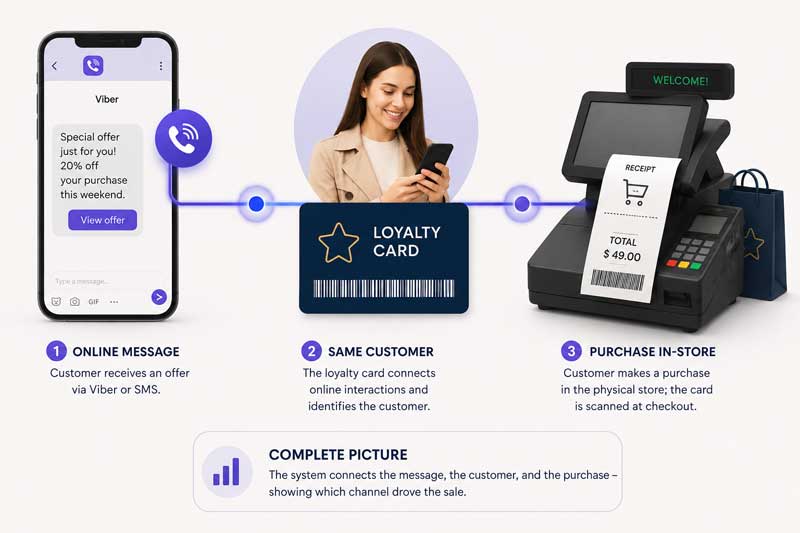
Everything mentioned above assumes that the customer’s entire journey takes place online — click, then purchase on the website. In our market, reality often looks different. The customer sees a Viber message about a promotion but makes the purchase in the store, paying in cash or by card, without a single click that would record anything.
For standard attribution tools, that sale is invisible. Google Analytics does not know that the Viber message was the one that brought the customer into the store. The channel that actually deserves credit for the sale remains unrecognized, and the budget shifts toward the channels that have “better-looking” digital numbers — not necessarily the ones that bring customers.
The solution is a unique customer identifier that follows the same person across all channels — and that is exactly what a loyalty card does when it is connected to a system that records both online and offline activity. A loyalty card is not a discount trick. It is the bridge between the message you sent and the purchase that happened at the checkout.
How do you practically measure the contribution of each channel?
Measurement begins with three things: UTM tags for online channels, a unique customer identifier that connects online and offline activity, and a comparison of customer segment behavior before and after the campaign. Without these three elements, the numbers you get are incomplete.
UTM parameters solve only the online part — they show where the customer came from when visiting the website. They solve nothing if the customer buys in the store.
A unique customer ID solves that problem. When a loyalty card or customer account is linked to every transaction, the system knows that the same person received an SMS on Wednesday and made a purchase in the store on Friday, regardless of the fact that they did not click on anything.
The third step is comparison: you take a customer segment that received the campaign through one channel and compare their purchases with a segment that received nothing. The difference in the purchase rate is the actual contribution of that channel, not an assumption.
This sounds simple on paper, but in practice it requires all data — online and offline — to be in one place, connected through the same customer. Manually combining Viber reports, cash register data and email statistics in an Excel spreadsheet is not measurement; it is guessing with an extra step.
Spotlight does exactly that: it connects the loyalty card, point-of-sale transactions and campaigns through email, SMS, Viber and push notifications into a single customer profile, making it possible to see which channel actually led to which purchase — online and in the physical store.
What are the most common mistakes when measuring channels?
The first mistake is looking only at the last click. The last touchpoint before the purchase receives all the credit, even though the customer may have seen an advertisement three times earlier, received an email, and only then clicked on the SMS that “closed” the sale. The SMS turns out to be the hero, even though it only finished the job that the other channels had started.
The second mistake is completely leaving offline sales out of the equation. If you track only online conversions, the entire physical retail business — for many companies still the largest part of their revenue — remains outside the picture.
The third mistake is comparing channels without considering cost. A channel that generates fewer sales but does so almost free of charge may be more profitable than one that generates more sales but costs many times more per transaction.
Let’s be honest: none of these mistakes are the result of a bad marketer. They are the result of a system that does not record enough information, in enough places.
Which KPIs really track channel performance?
Four metrics provide a realistic picture for each channel: cost per acquisition (CPA), conversion rate, repeat purchase rate, and average order value. Tracked together, rather than individually, they show not only who brings customers, but also what kind of customers they bring.
- CPA shows how much each new customer costs through that channel.
- The conversion rate shows what percentage of people who received the message actually make a purchase.
These two figures together already reveal a lot — a channel with a low CPA but also a low conversion rate may simply bring inexpensive but unengaged traffic.
- The repeat purchase rate and the average order value show something even more important: whether the channel brings customers who return and spend more, or one-time customers who come because of a discount and disappear.
Today, customers go through an average of six to eight touchpoints before making a purchase, which means that observing only one KPI per channel rarely provides an accurate picture.
What does attribution look like when data and channels are in one place?
Let’s imagine a pharmacy with one physical store and a webshop, with 3,000 loyalty program members. During one month, they send an SMS campaign about a discount on vitamins (cost: 1500 dollars for 3,000 messages) and a Viber campaign about the same promotion (cost: 2200 dollars).
Without attribution, the report says: sales increased by 34000 dollars compared to the previous month, both channels “worked.” With attribution through the loyalty card, the picture is different: the segment that received only the SMS purchased, on average, 8% more than the control group that received nothing. The segment that received the Viber message purchased 21% more — and although Viber marketing cost more per message, it produced almost three times greater impact per dinar invested.
Without this information, the following month would most likely receive an equal budget for both channels again. With it, the decision is obvious.
Frequently Asked Questions about Marketing Attribution
What is an “attribution window” and why is it important?
An attribution window is the period of time during which a purchase is still connected with a particular channel — for example, 7, 14 or 30 days after the message is received. A window that is too short overlooks customers who need more time to make a decision, while a window that is too long falsely assigns credit to channels that did not actually play a meaningful role.
Should a small business with only one or two channels even think about attribution?
Yes, although the question is different: instead of asking “Which channel works?”, the question becomes “Does this channel generate enough to justify its cost?” Even with a single channel, comparing the customer segment that received the message with the one that did not reveals the real impact, without the need for complex attribution models.
What is the difference between attribution and the conversion rate?
The conversion rate shows what percentage of people made a purchase after a certain touchpoint — one number, without the context of where that touchpoint came from. Attribution goes one step further and distributes credit among multiple touchpoints that preceded that purchase.
Is attribution even possible without a CRM or CDP system?
Partially — it can be done manually through UTM tags and basic Excel comparisons, but only for the online part of sales. Without a system that connects the customer across all channels, offline sales and customer behavior over time remain beyond the reach of any manual analysis.
Does the attribution approach differ between B2B and B2C sales?
Yes — the B2B customer journey is longer and involves more people in the decision-making process, so models that give greater importance to early touchpoints (position-based and linear) usually provide a more realistic picture. B2C purchases are more often impulsive and shorter, so the last-click model makes more sense there than in B2B.
Marketing attribution is not an academic exercise for large teams with data analysts. It is the difference between spending your budget on channels that “look active” and spending it on channels that actually bring customers.
If you have a loyalty card, an email list, an SMS database and a Viber database, but you do not know which of them actually generates sales, that is not a lack of data. It is a lack of a system that connects that data.
The Spotlight platform connects every channel and every purchase, online and in-store, around a single customer profile, so that you stop guessing and start measuring.