Gift cards as corporate gifts bring new customers into your store. Learn how to create an offer for businesses and keep those customers coming back after the holidays.
Corporate gifts a glance
- Businesses are increasingly choosing gift cards over specific items because the same gift cannot suit hundreds of people with different tastes and needs.
- For a retailer, one corporate order can bring in dozens or hundreds of new customers at once.
- A physical card in attractive packaging still feels like a gift, while a code in an email feels like a voucher.
- Businesses are also replacing holiday gift packages for employees’ children with gift cards, creating an opportunity for toy shops, bookshops and children’s clothing stores.
- The real value comes after the first purchase: a card that also works as a loyalty card keeps the recipient engaged even after the gift balance has been spent.
In early November, the same conversation starts at most companies: what should we give employees and business partners this year? Calendars and planners no longer excite anyone, boxes of sweets end up on the kitchen table, and agreeing on “something useful” takes weeks. More and more companies are solving that problem with a gift card.
For retailers, this is an opportunity that is easy to miss. One corporate order means 50, 150 or 400 cards, and every card represents someone who will walk into your store.
Below, we look at why companies choose gift cards as corporate gifts, how to put together an offer they will choose, and how to make sure a corporate contract delivers more than a one-off sale.
How Has Corporate Gifting Changed ?
Corporate gifts have evolved from branded giveaways to gifts that offer real value to the recipient. Companies give gifts less frequently and choose more carefully, while some have switched to vouchers and cards to simplify logistics.
The standard used to be a planner, a calendar and a pen with a company logo. Today, businesses spend more and choose everything from locally made cakes and small tech gadgets to weekend getaway and spa vouchers.
For retailers, there are two conclusions to draw. Companies that still give gifts want every dollar to count. And logistics matter just as much as the gift itself. A gift card addresses both.
Why Is a Gift Card a Better Corporate Gift Than a Specific Item?
A gift card is a better corporate gift because one item cannot match the tastes, needs and habits of a hundred different people. A card lets the recipient choose. The company controls the amount, while the employee gets something they will actually use.
Imagine a company with 120 employees. They include young people without children and parents of three, people who do not drink alcohol and others who do not eat sweets, people who wear size S and others who need XXL. Any specific gift that suits one group misses the mark with another. A wine gift set means little to someone who does not drink, while a skincare set means little to someone who already has their preferred products.
Research shows the same pattern across different markets. In a Snappy survey of around 1,000 US employees, 40% admitted to regifting or throwing away a corporate gift, while 68% would rather choose for themselves than have their employer choose for them.
In an Israeli survey by AllJobs, 86% of respondents wanted a gift that gave them freedom over how to use it, while only 11% preferred a physical item. According to Fiserv research, 80% of employees would rather receive a gift card than other non-cash rewards.
| Specific item | Gift card | |
|---|---|---|
| Who chooses | The company | The recipient |
| Risk of getting it wrong | High with large groups | Minimal |
| Logistics | Sourcing, packing, storage and distribution | One product, one invoice |
| Value to the recipient | Depends on personal taste | The full loaded value |
| Budget control | Prices vary from item to item | The same amount for everyone, or different amounts by group |
| What the retailer gains | A one-off sale | A new customer in the store |
When Does a Specific Gift Still Make Sense?
A physical item makes sense for a small number of key business partners or for anniversaries, when the gift needs to carry a personal message. Even then, a combination is often the best solution: a small branded gift and a gift card in the same package.
The item carries the message. The card carries the value.
Why Does a Physical Gift Card Still Work Better Than a Code in an Email?
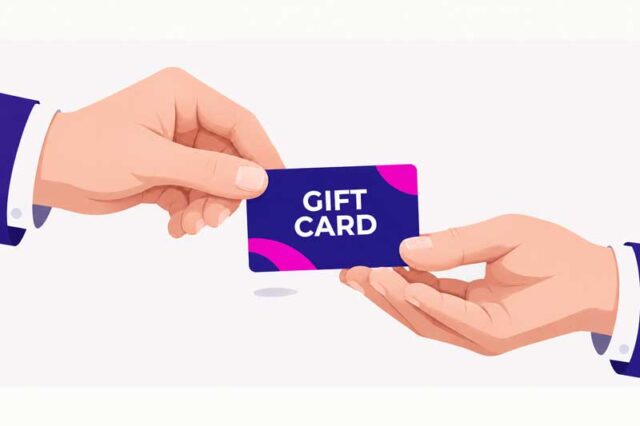
A physical gift card in attractive packaging can be handed over and opened like a gift, while a code in an email feels like a voucher or coupon.
A card in a presentation holder with a greeting can be handed out at a holiday party. There is a moment of opening it, and it stays on the recipient’s desk. A code lands in an inbox between bills and newsletters.
A physical card also has a practical advantage for the retailer: it stays in the wallet. Every time the recipient opens their wallet, they see your brand. Digital cards have their place for remote employees or when a gift needs to arrive at the last minute. The best corporate offer therefore includes both options, with the physical card making the strongest impression.
If you plan to offer cards to businesses, check three things before sending your first proposal.
- First, does the card look like a gift or like a voucher printed at the till? The material, design and packaging shape how employees perceive it.
- Second, can you offer an amount that suits the company’s budget, rather than just two or three fixed denominations?
- Third, will you be able to see where and when the cards were redeemed?
The Spotlight gift programme covers all three: cards are designed to match your brand identity and come with display stands and presentation holders; retailers set their own minimum and maximum values; and the system tracks card use by store. The same system also issues digital cards, so your corporate offer can include both formats.
Holiday Gifts for Employees’ Children: An Opportunity Most Retailers Miss
Holiday gift packages for employees’ children are a tradition that businesses are increasingly replacing with gift cards. For toy shops, bookshops, children’s clothing stores and health and beauty retailers, this is an easy way to start a conversation with a company.
The gift package is a tradition, but it comes with familiar problems: the same contents for a three-year-old and a fourteen-year-old, sweets that parents do not want, toys the child already owns. Companies know this. As far back as a decade ago, banks were reporting that businesses were giving employees’ children cards instead of gift packages so the children could choose what they wanted.
Here is how to turn that into an offer:
- Offer one amount per child, regardless of age. This makes budgeting easy for the company and gives a three-year-old and a fourteen-year-old a gift of equal value.
- Create a child-friendly card and holder design, different from the adult version, so the child receives something that looks like a gift.
- Send your proposal in October or early November, because decisions about children’s gift packages are made earlier than those about employee gifts.
For the retailer, there is an added benefit: the child visits the store with a parent, and that parent is a customer who may return.
How Can Retailers Create a Corporate Gift Card Offer?
A good corporate offer answers four questions: how much does it cost, how is payment handled, how are the cards delivered, and what does the employee receive? The less work you leave to HR and accounting, the more likely the company is to choose you.
What the Corporate Package Should Include
- Value: the same amount for all employees or different amounts by group, with one invoice for the entire order.
- Validity: at least one year. A card that expires before it is used leaves a poor impression of both your business and the company that gave it.
- Packaging and delivery: cards in presentation holders, ready to hand out and delivered to the company.
- Where it can be used: all your stores and your online shop, if you have one.
Who Should You Contact, and When?
HR and management make decisions about employee gifts, often with trade union involvement in larger companies. Existing B2B customers are a good starting point because they already know your offer and can reach a decision more easily. Opportunities extend beyond the festive season: International Women’s Day, long-service awards, company anniversaries, welcome gifts for new employees and sales team rewards.
Send your offer early enough for the company to approve the budget, choose the amounts and arrange distribution. For holiday gifts, it is worth starting conversations in October or early November.
Contact us for physical gift cards and matching presentation holders!
Tell us about your brand, the quantity you need and your deadline, then agree on the card and packaging design. You can then offer businesses a complete gift, ready to hand to employees or business partners.
Four Questions to Ask Before Sending a Proposal
- How many people are you giving gifts to, and will everyone receive the same amount?
- Who approves the budget, and what is the decision deadline?
- What did you give last year, and how did people respond?
- Are you also giving gifts to employees’ children?
The answers immediately reveal the size of the order, the deadline and the argument most likely to win the business. When a company is choosing between two retailers offering the same card value, what employees receive beyond the gift itself often makes the difference.
A card that also provides loyalty programme benefits is worth more than its face value. That gives HR a clear advantage to point to when explaining their choice.
What Happens When the Gift Card Balance Runs Out?
With a standard gift card, nothing happens: the recipient spends the balance, and the store knows neither who they were nor how to bring them back. A card that also works as a loyalty card turns a one-off purchase into the start of a relationship with a new customer.
This is what determines whether a corporate contract brings you new customers or simply prepaid sales. Consider 200 corporate gift cards in two scenarios.
An anonymous card. In January, 200 people visit. They spend the balance, some spend more, and they leave. Some would return if they had a reason, but the store has no name, no purchase history and no way to send them an offer. The card ends up in a drawer.
A card with loyalty functionality. The recipient earns points from their very first purchase. Once the gift balance is spent, the card stays in their wallet as a loyalty card. With the customer’s consent, the retailer gains their contact details and purchase history, allowing them to send an offer after two months without a purchase or a birthday coupon. The corporate gift becomes a route into the loyalty programme rather than a one-off transaction.
What is worth measuring for corporate gift cards:
- how many cards were redeemed and how quickly;
- the average purchase value compared with the card value;
- how many recipients made another purchase after spending the gift balance;
- which stores receive the most corporate gift cards.
The third figure shows the true value of a corporate contract. It also provides the basis for next year’s conversation: you can show the company how many employees actually used their gift, while seeing for yourself how many regular customers you gained. For more on measuring customer loyalty in physical retail, read our article on customer loyalty.
What Mistakes Do Retailers Make with Corporate Gift Cards?
The most common mistakes are sending offers too late, issuing cards that look like vouchers, and using cards that lose their purpose once the balance is spent. Each can cost you a contract or a customer.
- The offer arrives in December. By then, decisions have been made and orders have gone to competitors.
- The card looks like a voucher. A paper voucher or generic design does not feel like a gift, so the company chooses another retailer.
- The validity period is too short. A card that expires a few months after the holidays leaves both employees and the purchasing company disappointed.
- The card value does not match the product range. If an average item costs more than the card value, the recipient has to pay a substantial amount out of pocket, making the gift feel less generous.
- Unused balances are treated as profit. In the short term, they are money retained, but every unused card represents a customer who never visited, and the purchasing company notices.
- The card loses its purpose once the balance is spent. A recipient with no reason to return will not return.
Corporate Gift Cards: What Are You Really Selling?
You are selling the company a solution to gift selection and logistics. For your own business, you gain access to hundreds of people who might never have walked into your store without that card. That access is only valuable if you maintain the connection.
That is why the best advice is to make your corporate gift card a loyalty card too. The recipient gets a gift and ongoing benefits, the company can explain why its gift offers greater value, and you gain a customer you know.
Spotlight manages gift cards and a loyalty programme on one platform, with points, coupons and automated messages that bring back customers who have not shopped for a while. Card design, packaging and the system behind them all come from one place. If you are considering a corporate offer for this season, now is the time to set it up so that, after the holidays, you have both sales and a customer base.
Frequently Asked Questions About Corporate Gift Cards
What Is a Typical Gift Card Value for Employees?
There is no fixed amount; it depends on the company’s budget.
How Long Should a Corporate Gift Card Be Valid?
At least 12 months, so the recipient can use it after the holiday rush. Some retailers offer much longer validity periods, even up to ten years from the last top-up, making the decision easier for the company.
Can a Gift Card Also Be a Loyalty Card?
Yes, if the retailer manages gift cards and the loyalty programme through the same system. The recipient spends the gift balance while earning benefits, and once the balance is used up, the card remains active as a loyalty card.
What Happens to an Unused Gift Card Balance?
That depends on the terms set by the retailer issuing the card. With many cards, any unused balance is forfeited when the card expires. The terms should therefore be clearly communicated to the company before purchase, so employees do not lose part of their gift.
A Corporate Gift That Brings Customers In—and Gives Them a Reason to Return
The company wants a gift that employees will be happy to use. Your store can offer exactly that while reaching customers who may never have shopped with you before. When you connect a gift card to a loyalty programme, your relationship with them can continue after they have spent the gift balance.
Spotlight connects gift cards and loyalty benefits, bringing the gift’s presentation and its use together in one offer.
Want to add gift cards to your corporate offering?
Contact us to create a solution for your brand, from the card and packaging to benefits that encourage the next purchase